The GEO Trap: Why Buying Your Way Into AI Overviews Could Sink Every Location
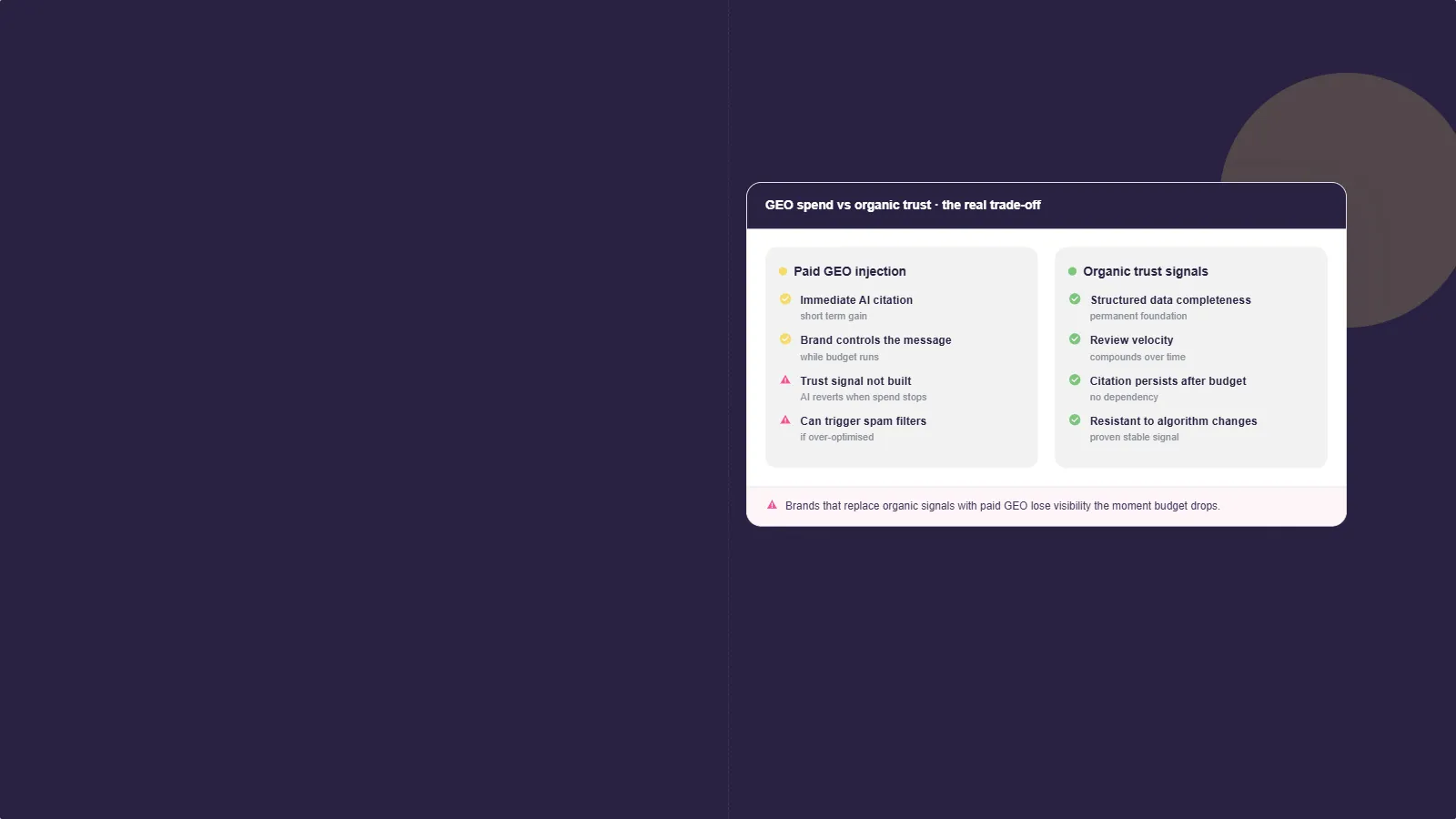
A vendor emails your brand with an irresistible pitch: guaranteed mentions inside Google’s AI Overviews for all 240 of your locations, fully automated, billed monthly. It sounds like the shortcut every multi-location marketer has been waiting for. It is also one of the fastest ways to put your entire brand on Google’s radar for the wrong reasons.
In May 2026, Google made its position on this unusually blunt. As brands rush to be cited in AI answers, a whole category of tools has appeared promising to manufacture that visibility. The message coming back: that is the new paid-link scheme, and it will not end well.
What Google Actually Said in May 2026
At Search Central Live Shanghai on 15 May 2026, Google’s Gary Illyes was asked about buying brand mentions to appear in AI responses. The exchange was not published by Google. It reached the industry through SEO consultant Kenichi Suzuki, who posted his account of it on LinkedIn, and was then picked up by the SEO trade press.
By Suzuki’s account, Illyes and his colleague Cherry Sireetorn Prommawin compared the practice directly to paid links, something Google’s systems are built to detect, disregard and ultimately ignore. They stopped short of confirming how much authentic, organic mentions help AI search, saying they were not certain how useful ordinary mentions across the web actually are. On the manufactured kind they were not hedging at all.
That is a secondhand account rather than a Google statement, so treat the exact wording with the care it deserves. What it lines up with is not secondhand. Google’s published guidance on optimising for generative AI warns that seeking inauthentic mentions is not as helpful as it might seem, and explains that its core ranking systems focus on high-quality content while separate systems block spam, with its generative AI features depending on both.
Google also confirmed this year that its standard search spam policies apply to AI Overviews and AI Mode. So the firewall some marketers imagined between “SEO rules” and “AI visibility” does not exist. The same enforcement that governs your blue links governs whether your locations show up in an AI answer.
Why This Hits Multi-Location Brands Harder
A single independent restaurant that buys a few fake mentions is taking a contained risk. If it backfires, one listing suffers. A multi-location brand operates very differently, and that difference is exactly what makes mention-buying dangerous at scale.
-
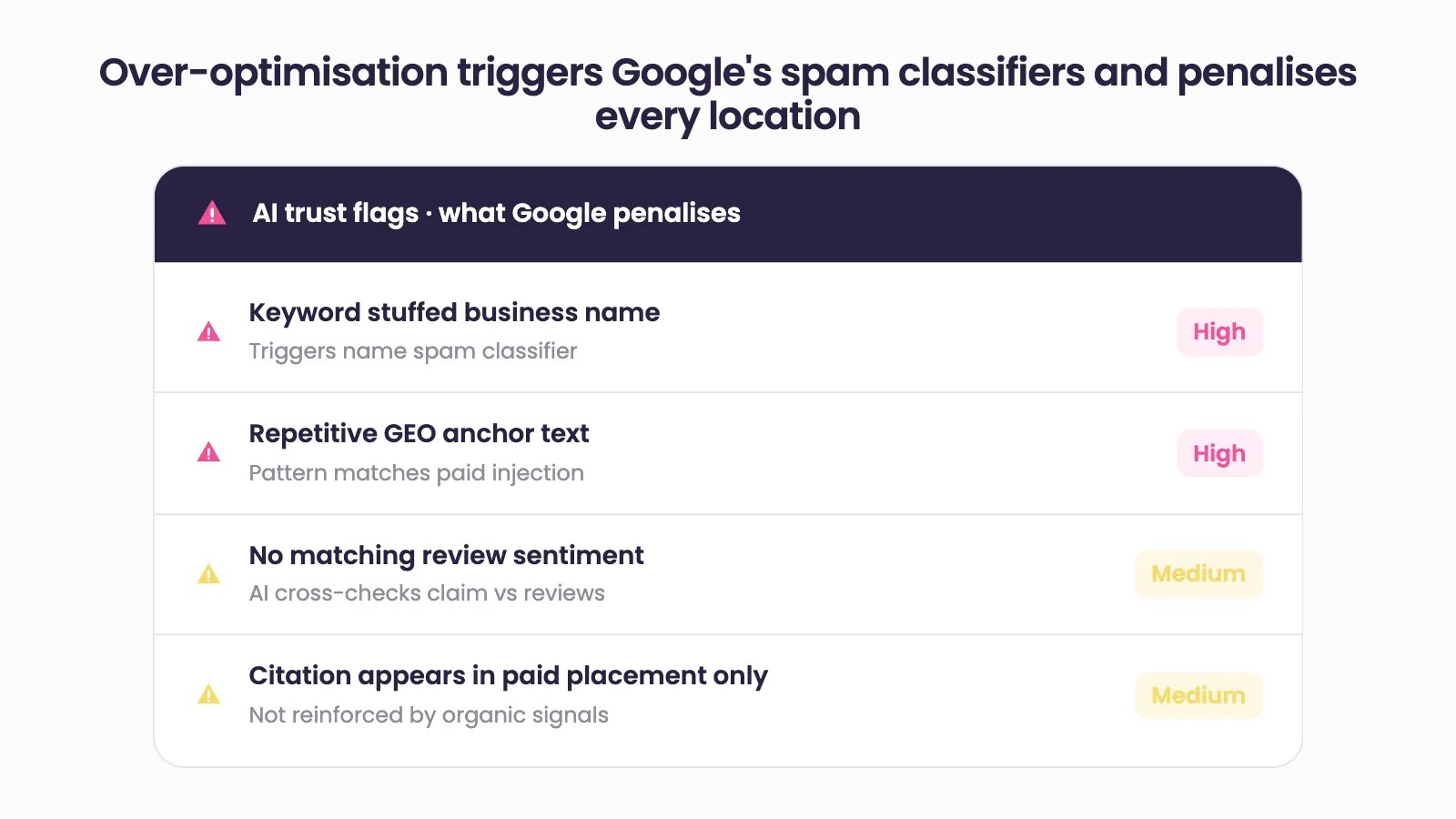
One vendor, one footprint. When an agency or tool seeds manufactured mentions across all your locations, it usually does so with the same patterns, source sites, and timing. That is precisely the kind of correlated signal spam systems are designed to catch.
-
Brand-level exposure. Your locations share a brand name, a website, and often a single set of citations. A problem detected at the brand level does not politely stay contained to one branch.
-
It works, until it doesn’t. Anyone who lived through the Penguin update remembers the shape of this. Bought links worked beautifully for a while, then collapsed overnight. AI spam enforcement is likely to move faster, not slower.
The uncomfortable truth is that the scale which makes multi-location brands powerful in local search is the same scale that turns a bad shortcut into a brand-wide liability.
How to Spot the Risk in a “GEO” Proposal
Generative Engine Optimisation, or GEO, is a real and useful discipline. But the label is now being stuck on tactics that are simply old-fashioned manipulation in new clothing. A proposal deserves hard questions if it includes any of the following:
-
Guaranteed mentions or citations inside AI Overviews, AI Mode, ChatGPT, or similar systems.
-
Automated posting of brand mentions across forums, Reddit threads, or comment sections at volume.
-
Paid placements dressed up as “authentic community discussion”.
-
Per-location mention quotas billed monthly, with no human or editorial basis behind them.
If a tactic would have looked like a paid-link scheme in 2015, treat it as a paid-mention scheme in 2026. The mechanics, and the eventual outcome, are the same.
What Authentic AI Visibility Looks Like at the Location Level
The reassuring part of Google’s guidance is that the durable path has not changed. AI features draw on the same trusted signals that have always decided local visibility, and across 250 locations we found five characteristics that separate cited pages from invisible ones. For a multi-location brand, that means doing the unglamorous work well, everywhere:
-
Accurate, complete listings for every location, with correct hours, categories, attributes, and descriptions. AI answers are only as good as the underlying data.
-
Genuine review volume and velocity earned from real customers, with thoughtful responses. This is the single richest source of the language AI uses to describe your locations.
-
Real local content and structured data on your location pages, so machines can read what each branch offers without guessing.
-
Earned mentions that come from doing things worth talking about, not from a monthly mention quota.
None of this carries a hidden penalty waiting to detonate. That is the whole point.
How Social Places Helps You Earn AI Visibility the Safe Way
Social Places exists to make the durable path manageable across hundreds of locations. Accurate, synchronised Listings give AI systems clean data to draw from. Structured Reputation management helps every branch earn and respond to real reviews at scale, which is exactly the authentic signal Google’s AI depends on. And Brand Listening shows you what is genuinely being said about your locations across the web, so you can act on real conversations rather than manufacture fake ones. If a vendor is promising to buy your way into AI answers, we are happy to give you a second opinion. Contact Us.
Related reading
-
How Google’s AI now enforces review authenticity shows the same detection logic applied to review signals, including which long-standing review tactics now create exposure.
-
What separates a cited location page from an invisible one sets out the earned path in practical detail across 250 locations.
-
Why forum and Reddit posts now surface inside AI answers explains why those threads matter, and why seeding them at volume is the wrong response.
Frequently asked questions
Does buying brand mentions help my locations appear in Google's AI Overviews?
No. At Search Central Live Shanghai on 15 May 2026, Google's Gary Illyes was reported as comparing bought or manipulated mentions to paid links, and Google's published guidance warns against seeking inauthentic mentions. These systems are designed to detect and ignore manufactured signals, and the same spam policies that govern search now apply to AI Overviews and AI Mode.
Is GEO (Generative Engine Optimisation) a scam, then?
Not at all. Legitimate GEO is about making your real content, listings, and reviews easy for AI systems to understand and trust. The problem is only with tactics that manufacture mentions or citations at scale, which are manipulation regardless of what they are called.
Why is this a bigger risk for multi-location brands?
Manufactured mentions across many locations tend to share the same patterns and sources, which is easy for spam systems to spot. Because your locations share a brand, website, and citations, enforcement detected at the brand level can affect the entire estate at once rather than a single branch.
What should we do instead to be visible in AI search?
Focus on the trusted signals AI already relies on: accurate and complete listings everywhere, genuine reviews earned from real customers, real local content with structured data, and mentions earned through things worth talking about. These improve visibility without carrying a hidden penalty risk.