Google Is Now Using AI to Police Your Reviews. Here's What Multi-Location Brands Need to Change
For fifteen years, the unwritten rule of local search was simple: more five-star reviews, more visibility. A whole cottage industry grew around getting them, fast and at volume. That era just ended.
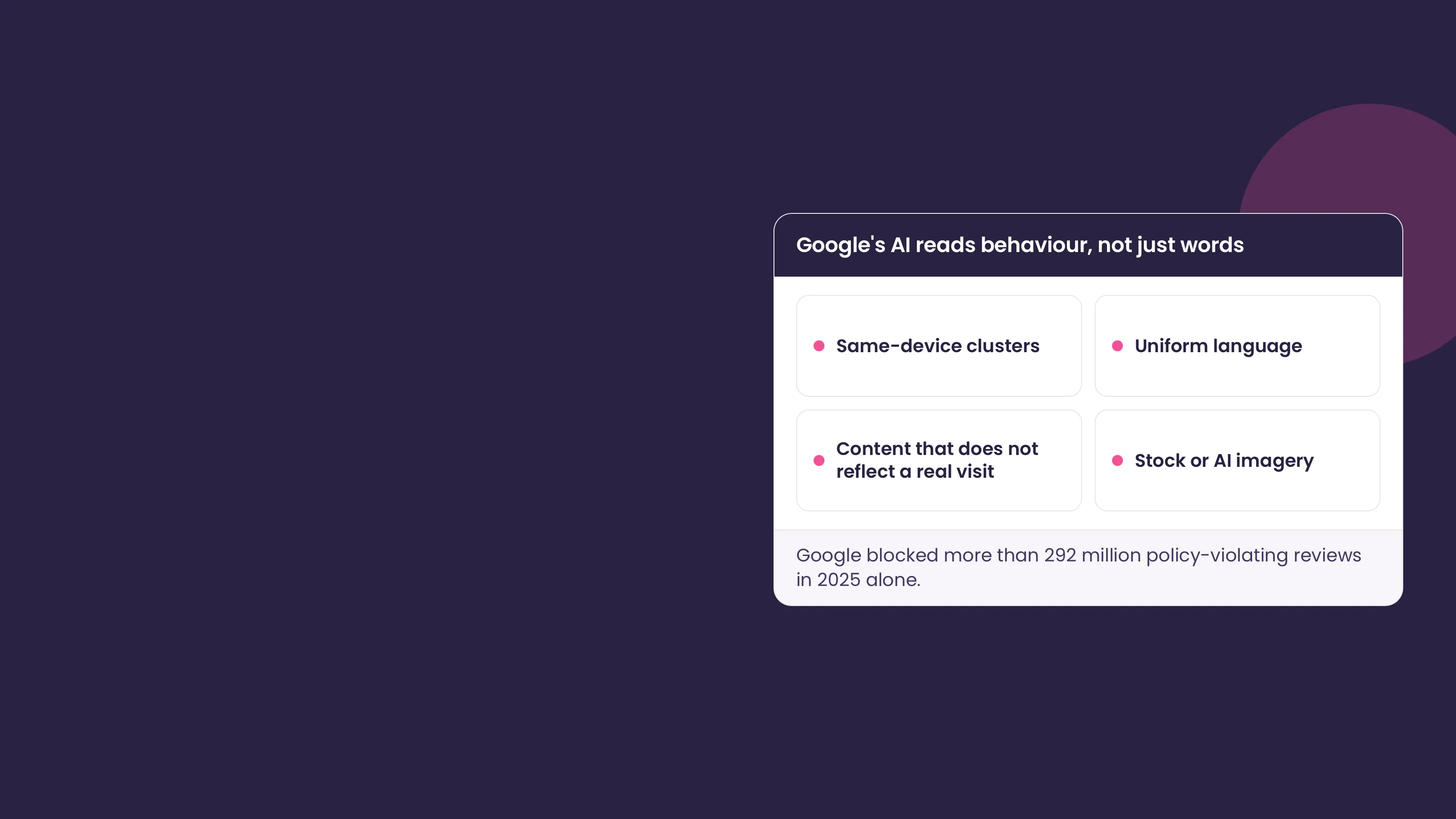
Google is now actively using AI to detect and remove reviews it judges to be inauthentic, and it is doing so at a scale nobody has seen before. In 2025 alone Google blocked more than 292 million policy-violating reviews and removed 13 million fake Business Profiles. The catch is that the same automated sweep does not only catch the bad actors. It catches well-meaning brands using tactics that were considered normal twelve months ago.
We covered the late-2025 removals and the detection mechanics in detail in Google Review Removals in 2025: What happened to your stars? This piece focuses on the newer FTC and legal-exposure angle.
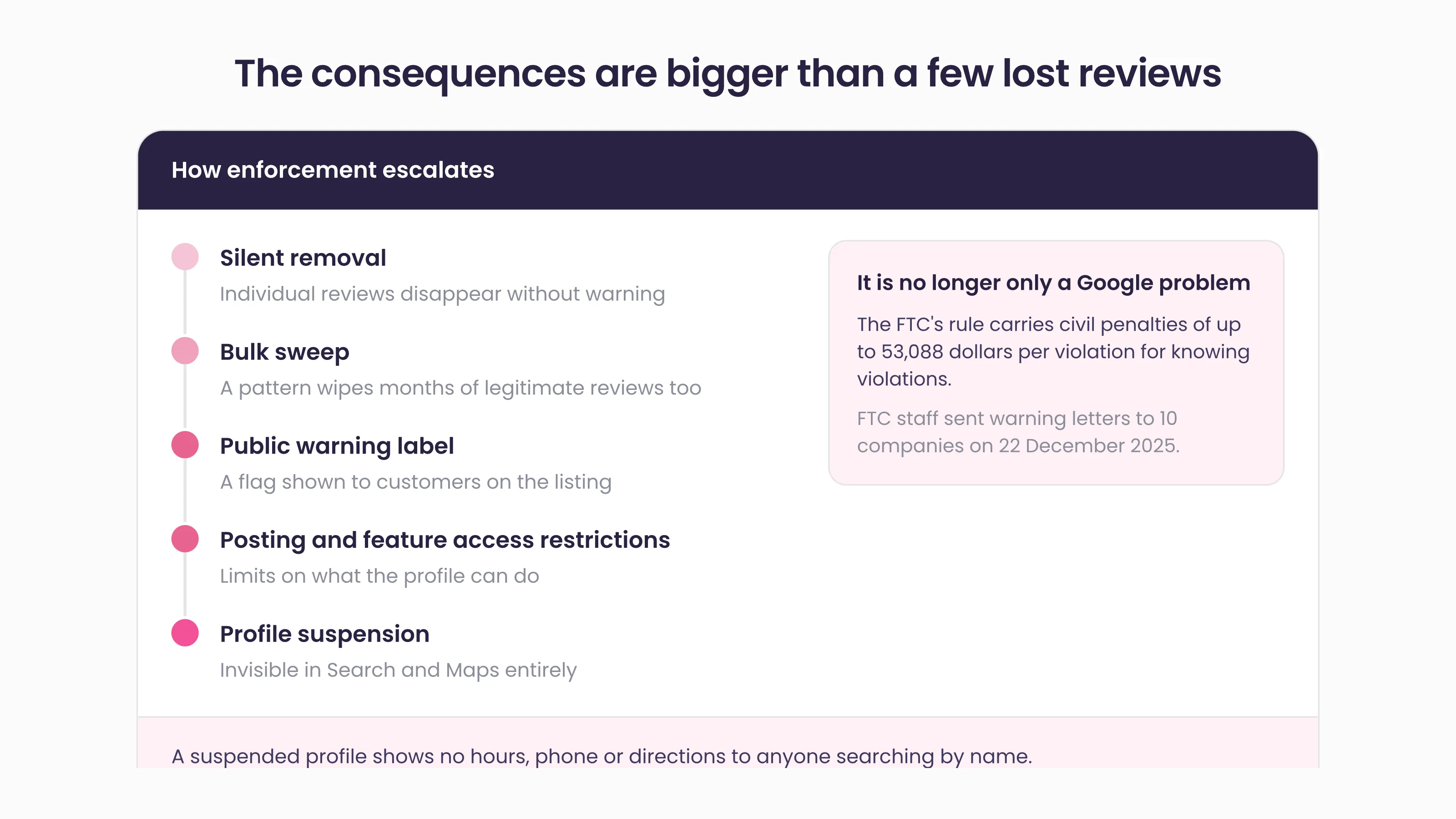
This is no longer just a Google policy problem. In the United States the FTC’s Consumer Reviews and Testimonials Rule has been fully in effect since 21 October 2024 and authorises courts to impose civil penalties for knowing violations of up to $53,088 per violation. That is the current maximum: there was no federal inflation adjustment to civil penalty amounts for 2026, so the 2025 level still stands. On 22 December 2025, FTC staff sent warning letters to 10 companies over potential violations. The FTC was clear those letters were not findings of a violation, but it warned that Rule violations can result in a federal lawsuit and civil penalties.
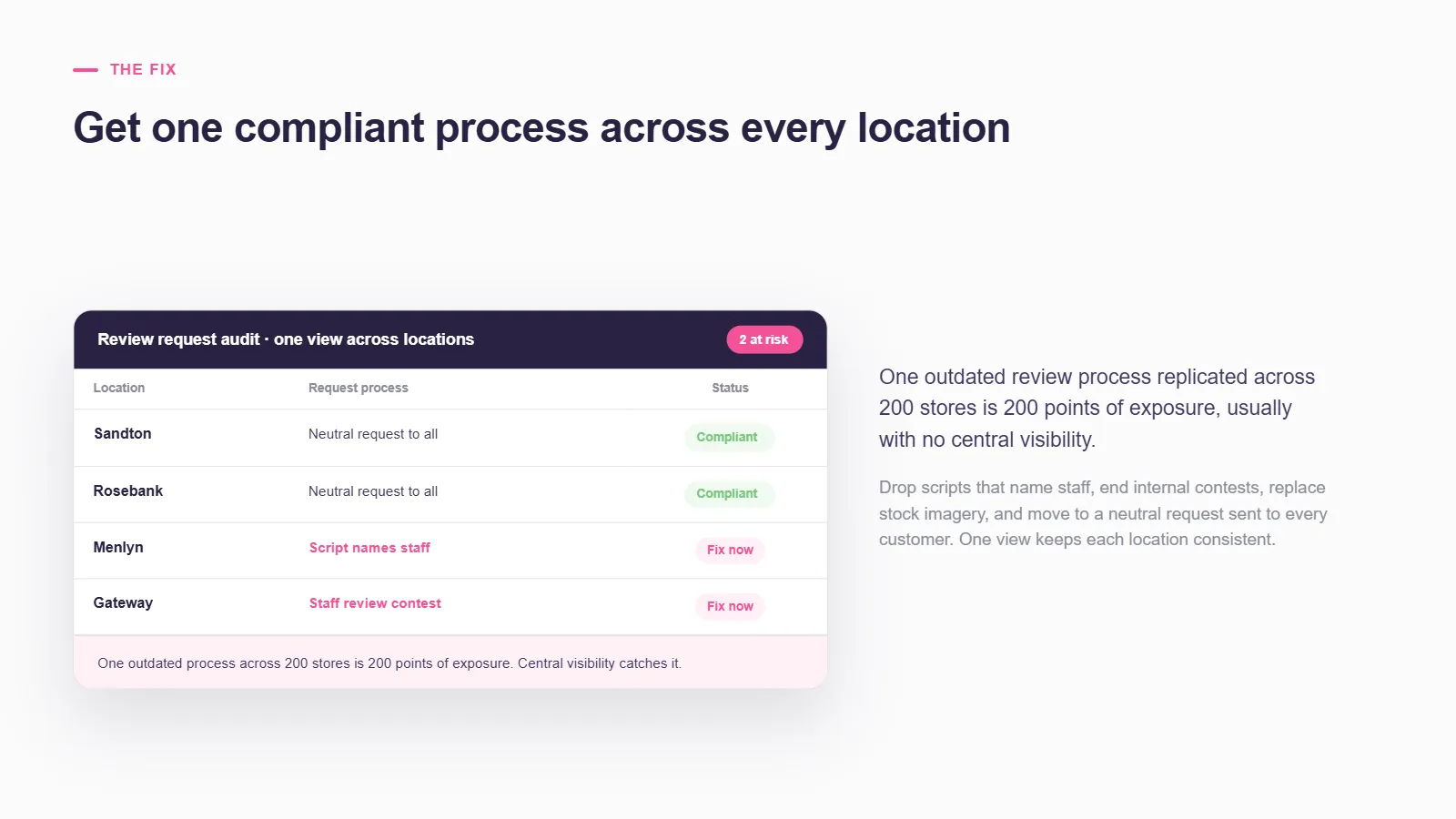
“The brands most at risk right now are not the ones cutting corners on purpose. They are the ones running review programmes that were perfectly acceptable a year ago and have never been reviewed since. At a multi-location level, one outdated process replicated across two hundred stores is two hundred points of exposure.”
Ashleigh Wainstein, Co-Founder and Client Service Director at Social Places
1. What Google Is Actually Detecting
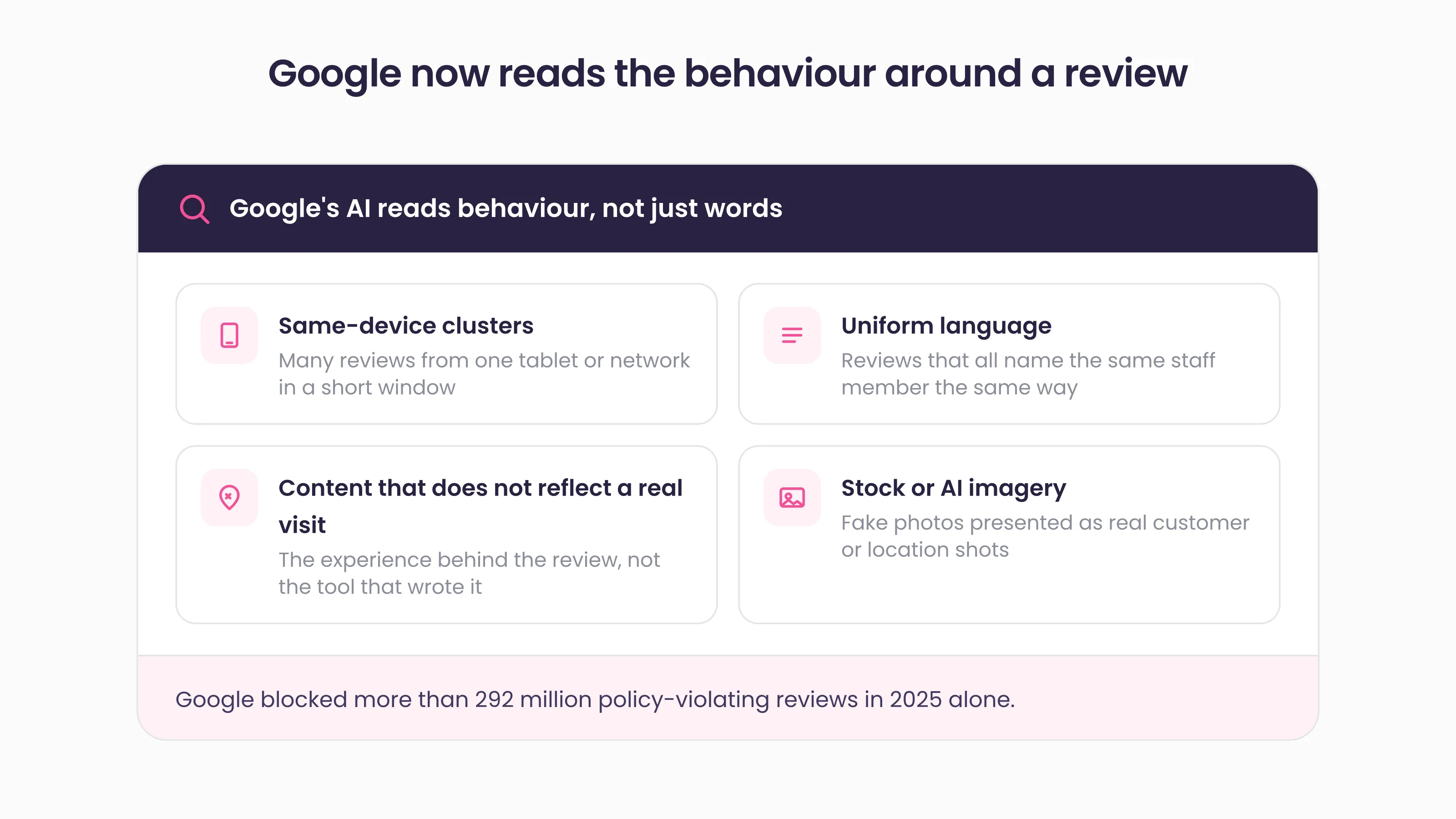
Google’s automated moderation no longer just reads the words in a review. It reads the behaviour around it. Patterns that look coordinated get flagged, even when every individual review is from a real customer describing a real visit.
- Clusters of reviews posted from the same device, in-store tablet, or network within a short window
- Unnaturally uniform language, including reviews that all mention a specific staff member by name in the same way
- Profiles with a suspiciously perfect rating and very little sentiment variation
- Review text that does not reflect a genuine experience. Google’s standard is the experience behind the review, not the tool used to write it, so it does not publish a rule against AI-drafted wording on its own
- Stock or AI-generated imagery presented as real customer or location photos
The uncomfortable part for honest businesses is that detection often builds quietly over weeks before anything visibly happens, and removals usually arrive with no warning at all.
2. The Consequences Are Bigger Than a Few Lost Reviews
It would be easy to treat this as a minor housekeeping issue. It is not. Individual violating reviews are removed silently. A pattern of abuse can trigger a bulk sweep that wipes months of legitimate reviews along with the flagged ones. Serious or repeated violations can lead to a public warning label on the listing, posting and feature access restrictions, or full suspension of the profile. A suspended profile does not appear in Search or Maps at all, which means customers searching for that location by name cannot find its hours, phone number, or directions.
3. Where Franchise and Multi-Location Brands Get Caught Out
Single-location businesses have one process to fix. Multi-location brands have the same risk multiplied across every store, usually without central visibility into what each location is actually doing.
- Review scripts that ask customers to name staff. A template that says “please mention your server” looks helpful, but at volume it produces exactly the uniform pattern Google’s AI is built to catch.
- Internal review contests and quotas. Incentivising staff to generate reviews crosses straight into FTC territory and creates coordinated behaviour signals.
- Review gating. Filtering for happy customers before sending them to Google is both a policy violation and a regulatory one.
- Stale photo libraries. Stock or AI images used to fill out location profiles undermine the authenticity signals Google now rewards.
The pattern is always the same: a process designed centrally, rolled out once, and never revisited. At scale, that is the single biggest source of exposure.
4. What to Do Now
This shift actually favours brands willing to do reviews the honest way, because it removes the artificial advantage competitors gained by gaming the system. The practical moves:
- Remove any script or template that tells customers what to write or which staff member to name
- Stop all internal review contests, quotas, and incentives immediately
- Audit location photo libraries and replace stock or AI imagery with genuine photos
- Move to a neutral, consistent review request that goes to every customer rather than only the satisfied ones
- Get central visibility into how each location requests and manages reviews, so one bad process cannot quietly replicate across the estate
How Social Places Helps Multi-Location Brands Stay Compliant
The hardest part of this for any brand with more than a handful of locations is not knowing the rules. It is seeing what every location is doing in practice and keeping the response consistent. Our Reputation tools give brands a single view of reviews and responses across every location, so you can standardise a compliant request process, spot anomalies early, and respond to reviews without slipping into anything that looks coordinated. Paired with accurate, consistent Listings, it keeps your profiles trustworthy in exactly the way Google’s systems now reward. If you want a clear read on where your estate stands, Contact Us.
Frequently asked questions
Can I still ask customers for reviews?
Yes. Asking for reviews is explicitly allowed and encouraged. The restrictions are around how you ask: do not offer incentives, do not ask only your happy customers, and do not tell customers what to say or which staff member to mention.
Is it against the rules to use AI to reply to reviews?
No. Google does not penalise businesses for using AI to draft review responses when those responses are authorised by the business. The prohibition is on AI-generated review content posing as genuine customer feedback, not on your replies.
What happens if legitimate reviews get caught in a sweep?
Google does allow you to contest a removal where a genuine review was filtered by mistake. Reinstatement is not guaranteed, and outcomes can vary, so the safer position is to keep your request process clean so legitimate reviews are less likely to be flagged in the first place.
Does the FTC rule apply to South African businesses?
The FTC rule is United States law, so it directly affects brands operating or marketing in the US market. For South African and international brands the bigger immediate risk is Google's own enforcement, which applies globally regardless of jurisdiction, alongside local consumer protection expectations around honest advertising.