What 250 Locations Taught Us About Getting Cited by Google AI Overviews and ChatGPT
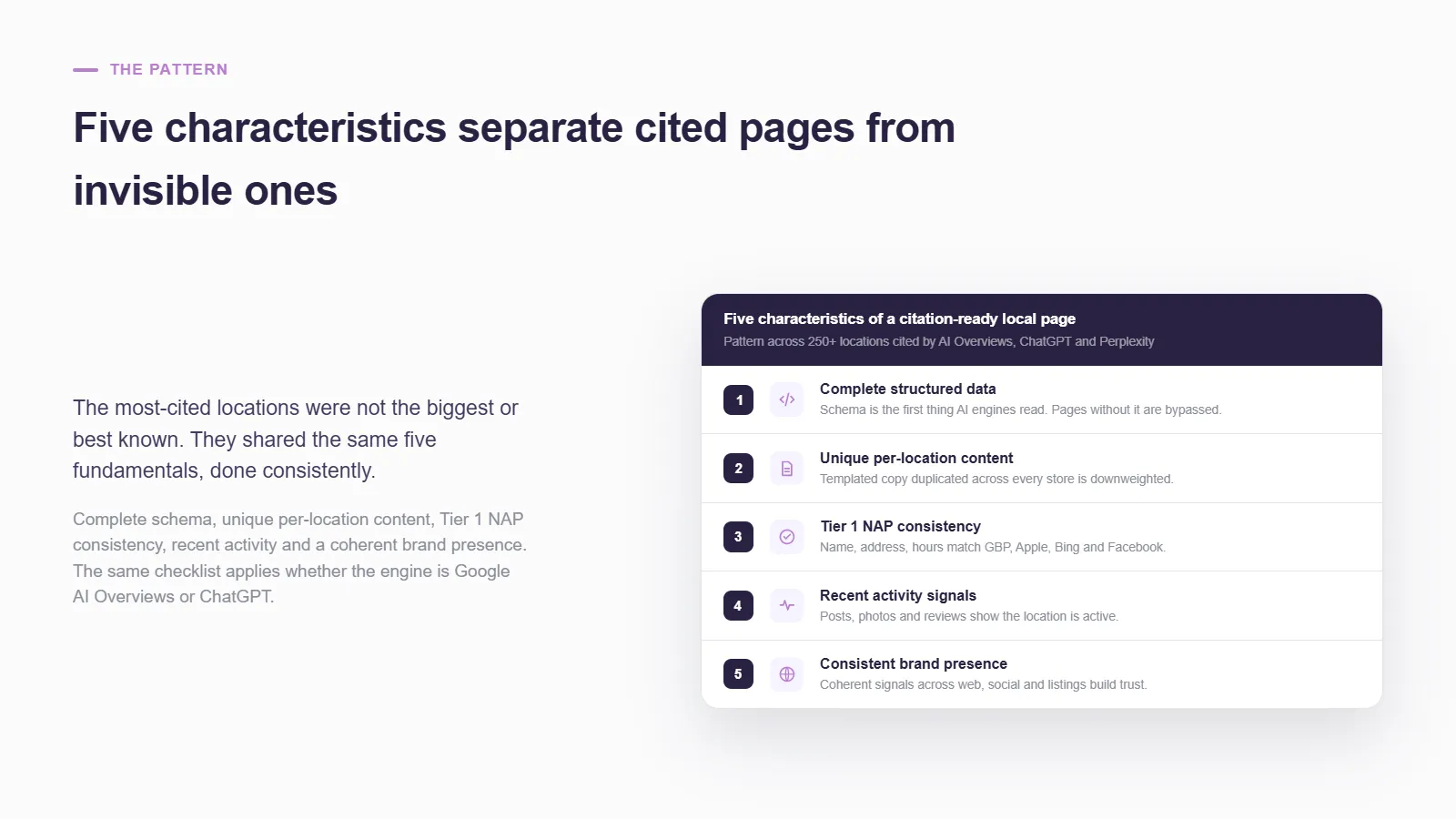
Google AI Overviews and ChatGPT are already citing local pages from enterprise multi-location brands on non-branded queries. Across enterprise brands we manage, we have direct evidence of local pages appearing as cited sources in AI Overviews for queries like “pizza takeaway in [city],” “best breakfast in [shopping centre],” and “coffee takeaway [suburb].” ChatGPT search returns local-page URLs as cited sources with direct links and review data. The pattern is not random. Pages that get cited share five characteristics: complete structured data, unique per-location content, consistent NAP across Tier 1 platforms, recent activity signals, and consistent brand presence across all platforms.
Key takeaways
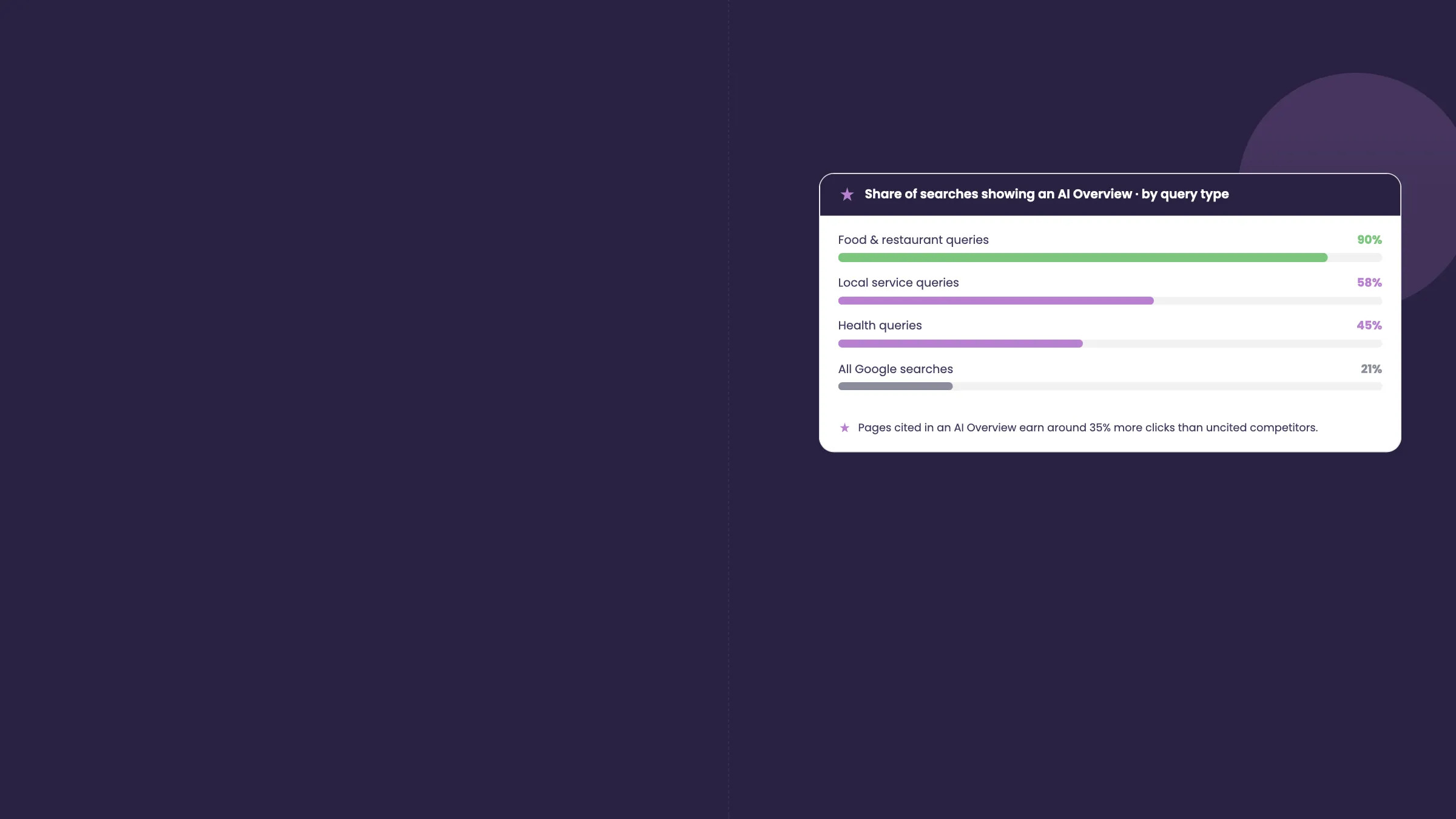
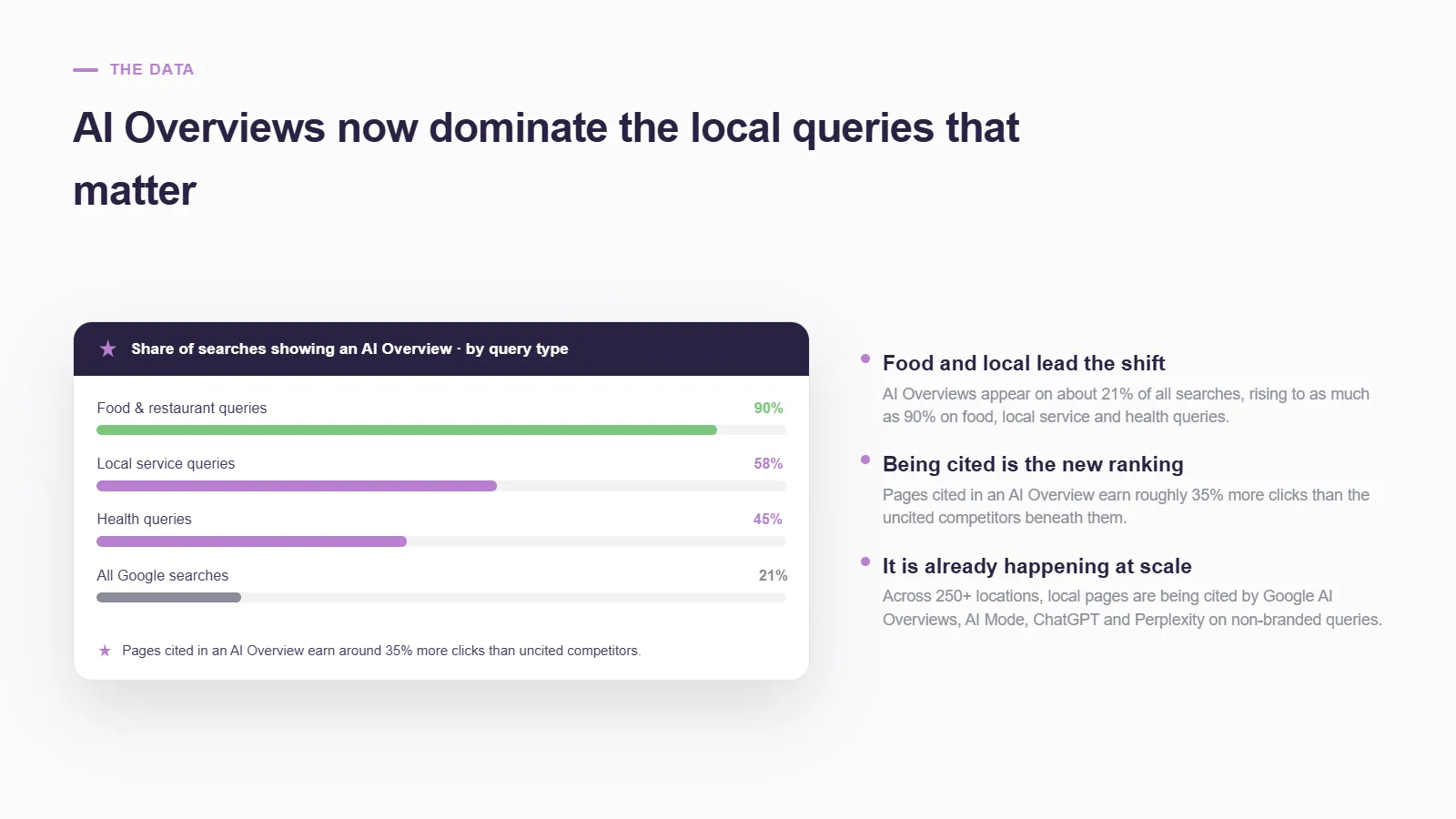
- AI Overviews now appear on roughly 21% of all Google searches, rising to between 40% and 90% on food, local service, and health queries (independent analysis of 146 million SERPs, September 2025).
- Pages cited in AI Overviews receive approximately 35% more clicks than uncited competing pages (industry research, 2025).
- Across a 250+ location enterprise QSR migration, local pages are being cited by Google AI Overviews, Google AI Mode, ChatGPT search, and Perplexity on non-branded location-specific queries.
- Five characteristics distinguish cited pages from uncited pages: schema completeness, unique per-location content, Tier 1 NAP consistency, recent activity signals, and consistent brand presence across all platforms.
AI Overviews are now a normal part of local search
The question of whether AI search would displace traditional results is closed. Independent research found 58.5% of US searches are now zero-click, rising to 77.2% on mobile.
Further analysis measured a 61% organic CTR decline on queries with AI Overviews and a 41% decline even on queries without them, across 3,119 queries and 25.1 million impressions.
Pages cited in AI Overviews receive roughly 35% more clicks than uncited competing pages. Being cited is the new ranking. The goal can no longer only be ranking in the Google 3-pack; brands now have to ensure they are ticking the boxes to appear in AI answers too.
What we’re seeing across our client network
Across the enterprise and multi-location brands we manage, we have been tracking AI citation behaviour on non-branded, location-specific queries, the kind that reflect real customer intent rather than branded searches.
On a sample of queries across several locations, the pattern was consistent:
- A non-branded query like “pizza takeaway in [shopping centre]” returned an AI Overview citing the brand’s local page as a primary source, with a direct link to the URL.
- “Best breakfast in [suburb]” returned an AI Overview referencing the brand’s location and citing the local page.
- “Coffee takeaway [suburb]” returned the brand’s location in the Local Pack, the local page ranking in organic, and the local page cited in the AI Overview.
- ChatGPT search returned the brand’s local pages as cited sources for “best pizza in [shopping centre]” and “best breakfast in [shopping centre],” with direct link, brand name, and aggregated review data.
- Perplexity returned brand pages and local pages as sources for location-specific queries with similar consistency.
This is direct first-party evidence of AI citation behaviour at scale.
What makes a page citation-ready
1. Complete structured data. The schema markup on a local page is the first thing AI engines read to understand what a business is, where it is, and whether it can be trusted as a source. Pages without it, or with incomplete implementations, are consistently bypassed.
2. Unique per-location content. A page that says “Welcome to [Brand Name] in [Location]. We serve great food.” duplicated across 250 locations is not citation-ready. AI engines downweight templated content.
3. Tier 1 NAP consistency. The local page’s name, address, phone, hours, and category have to match the brand’s Google Business Profile, Apple Maps listing, Bing Places listing, and Facebook local store page.
4. Recent activity signals. Posts, photos, reviews, and content updates all signal that the location is active.
5. Consistent brand presence across platforms. The local page needs to connect to the brand’s broader digital presence, the same name, address, category, and brand signals appearing consistently across the website, social profiles, and listings. AI engines build trust from coherence.
Measuring AI citations vs measuring clicks
The pragmatic measurement model that works today:
- Track GBP performance on the metrics that still matter. Impressions, direction requests, calls, and post-click engagement. Website clicks have dropped industry-wide.
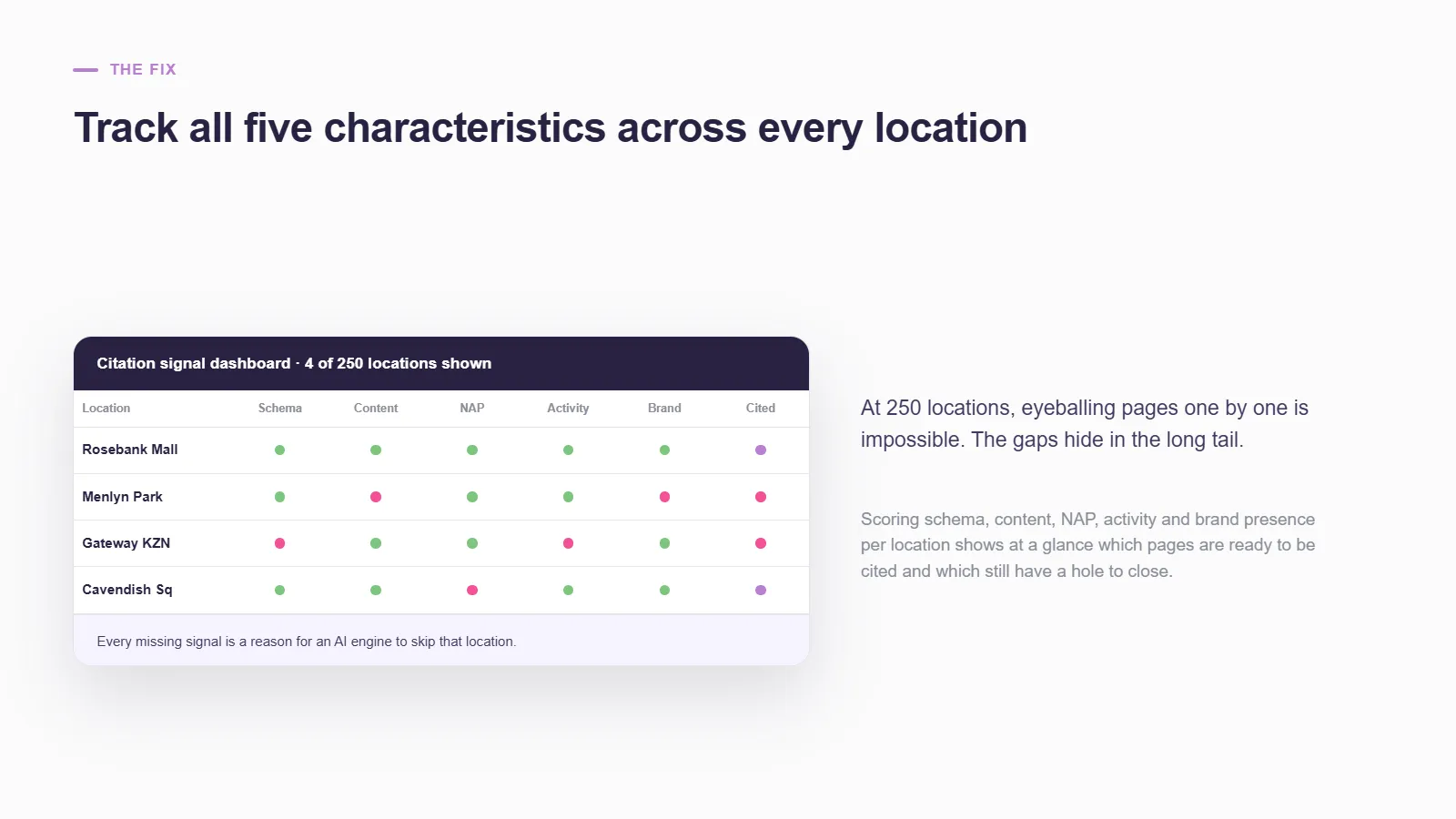
- Track non-branded query citation manually until tooling matures. Identify the 20 to 30 most important non-branded queries for a representative sample of locations. Run them on Google, ChatGPT, and Perplexity monthly.
- Track structured data coverage as a leading indicator. AI citation rate correlates with schema completeness.
How Social Places Helps
Social Places Listings keeps Tier 1 NAP data consistent across every platform AI engines read, and Local Pages give each location the unique, schema-rich, recently-active page that AI Overviews and ChatGPT cite. Contact Us
Frequently asked questions
Are AI Overviews citing local pages from multi-location brands?
Yes. Across the enterprise multi-location brands we manage, local pages are appearing as cited sources in Google AI Overviews, Google AI Mode, ChatGPT search, and Perplexity for non-branded location-specific queries.
Does Google Business Profile optimisation help with AI citations?
Yes. Independent 2026 research identifies GBP signals as the #1 factor for both Local Pack and AI Mode visibility, weighted at roughly 32% of the ranking model.
Should I measure clicks or citations?
Both, but the weighting is shifting. The pragmatic model in 2026 is to track GBP engagement metrics that still hold up (impressions, directions, calls) and to track non-branded query citation manually on a representative sample.