Your Review Strategy Ends at Google. Your Customers Have Moved On.
Ask a head office marketing team to describe their reputation strategy and you will hear about Google. Review volume on Google. Star ratings on Google. Response times on Google.
That was a reasonable strategy for a decade. It is now a partial one.
Between October 2025 and this month, the two biggest non-Google local surfaces were both rebuilt, and a third, Google’s own agentic layer, started acting on customers’ behalf rather than showing them a list. The reputation asset that decides what happens on those surfaces is not your star rating. It is your data.
What actually changed
Three things, all confirmed by the platforms themselves.
Apple consolidated everything. On 24 March 2026 Apple announced Apple Business, a single platform that absorbs Apple Business Connect, Apple Business Essentials and Apple Business Manager. It launched on 14 April 2026, free, in more than 200 countries and regions, and existing Business Connect data “will automatically migrate to Apple Business at launch”. Maps advertising follows in the US and Canada from summer 2026.
Bing Places moved house. On 3 October 2025 Microsoft retired bingplaces.com and moved the product to bing.com/forbusiness, with a rebuilt interface, a better import flow from Google, bulk editing tools and a recommendation engine that prompts owners for missing photos and details. Microsoft flagged the direction plainly: “deeper integrations with Bing Maps and Copilot”.
Google started doing the searching. At I/O on 19 May 2026 Google expanded agentic booking in Search “to a wide range of new tasks, including local experiences and services”, and agentic calling for categories including home repair, beauty and pet care. Both roll out to everyone in the US over the summer.
Here is the part nobody has said out loud
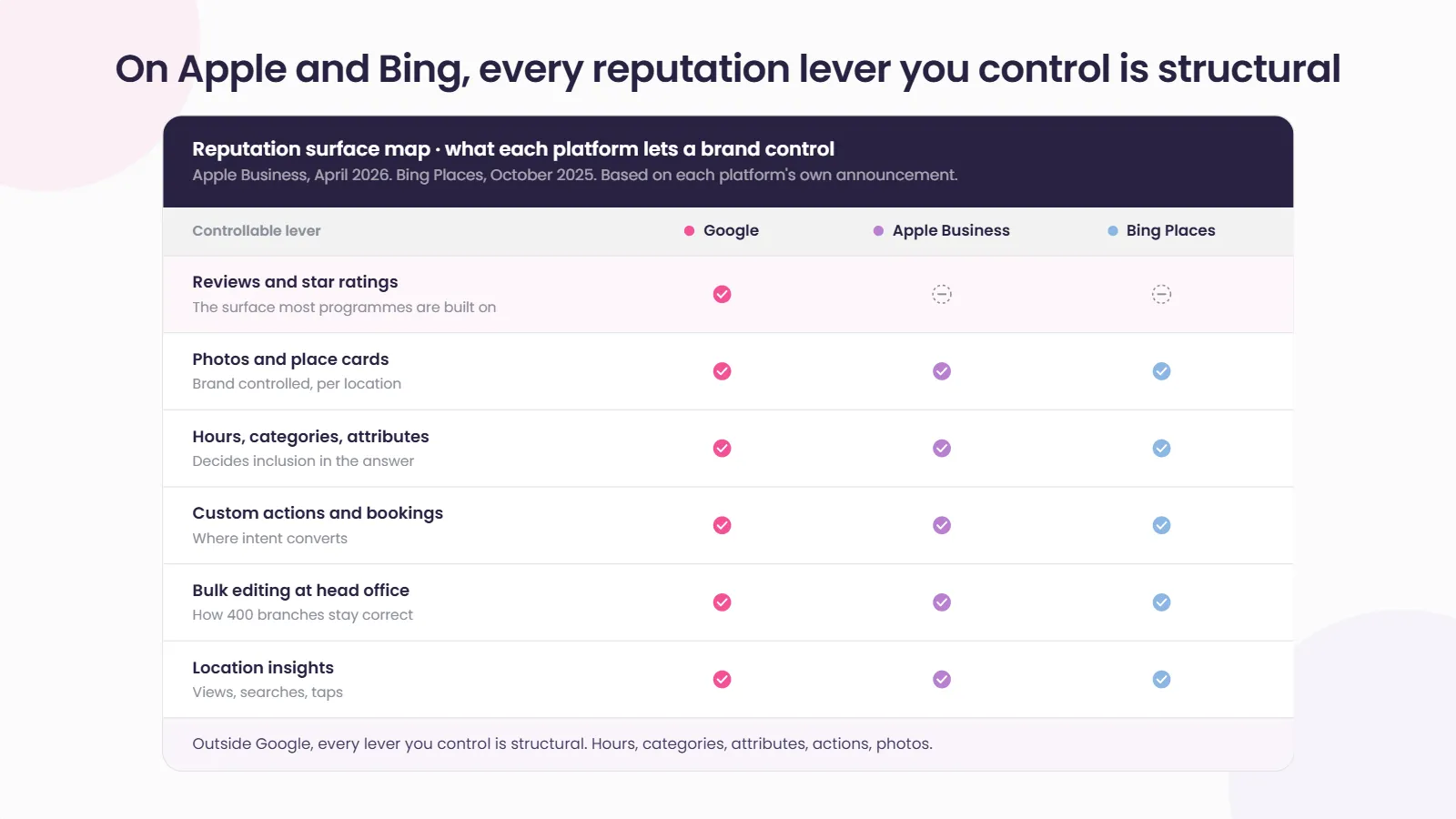
Read Apple’s announcement of Apple Business and count the mentions of ratings or reviews. There are none. What a brand gets is place cards, photos, Showcases, custom actions, branded Mail and Wallet, and location insights covering search, views and taps.
Read Microsoft’s relaunch post for Bing Places. Same result. Photos, business details, bulk editing, recommendations. No review layer.
So on the two surfaces growing fastest outside Google, the reputation levers a brand actually controls are structural, not sentimental. Hours. Categories. Attributes. Actions. Photos. The things a reputation team has historically treated as somebody else’s job.
Google, meanwhile, has not moved. Its published guidance on improving local ranking still names the same three factors: relevance, distance and prominence. Review count and review score sit inside prominence, alongside everything else Google knows about you. That has not changed, and it is why abandoning Google review work would be a mistake.
The shift is not from reviews to data. It is that reviews stopped being the whole of reputation.
What this means for a reputation programme
Three practical consequences.
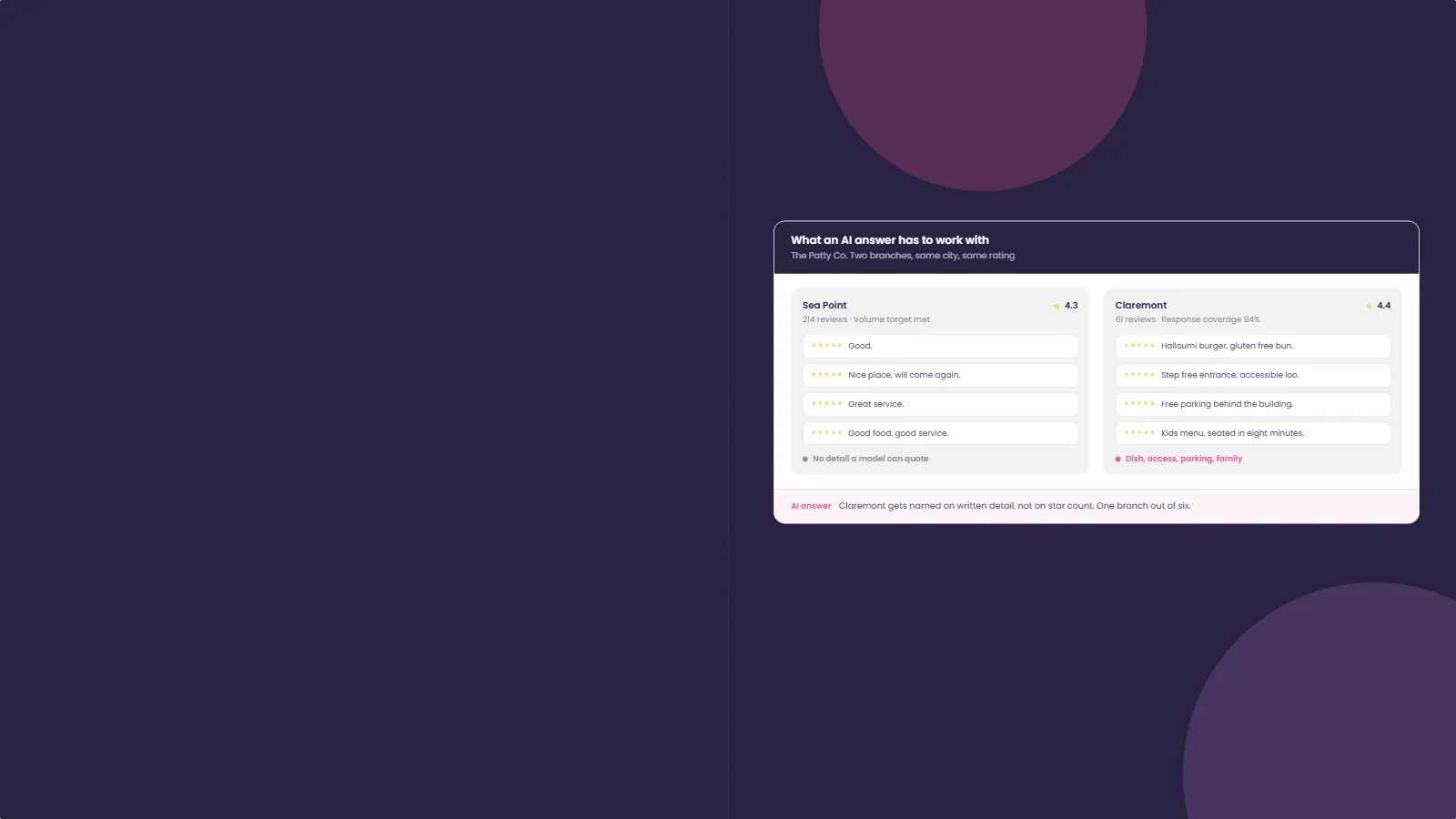
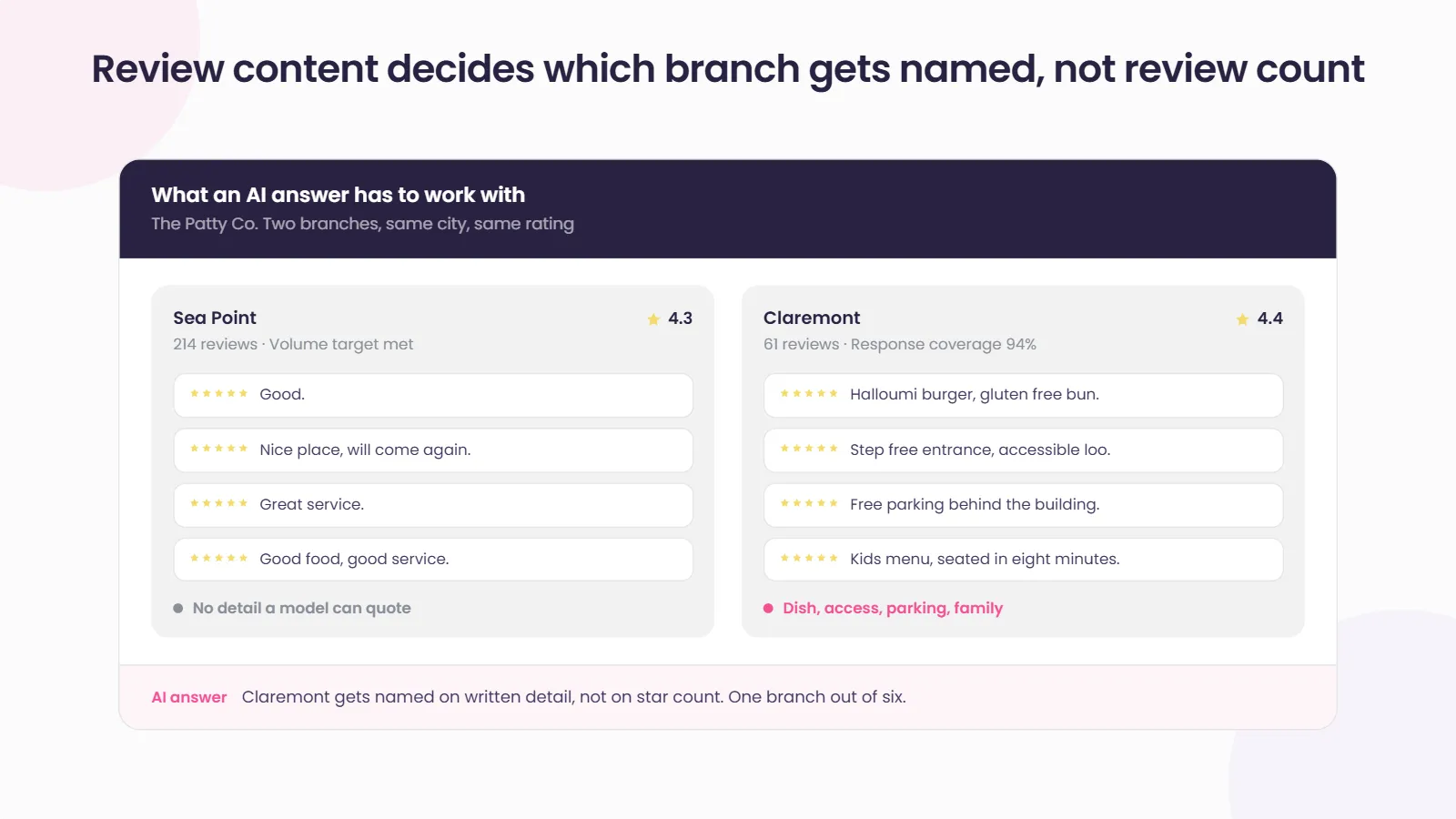
Your review content matters more than your review count. When an AI answer names one location out of six, it is reasoning over what people wrote, not counting stars. A location with 200 reviews that all say “good” is weaker input than one with 60 that name the dish, the service, the parking and the wheelchair ramp. Volume targets pointed at branches produce the former.
Your accuracy work is now reputation work. If your Cape Town branch has the wrong closing time on Apple, it does not get a bad review. It gets left out of the answer, silently, with no notification and no report line. Our piece on Apple’s auto-generated local lists covers how that exclusion actually happens.
Your Bing gap is a Copilot gap. Most brands have no head office owner for Bing Places at all, which was defensible when Bing was a search engine and indefensible now that it feeds an assistant. We covered what Copilot pulls from Bing Places when the redesign landed.
The compliance constraint most brands are still breaching
While the platforms changed, the rules on how you collect reviews did not soften.
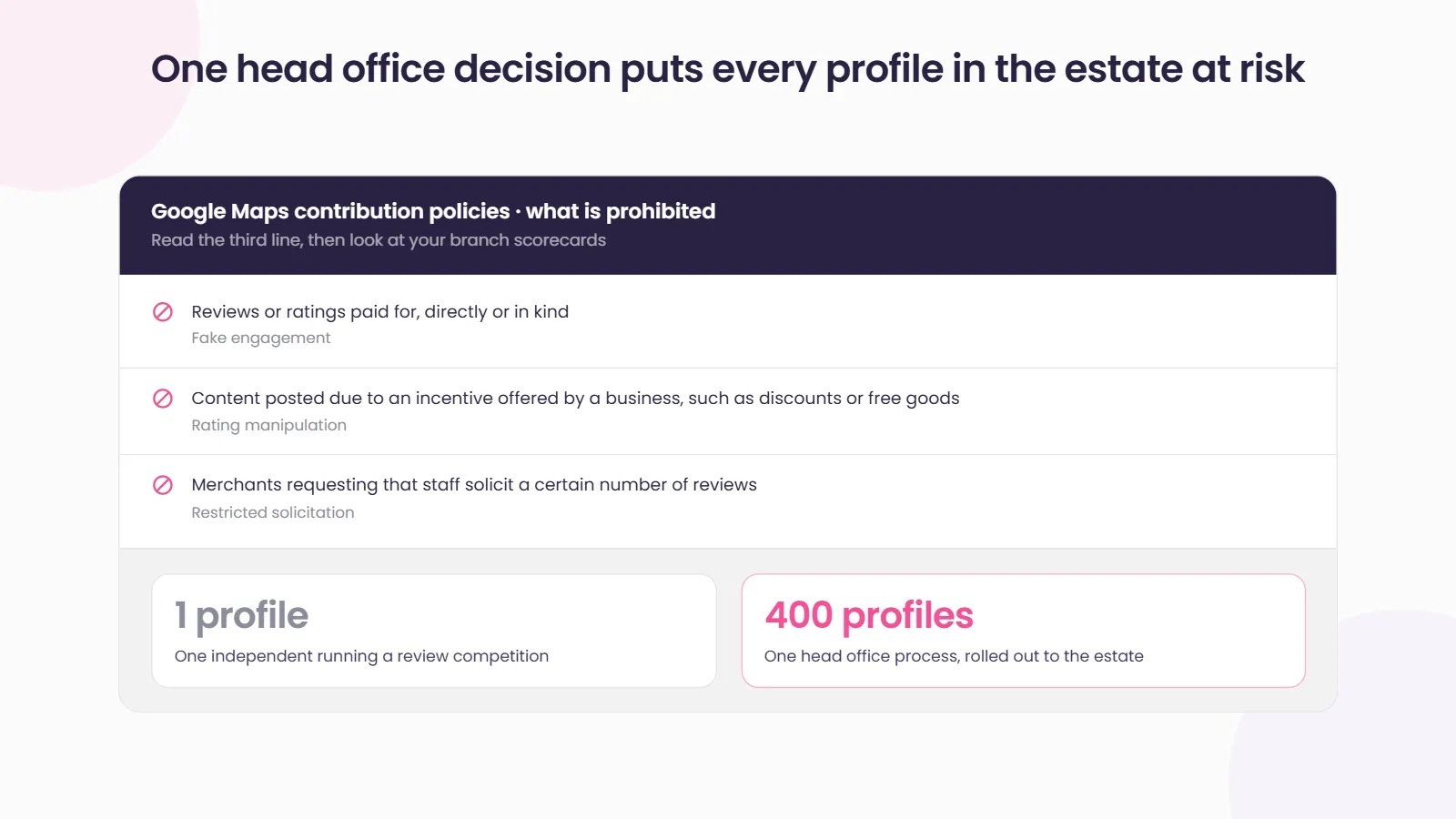
Google’s Maps contribution policies prohibit fake engagement, including “Reviews or ratings that have been paid for, directly or in kind”, and rating manipulation, including “Content that has been posted due to an incentive offered by a business - such as payment, discounts, free goods and/or services”. Solicitation is restricted too: “Merchants requesting that staff solicit a certain number of reviews” is explicitly prohibited.
Read that last one again, then look at your branch scorecards.
This is where multi-location brands carry disproportionate risk. A single independent restaurant running a dubious review competition is one profile at risk. A head office process rolled out to 400 branches is 400 profiles at risk, from one decision, taken once, by someone who thought it was a nice idea. Enforcement has also stopped being manual, which we wrote about in how Google now polices review authenticity.
Measurement changed, and not entirely in your favour
In June 2026 Google added a Generative AI performance report to Search Console. It covers AI Overviews and AI Mode, and you can break it down by page, country, date and device.
It reports impressions. That is, “how many times links to your site were shown to a user in a generative AI feature on Google Search”. Not clicks. Not position. Not which of your locations was named.
That is genuinely useful and genuinely thin. You can now prove you are appearing in AI answers. You cannot yet prove what that appearance was worth, and the usual Search Console limits, including the 1,000 row cap, still apply. Anyone selling you a confident AI visibility number in 2026 is estimating.
What to do this quarter
-
Claim Apple Business at head office. If you had Business Connect, your data migrated automatically on 14 April. Log in and check what came across, because migrated is not the same as correct.
-
Give Bing Places an owner. Use the import from Google, then bulk edit. This is an afternoon of work and almost nobody has done it.
-
Audit hours, categories and attributes across every branch, not just the flagships. On Apple and Bing this is the whole of your controllable reputation surface.
-
Change what you ask branches for. Retire review count targets. Ask for response coverage and response specificity instead, which is the part that feeds AI answers and the part that survives policy scrutiny.
-
Rewrite your solicitation script against Google’s actual policy text, not against what your agency did in 2021.
-
Turn on the Search Console Generative AI report and start a baseline now, so you have a trend line when the metrics get richer.
Where this lands
Reputation used to mean reviews. In 2026 it means everything a machine can read about a location before it decides whether to mention it.
Most multi-location brands are running a sophisticated programme on one surface and nothing at all on the other two. Closing that gap is not a new budget line. It is putting listings accuracy and reputation under the same owner, with the same reporting, for the first time.
If you want to know how wide the gap is across your estate before you commit to fixing it, we can audit it.
Related reading
How Google now polices review authenticity covers the enforcement side of the collection rules above, and why a head office process multiplies the risk.
What Microsoft Copilot pulls from Bing Places covers the surface most brands have no owner for, and what the October 2025 redesign changed.
Apple’s auto-generated local lists covers how a branch gets silently excluded when its data is stale, with no notification and no report line.
Frequently asked questions
Does Apple Business have reviews?
Apple's March 2026 announcement of the platform does not mention ratings or reviews among its business-facing features. What it gives brands is control over place cards, photos, Showcases, custom actions, branded communications and location insights. Treat Apple as a data accuracy surface rather than a review surface, and manage it accordingly.
Should we stop chasing Google reviews?
No. Google's published local ranking guidance still lists relevance, distance and prominence as the three factors, and review count and score sit inside prominence. What should change is the target. Move branch incentives away from review volume and towards response coverage and response quality, which is both safer under Google's policies and more useful as input to AI answers.
Is Bing Places worth the effort for a brand in South Africa?
It depends on whether your customers use Copilot, not on Bing's search share. Microsoft has said it is building deeper integrations between Bing Places, Bing Maps and Copilot, and Bing Places is the listing source behind those surfaces. The import-from-Google flow makes the setup cost low enough that the question is usually worth answering with a test rather than a debate.
How do we measure whether any of this is working?
Imperfectly, for now. Search Console's Generative AI performance report gives you impressions in AI Overviews and AI Mode, broken down by page, country, date and device. It does not give you clicks, position, or which location was named. Pair it with the actions you can still measure directly, such as calls, direction requests and bookings per location, and be honest in reporting about which numbers are measured and which are inferred.