Microsoft Copilot Is Answering Your Customers' Location Queries. Most Brands Aren't in the Answer.
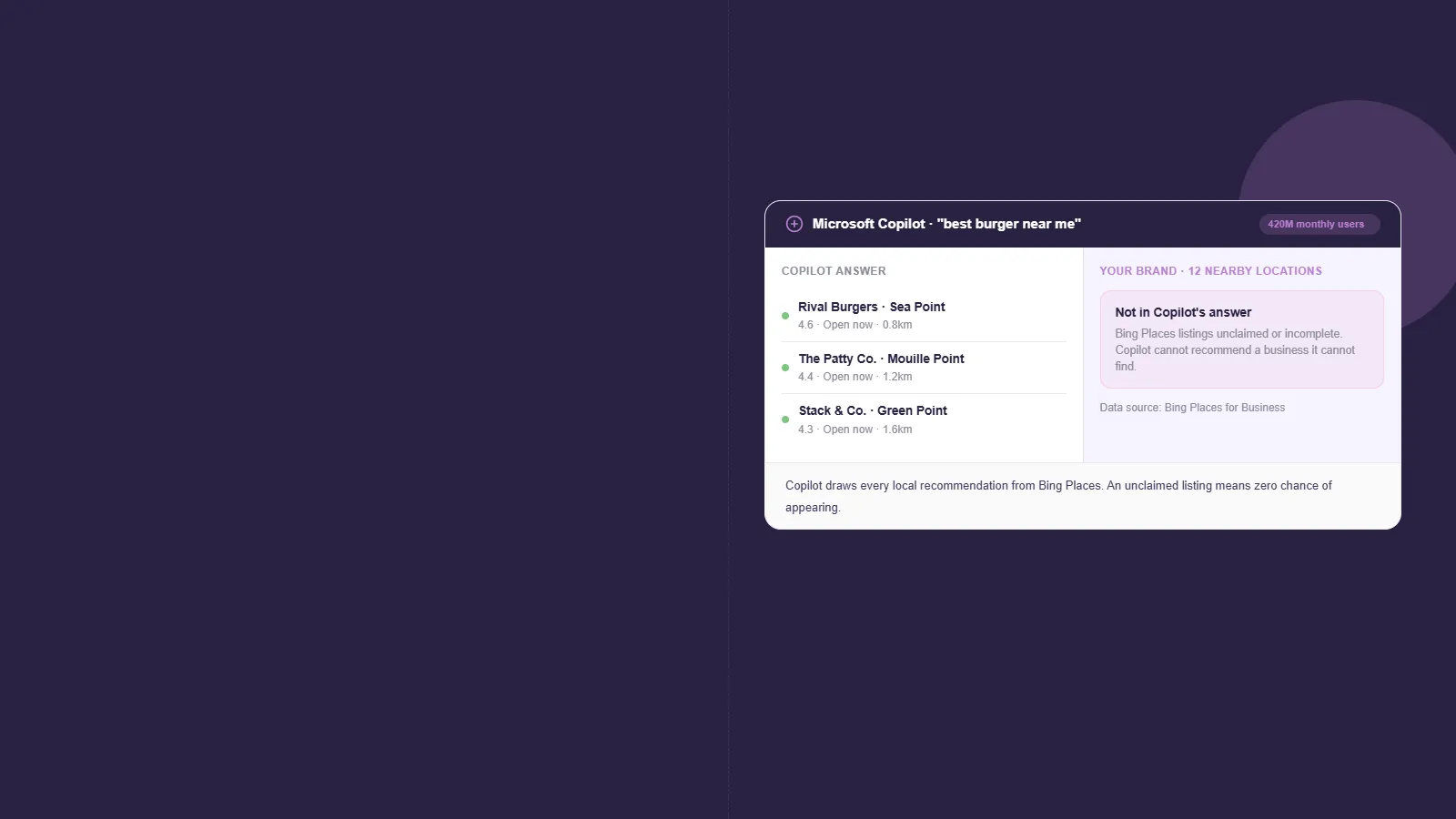
A customer opens Microsoft Copilot on their Windows laptop and types “best burger near me.” In seconds, Copilot generates three recommendations, business name, address, star rating, and a link to directions. Your brand runs twelve locations within a five-kilometre radius of that customer. Not one appears in the answer.
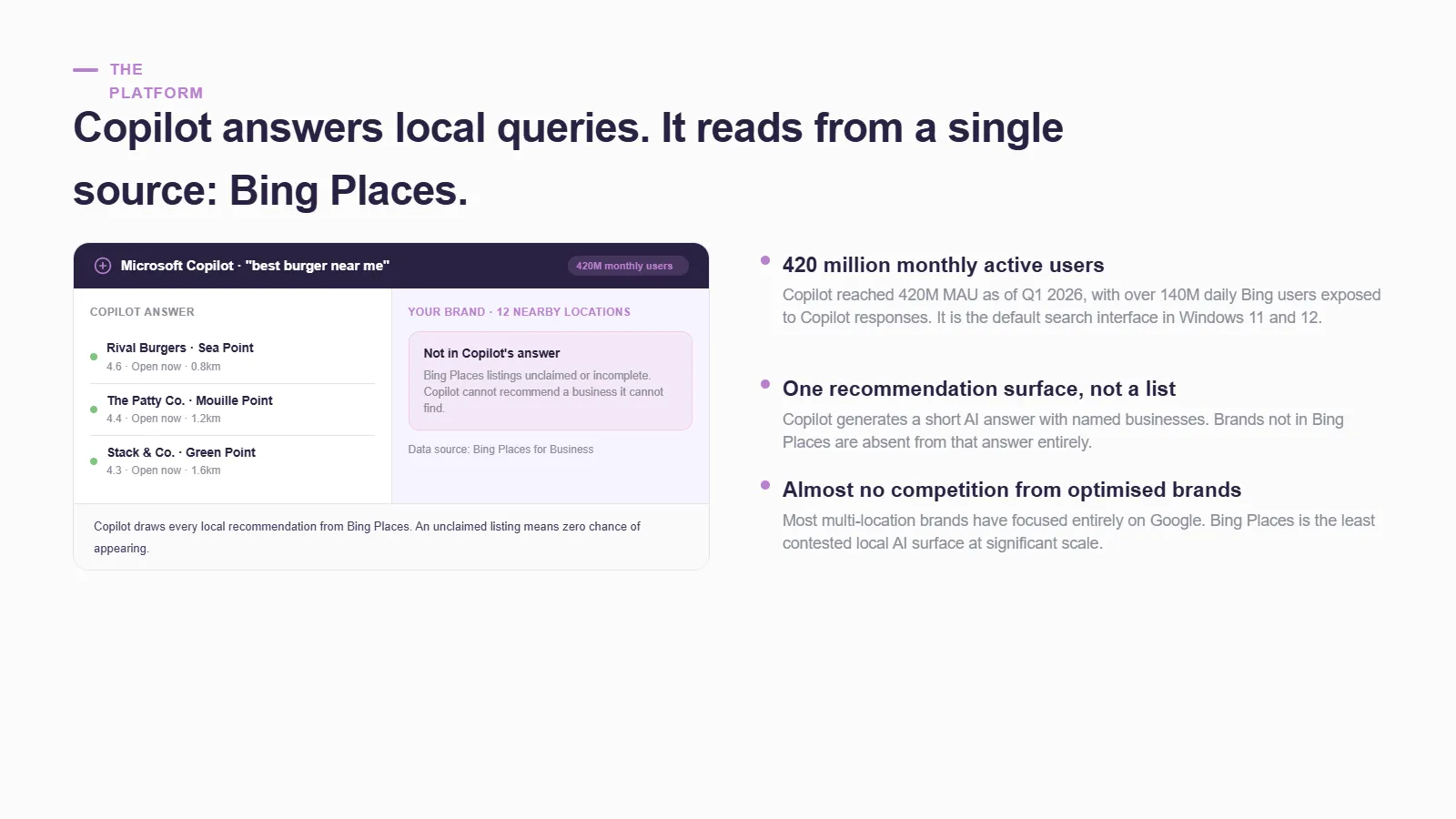
Most multi-location brands have spent 2025 and 2026 in an AI search arms race: auditing Google Business Profiles, publishing FAQ schema for AI Overviews, studying ChatGPT and Gemini visibility. What they have largely missed is the third AI platform answering location queries at significant scale, daily, with almost no competition from optimised brands.
That platform is Microsoft Copilot. And it gets its local business data from Bing Places.
The Local AI Nobody Is Optimising For
Copilot is no longer just a writing assistant inside Microsoft 365. It is the default search interface in Windows 11 and 12, the sidebar companion in Microsoft Edge, and a conversational layer sitting on top of Bing for hundreds of millions of users. As of Q1 2026, Microsoft Copilot has reached 420 million monthly active users, with over 140 million daily Bing users exposed to Copilot-generated responses every time they search.
When those users ask a location-specific question, “find a coffee shop near me,” “where can I get my tyres changed in Johannesburg,” “best Italian delivery in Cape Town,” Copilot generates an AI-powered local recommendation. It surfaces businesses by name, address, star rating, and current trading hours.
Every one of those recommendations comes from a single data source: Bing Places for Business.
Bing Places Is Doing Far More Work Than Most People Realise
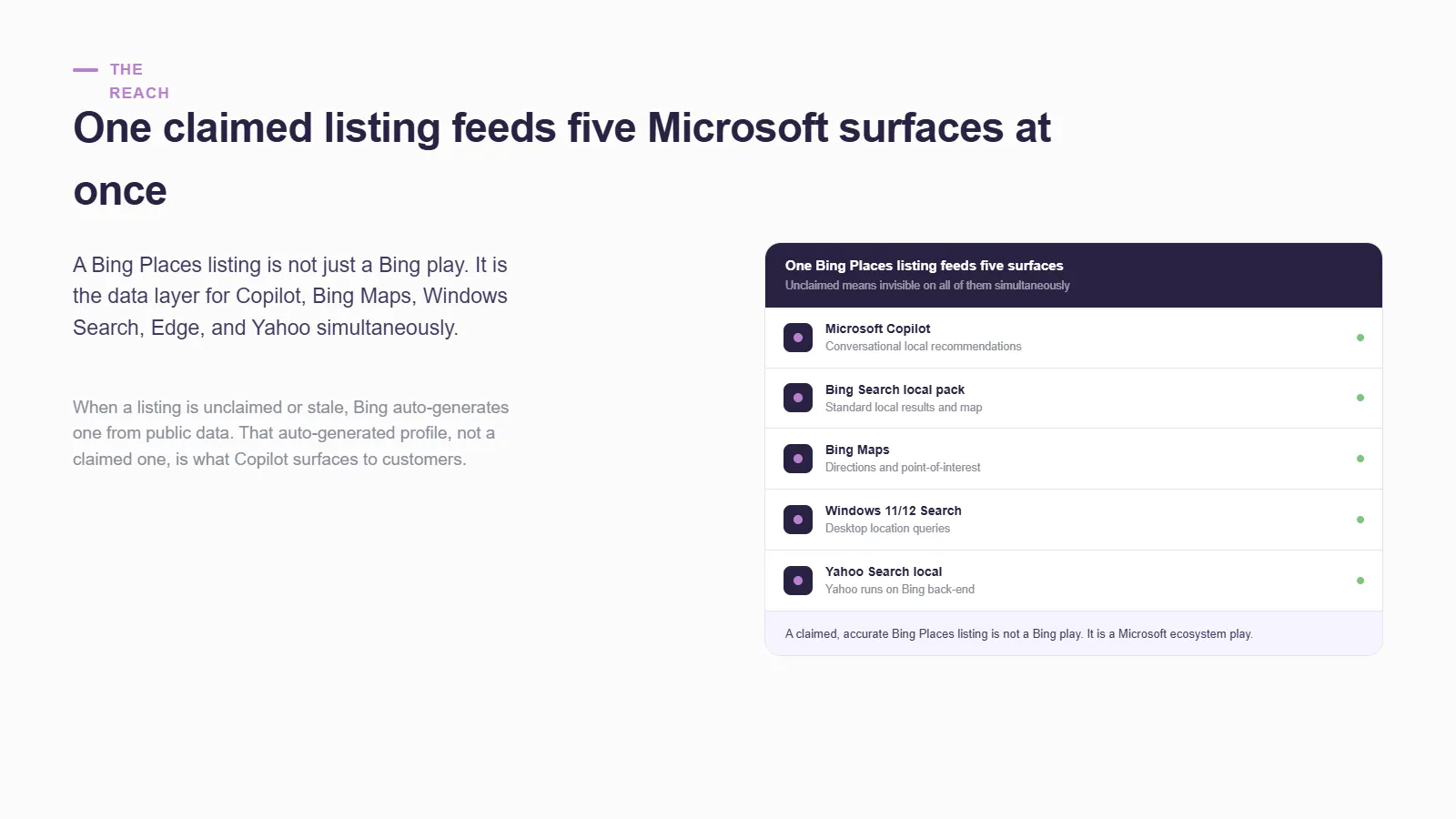
A claimed and verified Bing Places listing does not just appear on Bing.com. It feeds business data into Microsoft’s entire local discovery ecosystem:
- Bing Search local results and the Bing local pack
- Bing Maps directions and point-of-interest discovery
- Microsoft Copilot conversational local recommendations
- Windows 11 and 12 Search for desktop location queries
- Microsoft Edge local business card suggestions
- Yahoo Search local results (Yahoo’s back-end runs on Bing)
That is a substantial reach for a platform most marketing teams treat as an afterthought, or have not considered at all. If your Bing Places listing is unclaimed, incomplete, or carrying stale data from a location that has moved or closed, you are invisible across every one of those surfaces simultaneously. Copilot cannot recommend a business it cannot find.
The Multi-Location Problem Runs Deep
For a single-location independent business, a missing Bing Places listing is a minor gap. For a brand operating forty, a hundred, or three hundred locations, it is a systemic blind spot.
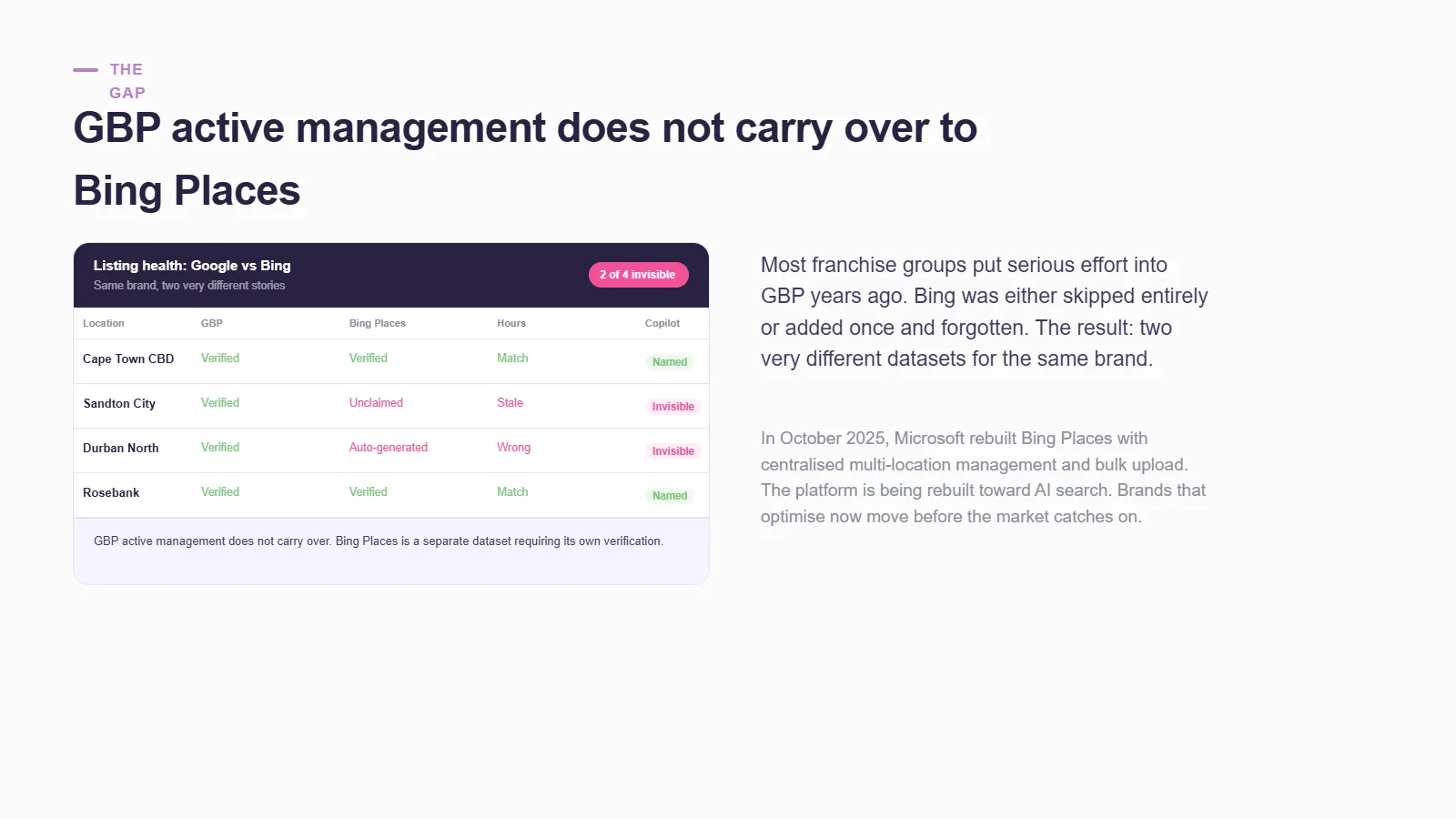
Most franchise groups and national chains put real effort into their Google Business Profiles years ago. Bing Places was either skipped entirely or added once and forgotten. The result: GBP is actively managed, current, and accurate. Bing listings are often unclaimed, never verified, or sitting with 2022 information, old addresses, disconnected phone numbers, wrong categories.
The compounding risk is Bing’s auto-population behaviour. When a business has not claimed its listing, Bing creates one using whatever public data it can scrape, which may include outdated addresses, incorrect trading hours, and categories that do not match the business. When Copilot surfaces that auto-generated profile to someone asking where to go, the brand has had no say in what appears.
Recent data on AI search accuracy shows that business profile accuracy on AI platforms sourced outside of Google’s direct data sits well below 100%. That accuracy gap is a key reason why Google’s own AI surfaces recommend local businesses at far higher rates than third-party AI platforms: the underlying data is simply better. Fixing Bing Places data directly closes part of that gap, for Copilot and every other Microsoft surface.
What Microsoft Rebuilt in October 2025
In October 2025, Microsoft launched a completely redesigned Bing Places for Business at bing.com/forbusiness, replacing the old interface with a significantly more capable platform. For multi-location brands, several changes are directly relevant:
- Centralised multi-location management, all locations managed from a single dashboard, replacing the fragmented location-by-location experience of the old platform
- Bulk upload via spreadsheet template, add or update 10 or more locations simultaneously, which previously required manual entry per location
- Improved analytics, per-location visibility into search impressions, direction requests, and call actions
- Photo carousel in search results, from February 2026, Bing business profiles began displaying an image slider directly in search results, making photo quality a visible differentiator
Microsoft has confirmed its roadmap includes deeper integrations between Bing Places and Copilot’s local recommendation layer. The platform is being rebuilt toward AI search, not alongside it. Brands that optimise now are moving before the broader market recognises the opportunity.
As a recent industry report noted at the time of the launch, this is the most significant update to Bing’s local business infrastructure in years, and it arrived with almost no coverage from the multi-location marketing industry.
How Social Places Helps
Managing listings across Google Business Profile, Apple Business Connect, Bing Places, and every other relevant directory simultaneously, at scale, across dozens or hundreds of locations, is operationally unmanageable without the right infrastructure. Social Places’ listings management platform centralises data across every major platform, ensuring your business information is accurate, consistent, and current everywhere your customers are searching, including on Bing and, by extension, Microsoft Copilot.
One update pushes to every platform, every location. No manual entry, no missed listings, no Copilot recommending a closed location or an address your brand left two years ago.
If your brand is carrying unclaimed or outdated Bing Places listings, the cost is already being paid in missed recommendations. Contact Us