Local Customer Optimization: Your Listings Now Spend Your Budget

There is a new setting in Google Ads that decides which of your branches get shown to a customer who is already in the car. It reads that branch list straight from your Business Profile. If the list is wrong, the budget goes to the wrong branches.
What Local customer optimization actually does
Google describes Local customer optimization as a feature inside Performance Max campaigns for store goals that lets you prioritise reaching potential customers who are close to or interested in your business area and ready to act immediately, such as visiting or making contact.
It is built for the moment someone is navigating, planning a trip, or searching for a location on Google Maps or Google Search. In other words, intent that expires in minutes rather than days.
Google published the help documentation for Performance Max for store goals in August 2026. The Google Ads Liaison then announced a wider push on 8 September 2026, framed around the trading peak, alongside a second feature for measuring in-store sales.
The restriction that decides your account structure
The most important line in Google’s documentation is a limit, not a feature. Local customer optimization is not compatible with online campaign goals, and it is not compatible with Performance Max campaigns carrying products from Merchant Center.
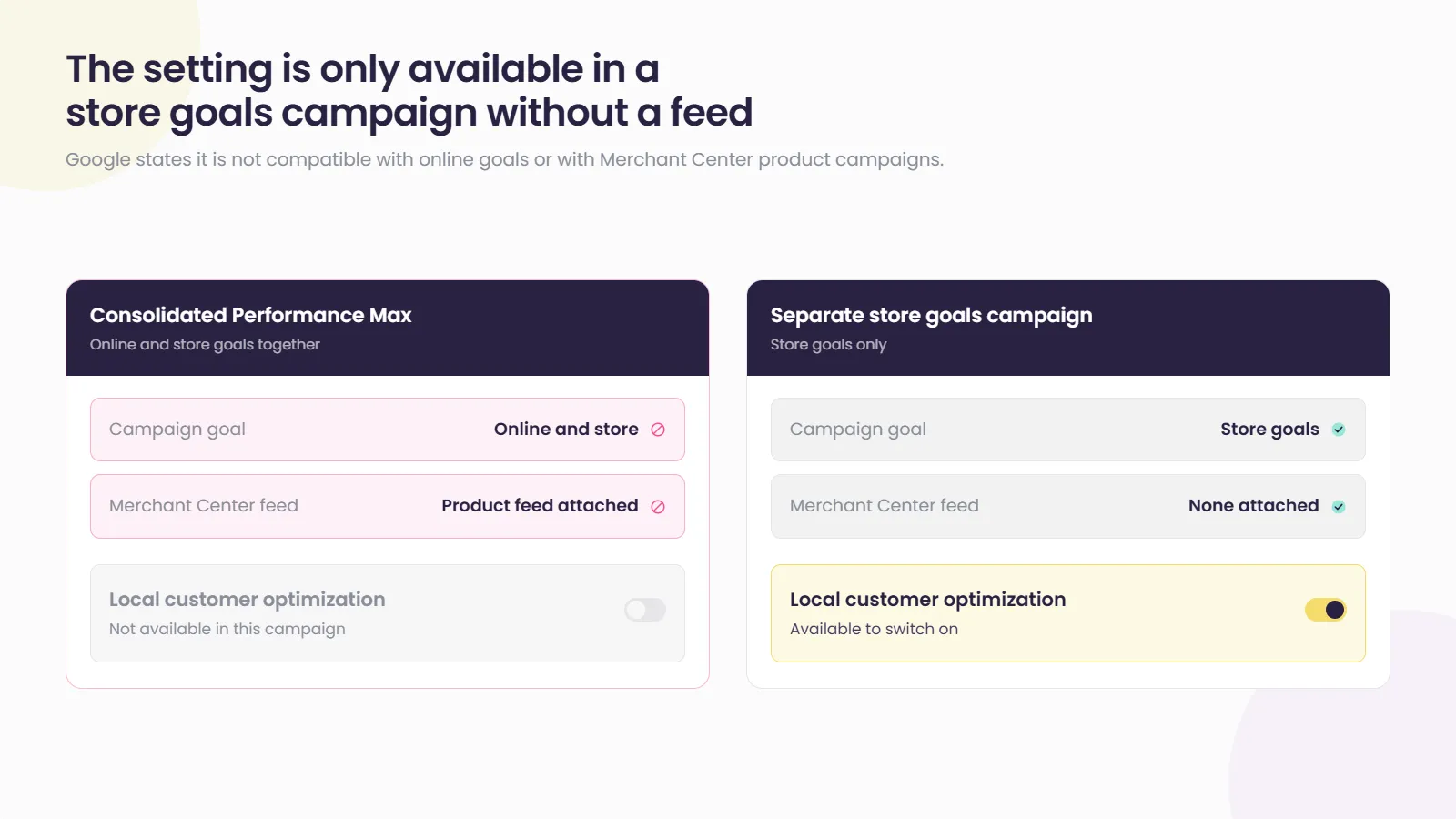
For a franchise or retail group that spent the last two years consolidating everything into a single Performance Max campaign, that is a structural split rather than a settings change. You need a separate store goals campaign in place before you can switch this on at all.
Plan that split now, while there is still time to let a new campaign gather signal, rather than in the week you actually need the traffic.
Your listings are now the targeting layer
Google’s own documentation says Performance Max campaigns for store goals use radius targeting for Business Profile and affiliate local asset locations, and that the radius varies by vertical, population density and the presence of competitors.
Read that again with a 200-branch estate in mind. The campaign is not targeting a map you drew. It is targeting the location records sitting in your Business Profile account. Which means:
- A permanently closed branch still in the account can pull budget toward a site nobody can visit.
- A duplicate profile splits signal between two records for one store.
- A pin dropped in the wrong place moves the radius away from your real catchment.
- Stale trading hours undercut a campaign whose entire premise is acting right now.
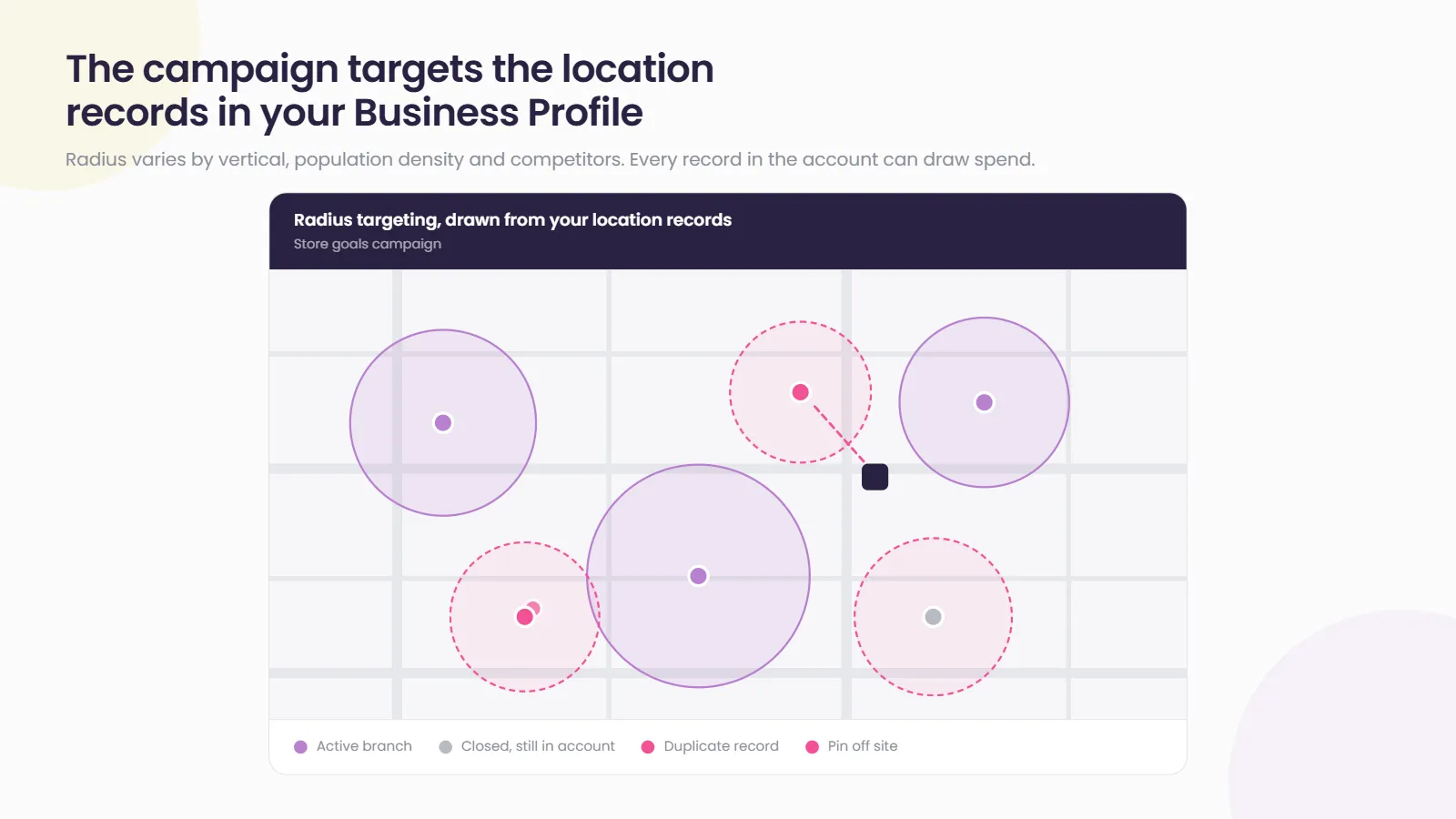
This was always a listings hygiene problem. It is now a media budget problem too. If your location set has never been cleaned at account level, the groundwork behind getting a full estate verified and consistent is the same groundwork this setting depends on.
The measurement half is gated, so check before you plan
The second feature connects a CRM or a Google Sheet inside Data Manager so that in-store sales data reaches the Google Ads account, instead of the heavier upload routes advertisers have used until now. Reporting at the time of the announcement placed the rollout in the weeks following, with no firm date from Google.
Access is not open to everyone. Google’s optimisation guidance for Performance Max for store goals says a store sales campaign must sit in an account that is already allowlisted for store sales improvements and eligible for store visits and store sales across all eligible channels. It also recommends a minimum of ten business locations for campaigns using store visits or store sales, and five for local actions.
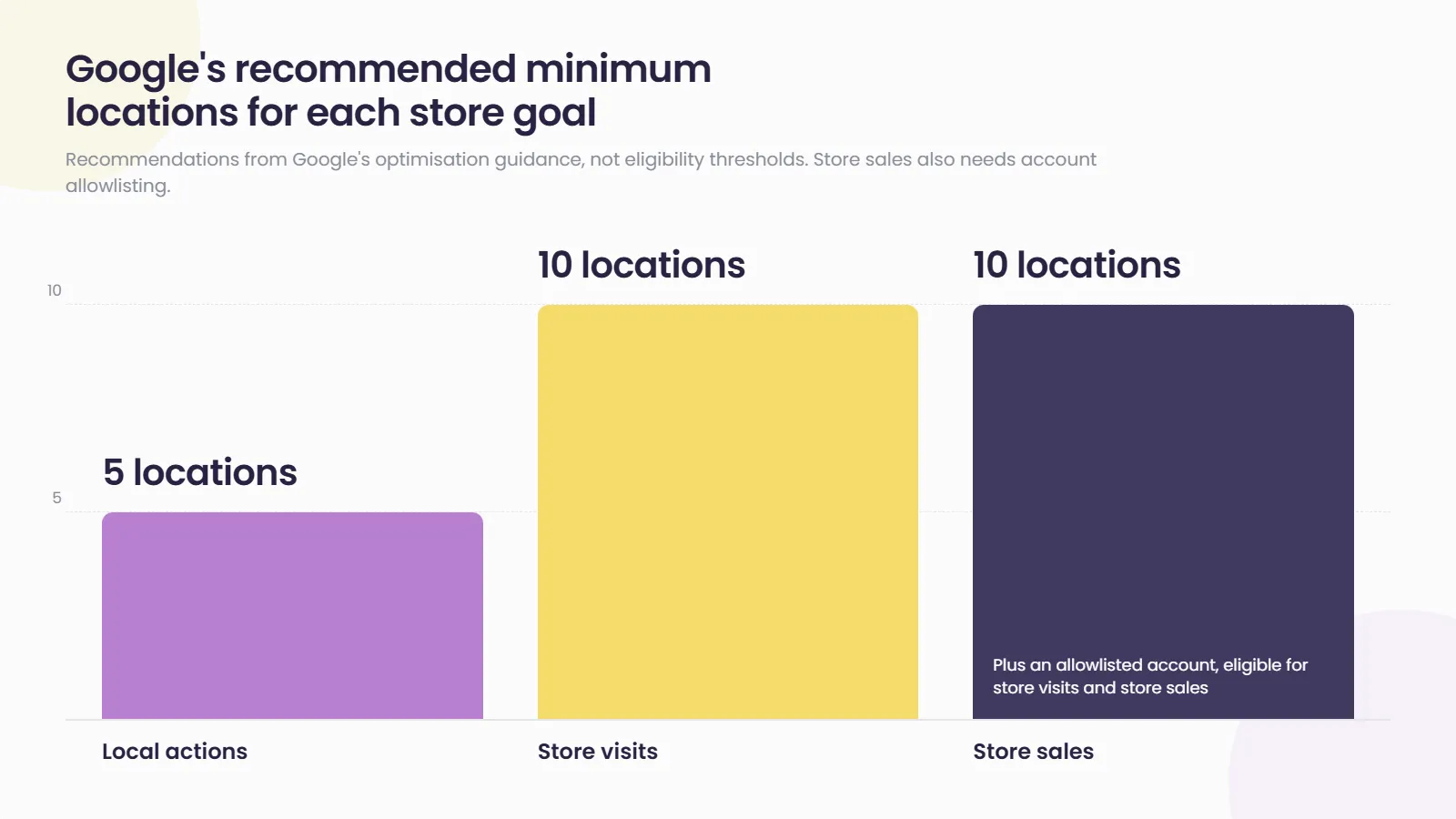
That is worth confirming before anyone builds a reporting promise around it.
What to do in the next fortnight
- Audit the location list feeding the ad account. Closed sites, duplicates, wrong pins, stale hours. Fix the records, not the campaign.
- Decide the campaign split. If your store goals sit inside a feed-driven Performance Max campaign today, that campaign cannot use this setting.
- Check store sales eligibility with your Google representative rather than assuming it.
- Set conversion values per goal so the bidding has something honest to optimise toward.
How Social Places helps multi-location brands get this right
When your ad targeting reads from your location records, the quality of those records stops being an operational detail and starts being a budget decision. Listings keeps the location record for every branch accurate and consistent from one place, so the list your campaigns draw on reflects the estate you actually trade from. If you want a second pair of eyes on your location data before the trading peak, get in touch.
Related reading
- Bulk verification for multi-location Google accounts covers how to get a full estate verified and consistent, which is the foundation this setting reads from.
- Google’s bilingual business name rejections covers what happens when a location record breaks policy across a whole fleet at once.
Frequently asked questions
Can I turn Local customer optimization on in my existing Performance Max campaign?
Only if that campaign is a store goals campaign and is not carrying products from a Merchant Center feed. Google states the feature is not compatible with online campaign goals or with Merchant Center product campaigns. Most consolidated setups will need a separate store goals campaign.
Does this replace location targeting?
No. It sits on top of how Performance Max for store goals already works. Google's documentation says those campaigns use radius targeting around your Business Profile and affiliate local asset locations, with the radius varying by factors including vertical and population density.
Why do my listings matter for a paid campaign?
Because the campaign draws its locations from your Business Profile account or your linked location assets. A closed, duplicated or mislocated record is a record your budget can still be spent against.
Is Store Sales in Data Manager available now?
Not universally. Google's guidance states that store sales campaigns require an account already allowlisted for store sales improvements and eligible for store visits and store sales. Confirm your eligibility before planning around it.