Google Now Rejects Bilingual Business Names. For Multi-Location Brands, That Is Not One Listing. It Is All of Them.
Somewhere in your location data there is a field called Business Name. If the convention in that field repeats your brand name in two scripts, Google now treats every row as a policy violation.
On 10 August 2026, Google added a new line to its business name guidelines. There was no announcement, no dashboard warning, and no email. Just a new entry in the list of things that are not allowed.
What Google actually changed
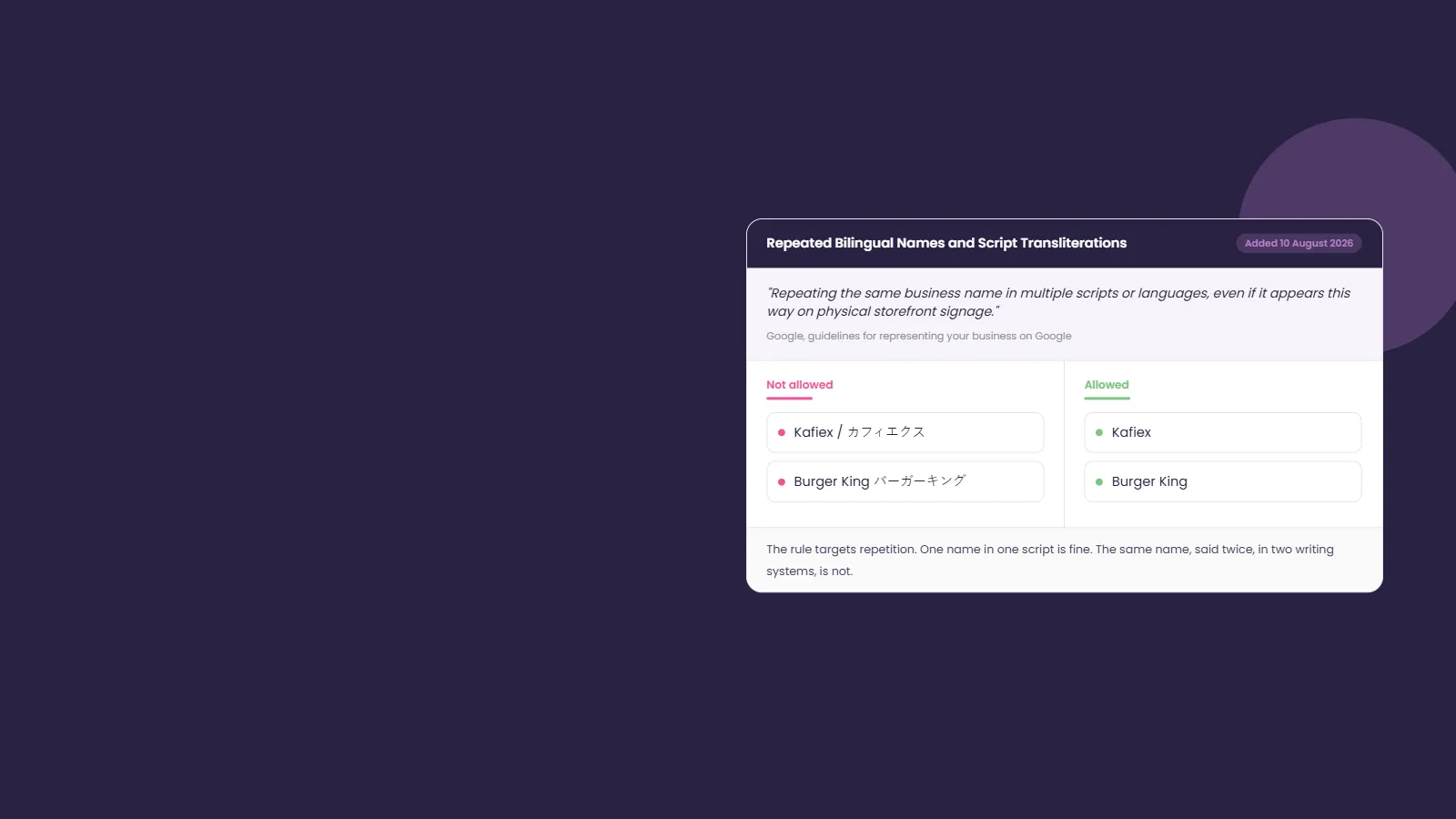
Google updated the name section of its guidelines for representing your business on Google. The new prohibited item is listed as “Repeated Bilingual Names / Script Transliterations”, and Google defines it like this:
“Repeating the same business name in multiple scripts or languages, even if it appears this way on physical storefront signage.”
The examples Google published make the rule concrete.
Not allowed: “Kafiex / カフィエクス” and “Burger King バーガーキング”.
Allowed: “Kafiex” and “Burger King”.
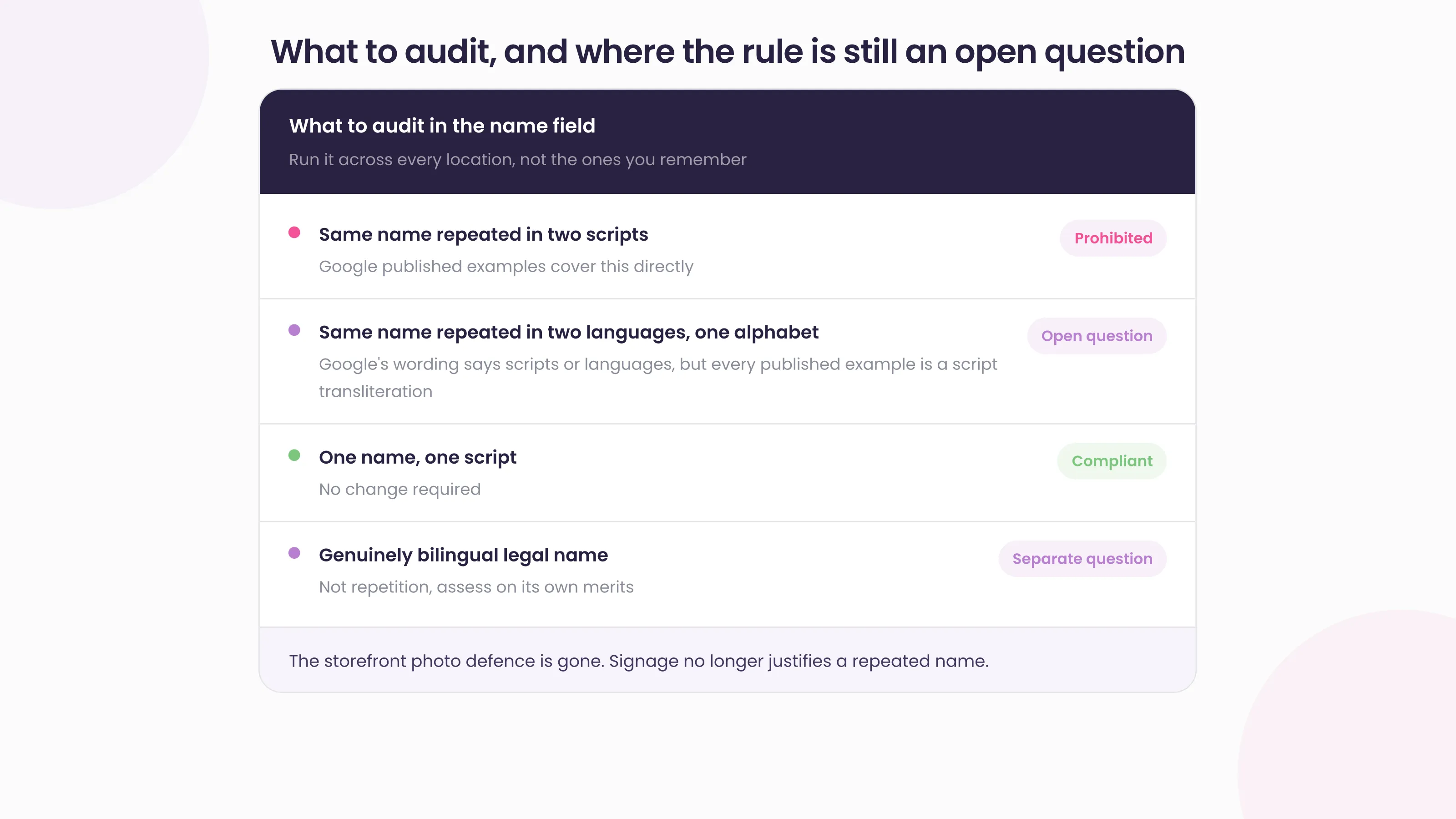
The rule is narrower than it first looks, and that matters. It targets repetition. One name in one script is fine. A genuinely bilingual legal name is a different question. What is now explicitly prohibited is the same name, said twice, in two writing systems.
The change was spotted on Google’s own support documentation by local search specialist Hiroko Imai and reported by Barry Schwartz on 10 August 2026.
Read Google’s business name guidelines
The storefront photo defence is gone
This is the part that changes how you operate, not just what you type.
For years, the way to defend a bilingual name in a reinstatement appeal was a photograph of the storefront. Google’s naming rules have always leaned on the principle that your profile should reflect your real-world name, and a picture of the sign was the evidence that ended the argument.
Google has now closed that door in writing. The rule includes the phrase “even if it appears this way on physical storefront signage”.
Read it as written. The sign is no longer evidence. It is the thing being overruled.
Imai’s own note on the change was blunt about the consequence: business name violations are a common trigger for profile suspensions. This is not a cosmetic guideline about tidiness. It sits in the part of the policy that gets profiles pulled.
Why this is a fleet-wide problem, not a listing problem
Here is the part that separates a multi-location brand from a single shop.
A single-location business with a bilingual sign has one field to fix. Someone notices, they edit it, it is done inside ten minutes.
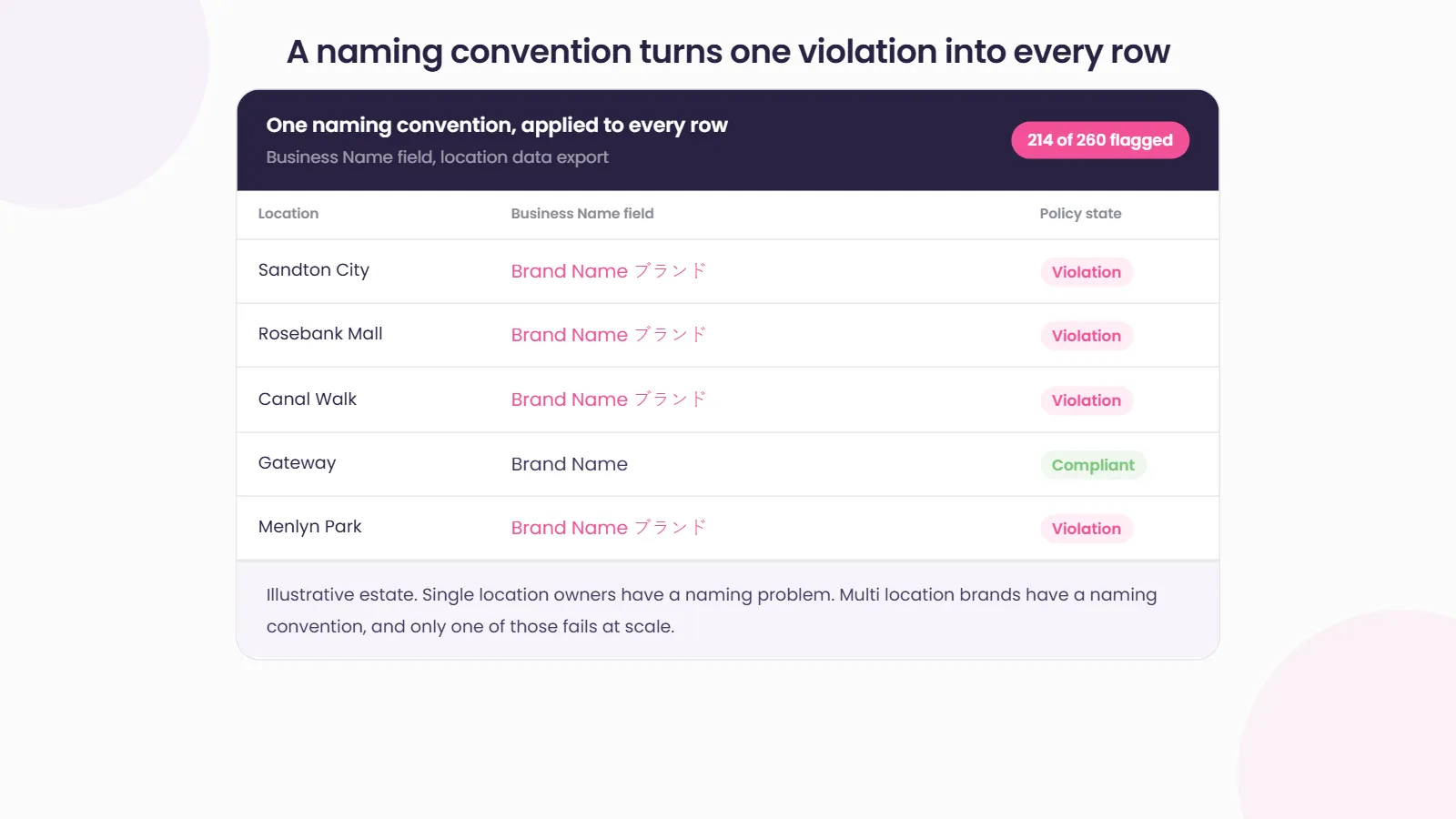
A multi-location brand does not have a field. It has a convention. That convention was decided once, written into a bulk upload template or an API payload, and applied identically to every location in the estate.
If the convention is non-compliant, the violation is not on one listing. It is on all of them, at the same time, and it looks intentional.
That changes the risk in three specific ways.
→ The exposure scales with the estate. A brand with 200 locations has 200 instances of the same violation, not one instance repeated for effect.
→ It reads as systematic rather than accidental. One odd listing looks like an owner mistake. Two hundred identical ones look like a deliberate naming policy, which is a harder position to argue from.
→ Remediation is a bulk operation with a verification step. Fixing it means re-issuing the name field across the estate and then confirming, per location, that the change actually landed. Pushing an update is not the same as the update propagating.
There is a fourth consequence most brands do not price in. A suspended profile does not simply disappear from Maps. It stops feeding the local data layer that AI assistants read when a customer asks for a recommendation nearby. The listing goes quiet in Search, in Maps, and in every answer engine drawing on that data underneath.
The grey area nobody has tested yet
We should be straight about the limits of what is known here, because the gap matters more in some markets than others.
Every example Google published is a script transliteration. Latin alphabet plus Japanese. That is a clean, obvious case.
But the wording of the rule is wider than the examples. It says “multiple scripts or languages”.
Languages, not only scripts.
On a plain reading, that would also cover a name repeated in two languages that share one alphabet. Afrikaans and English. French and English. Spanish and Portuguese. A profile named “Die Koffiehuis / The Coffee House” repeats the same name in two languages using a single script, and nothing in the published wording obviously excludes it.
We have not seen Google enforce against that case, and Google has not published an example of it. So treat this as an open question rather than a settled rule. What can be said with confidence is that the wording is broad enough to cover it, and the examples are not broad enough to confirm it.
If you operate in South Africa, across Africa, or anywhere with a genuinely multilingual customer base, that ambiguity is worth resolving on your own terms rather than waiting for an enforcement action to resolve it for you.
The audit to run this week
This is short, and it is not a strategy exercise. It is a data check.
- Export the name field for every location, on every platform. Every location, not a sample. Google first, then the rest, because the convention usually propagated everywhere.
- Flag any name containing a slash, a bracket, or two writing systems. Those three patterns catch the overwhelming majority of instances.
- Flag any name that says the same thing twice in two languages, even inside one alphabet. This is the untested grey area above. Decide your own risk position on it deliberately.
- Pick the primary script and remove the duplicate. Google’s own examples show exactly what the compliant version looks like: keep one, drop the other.
- Move the second language somewhere it is permitted. The business description, your local landing page copy, your on-page content. The name field is not the only place a customer sees their own language, and it is the one place that carries suspension risk.
- Verify propagation per location. Confirm that 200 profiles now read correctly. Do not confirm that one bulk job returned a success message.
One thing not to do. Do not add a descriptor to compensate. If you strip the second script and then bolt a city name or a service keyword onto the name field to recover the lost visibility, you have swapped one name violation for another. The descriptor rules did not change.
And once the name is corrected, holding it is a separate job. A customer, a competitor, or a well-meaning franchisee can still submit a suggested edit that restores the old bilingual version, and Google often accepts user-suggested edits without telling the owner. Correcting the name is the first move. Keeping it corrected is the ongoing one.
How Social Places helps
A naming convention is not a branding decision. It is a compliance surface that repeats itself across every location you own, which means it needs to be governed centrally rather than fixed store by store.
Social Places Listings manages the location record for every branch from one place, so a name-field audit runs across the whole estate at once rather than profile by profile. Bulk updates push the corrected convention out, per-field sync monitoring confirms it actually landed on each location, and LocTech detects and reverses unauthorised user-suggested edits on Google and Facebook, which is what stops a corrected name quietly reverting a month later.
If you are not certain what your name field currently says across every location, that is the first thing worth finding out. Contact Us
Related reading
One restricted Google account can suspend every location you manage covers what happens when a compliance problem escalates to account level.
Someone is trying to claim your client’s listing covers the other route by which listing data changes without you.
Frequently asked questions
Does this mean I have to remove my second language from Google entirely?
No. The rule applies to the business name field specifically, and only to repeating the same name twice. Your second language can still appear in the business description, in your local landing page content, and in your posts. Google is restricting where the translation sits, not whether you can serve multilingual customers.
My storefront sign genuinely is bilingual. Does that not count anymore?
Not for this rule. Google's wording explicitly says the repetition is not allowed "even if it appears this way on physical storefront signage". Historically a photo of the sign was the standard evidence in a naming appeal, and for this particular violation Google has now ruled that evidence out in advance.
Does this apply to names that use two languages in the same alphabet, such as Afrikaans and English?
This is genuinely unclear. Google's wording covers "multiple scripts or languages", which on a plain reading would include it, but every example Google published is a script transliteration rather than a same-alphabet translation. We have not seen enforcement against the same-script case. Brands in multilingual markets should decide their own risk position rather than assume either answer.
What happens if a profile is suspended for a name violation?
A suspended profile is removed from Google Search and Maps until it is reinstated, which also cuts off the location data that AI assistants and other downstream services read. Reinstatement requires correcting the violation first and then appealing. Google does not publish appeal turnaround times, and reported experiences vary widely, so the reliable protection is fixing the name before enforcement rather than after.