TikTok's Local Feed Isn't in South Africa Yet. That's the Head Start.
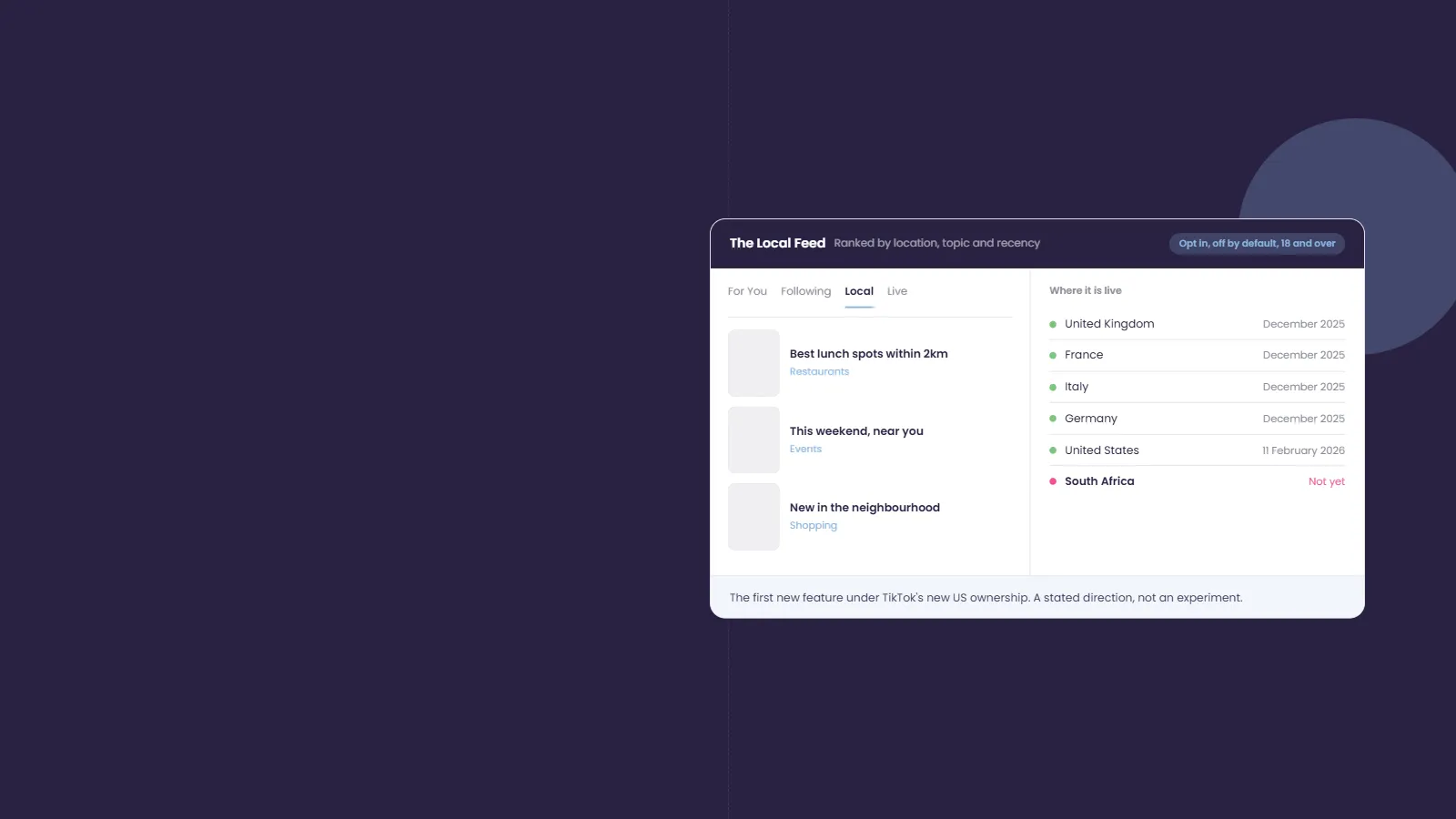
In February, TikTok gave American users a dedicated tab for finding restaurants, events and shops near them. South African users still do not have it. That gap is not protection. It is a head start, and most brands are going to waste it.
The reason to say that now is that the waiting part is over. TikTok is a connected platform across Social Places as of this month, so posting, comments and chats run from the same dashboard as your other channels. The head start stopped being something to plan for and became something you can start publishing against today, here and in the markets where the feed is already live.
What TikTok Actually Shipped
On 11 February 2026, TikTok launched a Local Feed in the US. It is a new tab on the home screen showing content on travel, events, restaurants and shopping, alongside posts from small businesses and local creators. Posts are ranked by location, by topic, and by how recently they were posted.
Two details matter more than the headline. It is opt-in, off by default, and limited to users 18 and over. And it was the first new feature released under TikTok’s new US ownership structure, which tells you this is a stated direction rather than an experiment.
It had already been running in the UK, France, Italy and Germany since December 2025. You can read TechCrunch’s coverage of the launch here.
The Feed Is the Least Interesting Part
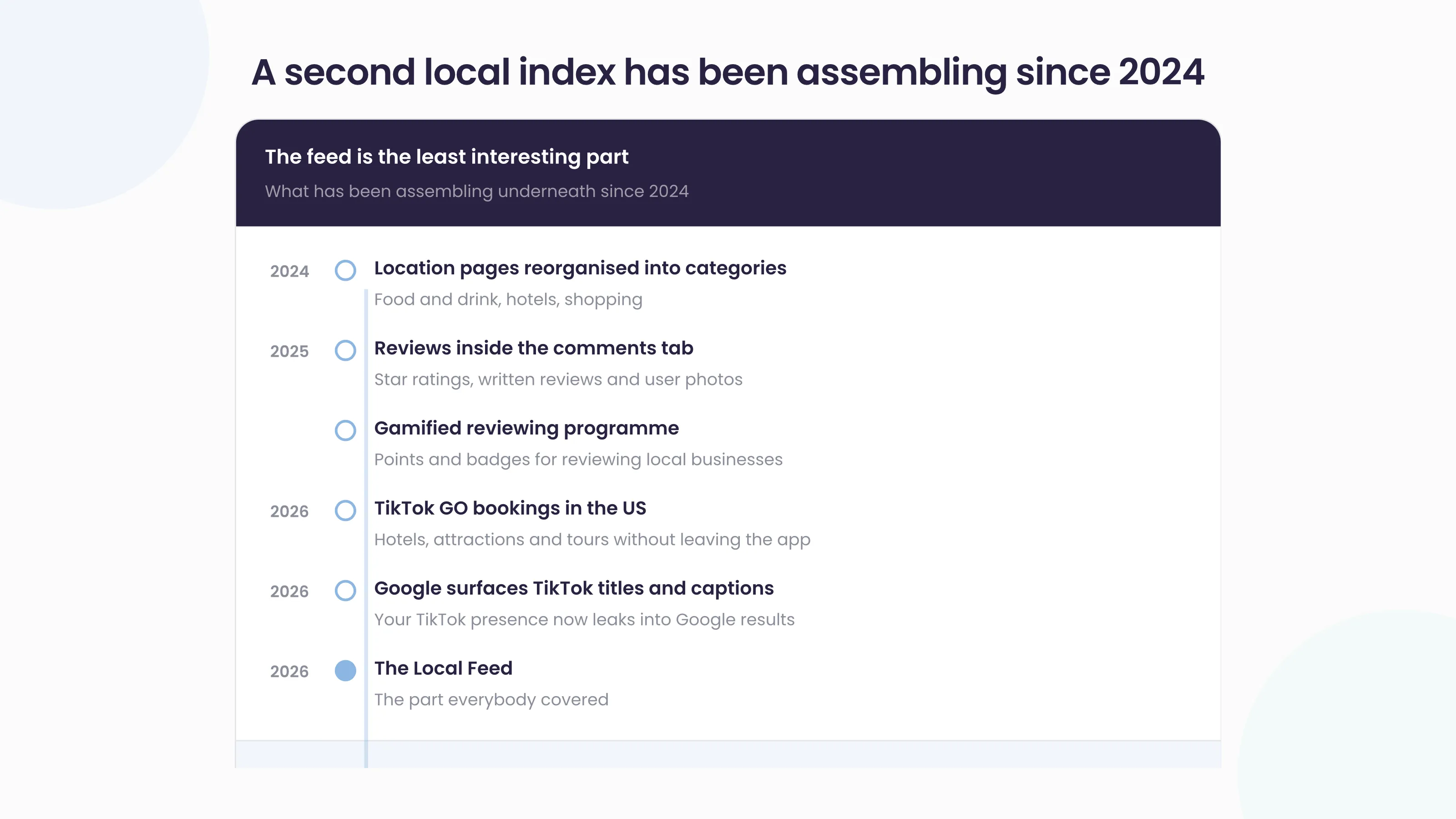
Everyone covered the feed. Almost nobody covered what sits underneath it, which has been assembling since 2024.
- Location pages were reorganised into categories like food and drink, hotels, and shopping
- Reviews appeared inside the comments tab of location-tagged videos, with star ratings, written reviews and user photos
- TikTok’s “Local Explorer” programme launched, a gamified reviewing initiative awarding XP and perks for reviewing local businesses, similar in spirit to Google’s Local Guides
- TikTok GO launched in the US, letting users book hotels, attractions and tours without leaving the app, built directly into video, search and location pages
- Google began surfacing TikTok video titles and captions inside its own search results
Put those together and you are not looking at a social feature. You are looking at a second local index: a parallel place where your locations are described, rated, ranked and now booked, assembled largely without your input.
Why South Africa Is Not on the List, and Why That Changes Nothing
The Local Feed has not launched in South Africa, and TikTok has announced no date.
Our own survey data still shows 97.69% of South African users treating Google as their primary search method. Google is not under threat here in the near term, and anyone telling you otherwise is selling something.
But watch what happens in a market once the feed actually lands. TikTok’s own case for launching in the UK in December cited Oxford Economics data showing 46% of UK TikTok users had already visited a local shop, restaurant or attraction discovered on the platform. That is the existing behaviour the feed is built to capture and accelerate, not a new outcome produced in the two quarters it has been live, but a platform willing to put that number behind a dedicated local product is a platform serious about winning local discovery.
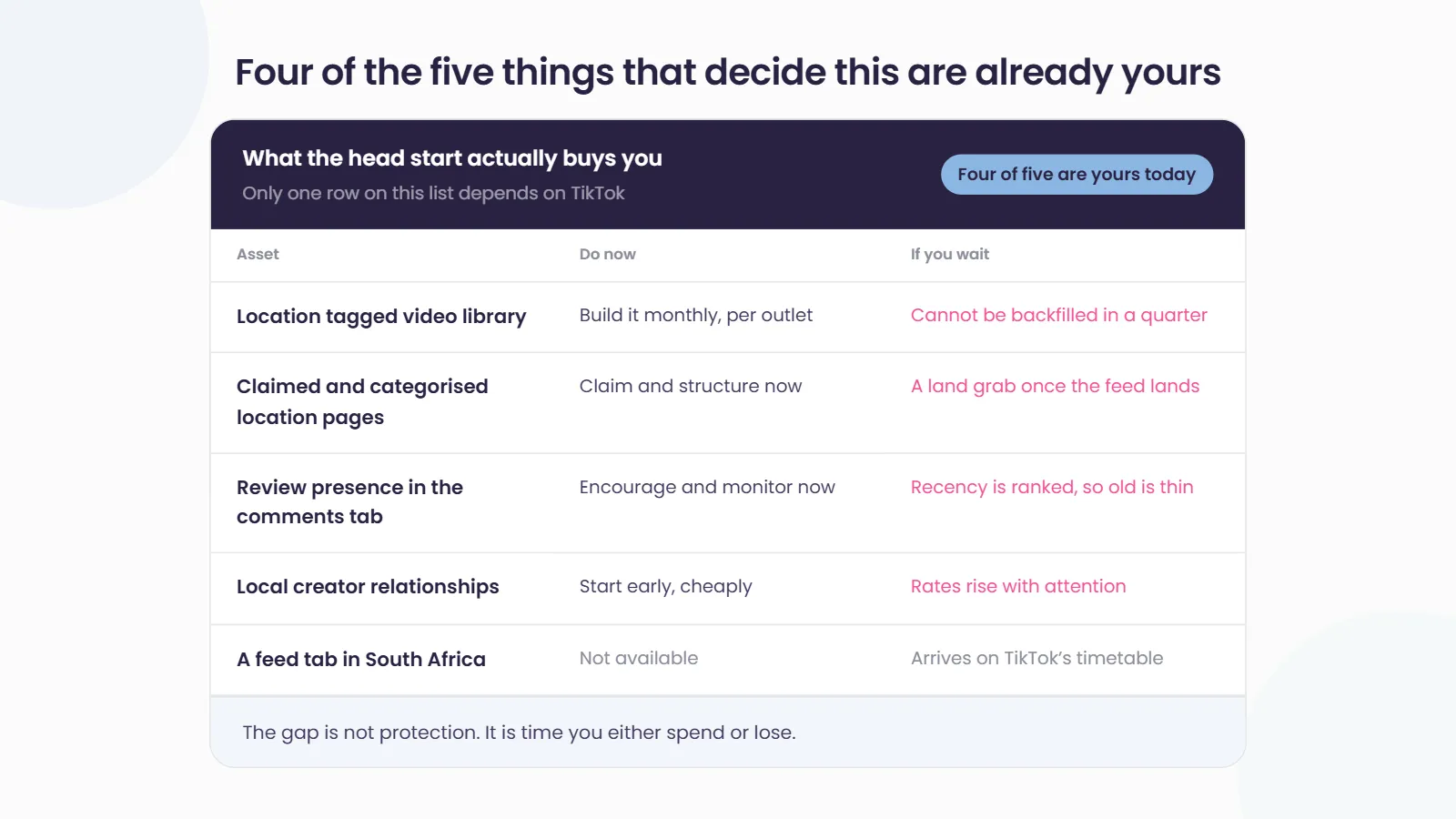
So the honest position is this. You have somewhere between twelve and twenty-four months. You cannot know which. And the preparation is worth doing whether or not the feed ever arrives, because every item on the list below pays for itself on Google alone.
What Actually Transfers
Four things carry over, and none of them require the feed to exist.
- Location-tagged content is the asset, not follower count. Posts are ranked partly on recency, which means the asset decays. This is a publishing cadence problem, not a campaign, and it is now a scheduling job rather than a phone job: TikTok video and image posts go through the Content Workflow with the same approval steps as every other channel.
- Your location data has to be right first. Every one of these surfaces gets built on top of whatever is already published about your stores. Wrong address, wrong hours, duplicate entries: the new index inherits your existing mess and repeats it at scale. Fixing your listings is cheaper now than after it propagates.
- Own the page you control. Feeds are rented. Your store locator and local pages are yours, they are indexable, and they are the only local surface where you still set the rules.
- Start watching TikTok now. You cannot manage what you cannot see, and the conversation about your stores is already happening there, feed or no feed.
The Part Nobody Wants to Say Out Loud
You do not control the review layer. Neither does anybody else.
TikTok reviews live inside TikTok. They do not syndicate to your Google rating. TikTok does not expose them to connected tools, so they are not aggregated into review management dashboards, ours included. There is no mature removal process, no established response workflow, and no service level anyone can hold a platform to.
The comments under a location-tagged video are functionally an unmoderated Q&A about your store. Running at scale. Visible to exactly the customers you are trying to win. Answered by strangers. Connecting your own TikTok account brings the comments and chats on your own posts into a managed inbox, which is worth doing, but it does not reach the conversation happening under somebody else’s video about your store.
That is a real and current gap for every multi-location brand. Anyone claiming to have solved it has not.
You Can Start Publishing on TikTok Now
Here is what you can actually do today, with what exists today.
TikTok is now a connected platform across Social Places. Schedule TikTok video and image posts through the Content Workflow with the same approval steps as every other channel, and handle TikTok comments and chats in the Reputation inbox alongside every other conversation channel.
That matters in both directions. In South Africa, where the feed has not arrived, it is how you build a location-tagged library at a cadence you can sustain for two years rather than one quarter. In the markets where the feed is already live, the UK, France, Italy, Germany and the US, it is the same connection running the channel your customers are already using to decide where to go. One dashboard, both situations, no separate workflow for the market that moved first.
Around that, Brand Listening monitors TikTok, so you can see what is being said about your locations before there is a feed pointing customers at it. Local Ads runs TikTok paid campaigns. Listings keeps your location data consistent across 50+ platforms, which matters more with every new surface built on top of it. And your Store Locator stays the one local page you fully own.
Two things we will not oversell. TikTok connects one account per brand rather than one per location, the same model as LinkedIn, so a brand whose outlets each run their own TikTok profile needs to decide how to structure that first. And TikTok’s in-app review layer is not covered by our reputation management, because TikTok does not make it available to connected tools. We would rather tell you that now than have you find out later.
If you want a clear view of how exposed your locations are across the surfaces that already exist, Contact Us
Related reading
The second search box covers how social search already works as a local discovery channel alongside Google.
Reddit is now inside Google’s AI results covers how community content becomes a discovery signal.
Frequently asked questions
Is TikTok's Local Feed available in South Africa?
No. It launched in the US on 11 February 2026 and has been running in the UK, France, Italy and Germany since December 2025. TikTok has announced no South African rollout date. Treat the current gap as preparation time rather than an exemption.
Do TikTok reviews affect our Google star rating?
No. They are entirely separate systems, and a TikTok review will not move your Google rating in either direction. The risk is a different one: a customer can form a firm opinion about your store inside TikTok and never reach your Google profile at all.
Should we post location-tagged TikTok content before the feed launches here?
Yes, with one caveat. Posts are ranked partly on recency, so old content will not sit there earning value indefinitely. Treat it as an ongoing cadence you can genuinely sustain, not a once-off content push you can bank.
Can Social Places manage TikTok for us?
Mostly, and the honest answer has three parts. TikTok is now a connected platform across Listings, Social and Reputation, so posting, comments and chats run from the same dashboard as your other channels. We monitor TikTok through Brand Listening and we run TikTok ads. What we do not cover is TikTok reporting, which is not part of this release, TikTok's in-app review layer, which the platform does not expose to connected tools, and comments left on other people's location-tagged videos rather than on your own posts.