The Second Search Box: Why Multi-Location Brands Can't Ignore Social Search in 2026

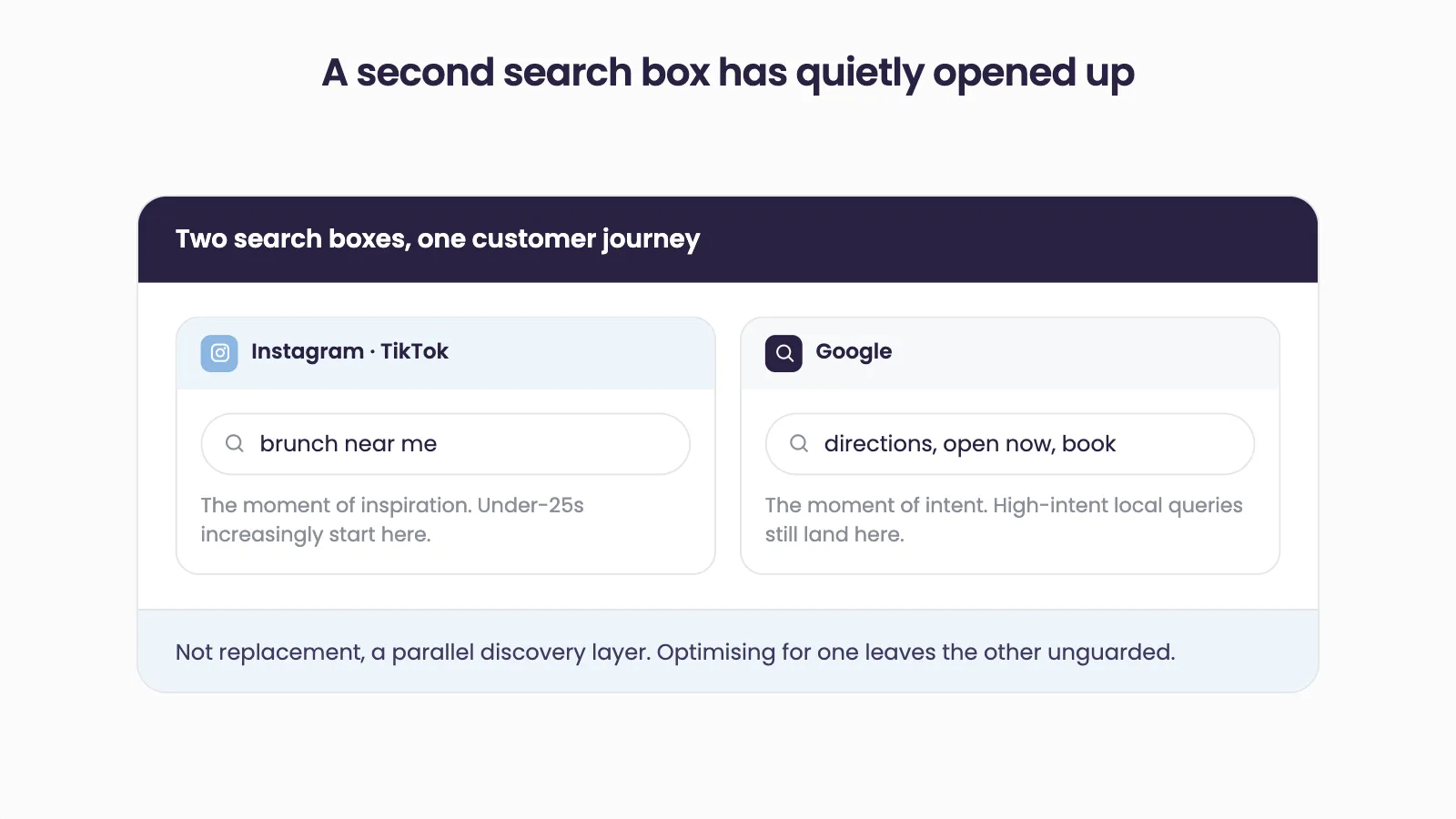
Picture a 22-year-old deciding where to eat tonight. She does not open Google Maps. She opens Instagram, taps the search bar, and types “brunch near me.” Then she flicks to TikTok to see a video of the actual plates. Only later, maybe, does she Google the address to get directions.
For multi-location brands that have spent years perfecting their Google Business Profiles, this is an uncomfortable shift. A second search box has quietly opened up, and most location-based businesses are not showing up in it.
Social search is real, but it is not replacing Google
The headline you have probably seen is some version of “social media is killing Google.” The reality is more useful and more nuanced than that.
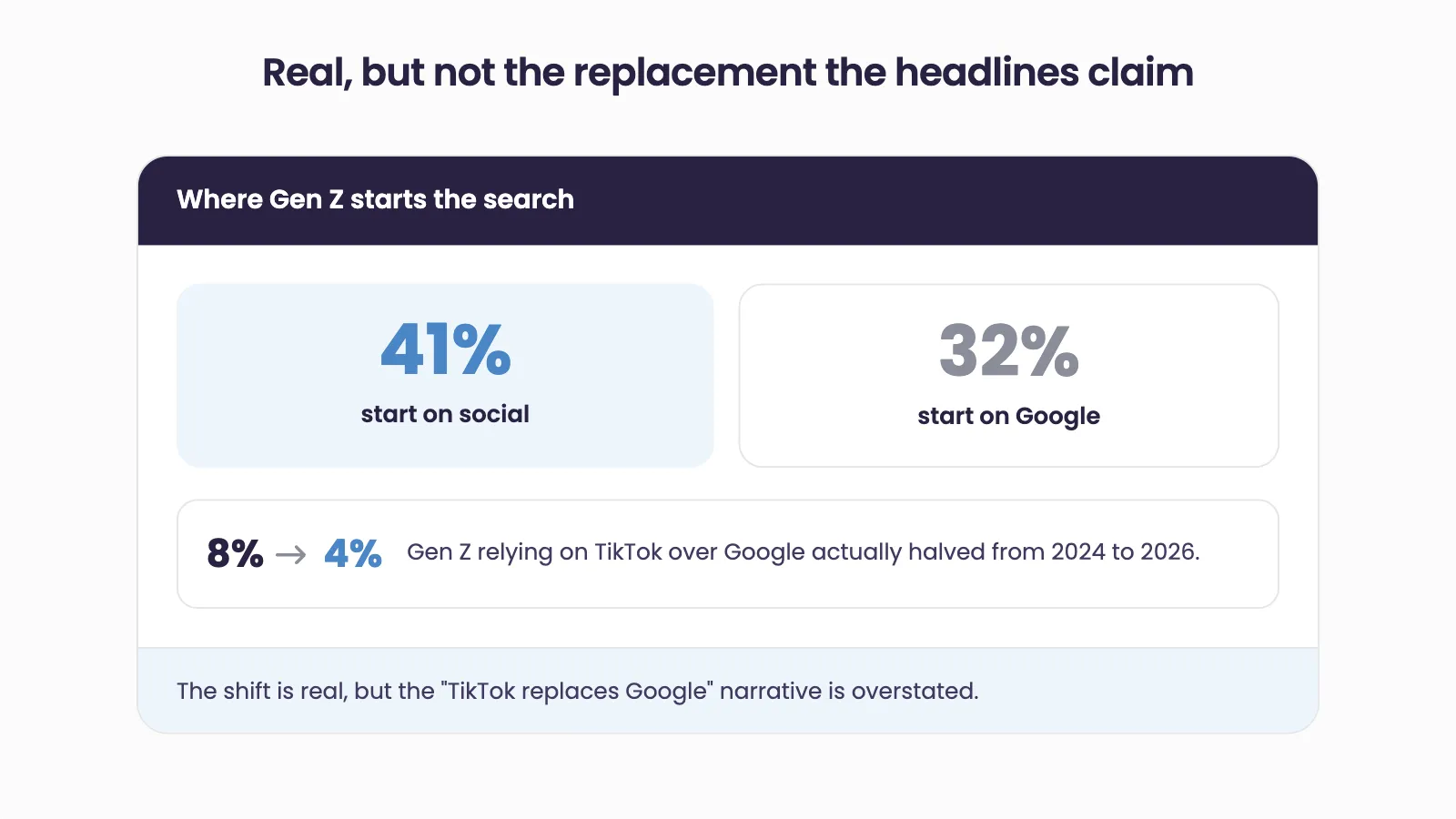
Recent survey research suggests a meaningful share of Gen Z now reach for social platforms first when they want information, with social media overtaking traditional search engines as the starting point for that age group. Around 41% of Gen Z turn to social first, against 32% who start with Google or a traditional search engine. For local discovery specifically, roughly a third of consumers say they would rather use social media first to find a restaurant or something to do.
But the “TikTok replaces Google” narrative is overstated. The share of Gen Z who say they are more likely to rely on TikTok than Google actually fell between 2024 and 2026, from 8% to 4%, roughly halving. And high-intent local queries, the “open now,” “directions,” and “book a table” moments, still land overwhelmingly on Google.
So the honest takeaway is not replacement. It is a parallel discovery layer. Google still wins the moment of intent. Social increasingly wins the moment of inspiration, especially for under-25s. Brands that only optimise for one are leaving the other unguarded.
Why this hits multi-location brands hardest
For a single-location business, social search is reasonably simple. One account, one suburb, one story.
For a brand with 50, 100 or 500 locations, it gets messy fast. A single corporate Instagram account cannot answer “is there one near me” the way a location-level Google Business Profile does. National brand content, built for awareness, rarely performs at the local level, because the in-app algorithms weight geographic relevance and local engagement, not just reach.
Three problems show up again and again:
- No local presence to find. Customers searching social for a specific suburb hit a national page that does not feel local, or nothing at all.
- Inconsistent profiles. Branch accounts get set up ad hoc by different managers, with different naming, no location tags, and no shared standard.
- Authenticity gap. The content that actually ranks and converts inside these apps is local and real. Polished national assets do not replicate that.
What “social search optimisation” actually means
Optimising for the search box inside Instagram and TikTok is closer to early SEO than to traditional social posting. The apps now read your content to decide what to surface.
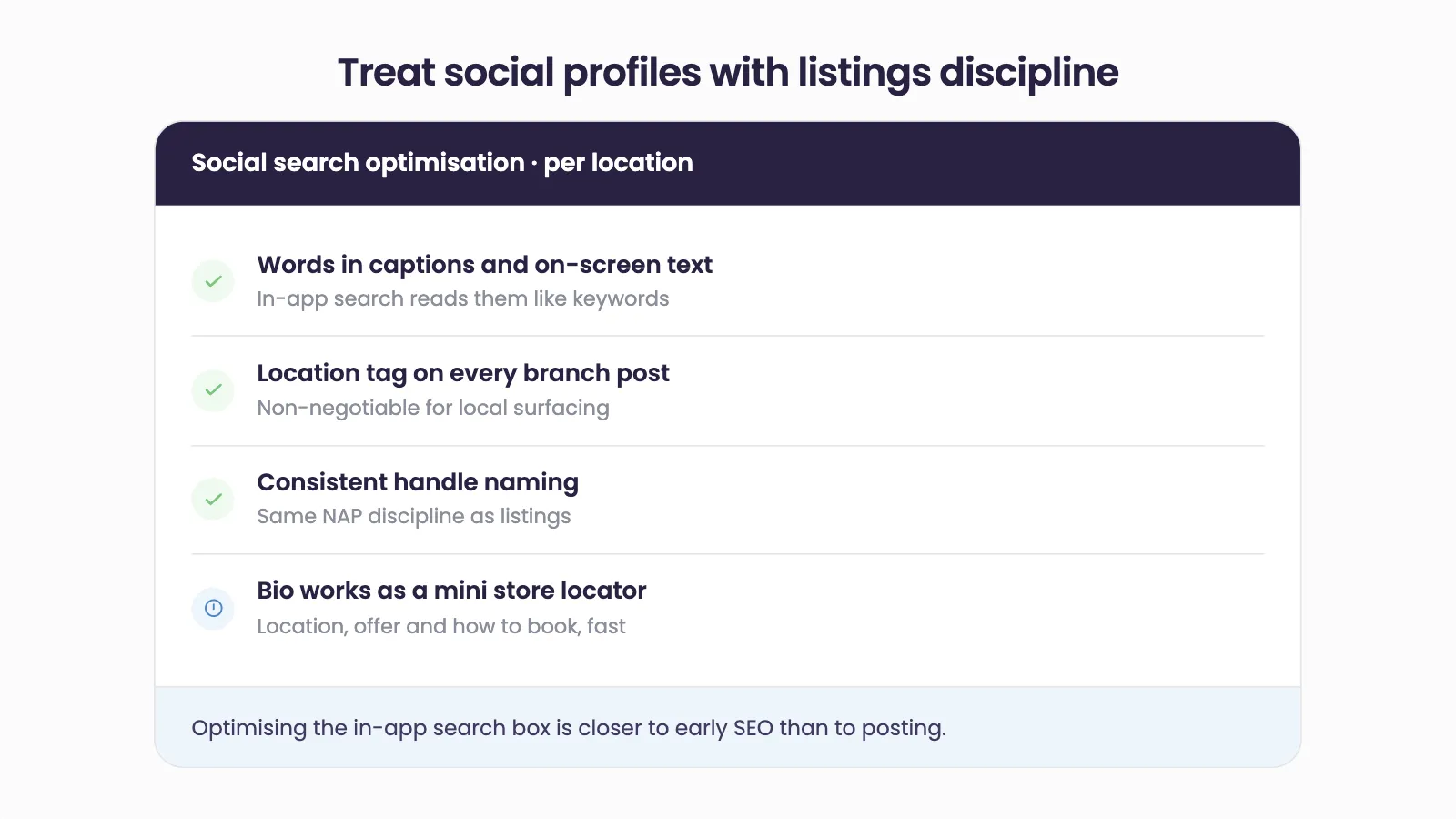
- Words matter again. Captions, on-screen text, spoken words in video, and hashtags are all signals the in-app search uses.
- Location tagging is non-negotiable. Every post from every branch should carry the correct location tag.
- Consistent naming across branches. Treat social handles with the same NAP discipline you apply to listings.
- The bio is a mini store locator. Make location, offer, and how to book or visit obvious in seconds.
Your listings and your social presence are now one system
None of this is an argument to abandon Google. The opposite, in fact. Local intent still mostly converts on Google, and the AI answers now appearing across search pull heavily from your structured listing data. Listings remain the foundation.
What has changed is that the discipline you already apply to listings, accuracy, consistency, and coverage across every location, now has to extend to social profiles too. They are one discoverability system, measured by a simple question: when someone looks for what you sell in a specific place, do you show up?
That also means listening matters. Knowing what customers are saying about each location across social platforms, not just on review sites, is now part of protecting local visibility and reputation.
How Social Places helps multi-location brands win the second search box
Social Places exists to make multi-location brands findable, consistent, and trusted in every place a customer might look. That now spans both search boxes. Our Social tools help brands manage and localise content across every location, while Listings keeps the underlying location data accurate everywhere it feeds discovery and AI answers. Store Locator and Local Pages give every branch a genuine local home, and Brand Listening keeps you aware of what is being said about each location across the social web.
If a growing share of your customers are searching somewhere your locations are not visible, that is a gap worth closing now. Contact Us.
Frequently asked questions
Is social media really replacing Google for local search?
No, not for high-intent searches. Google still dominates the "directions," "open now," and "book a table" moments. What is changing is the discovery and inspiration stage, where a growing share of under-25s start on Instagram or TikTok before they ever reach Google. The smart approach is to be visible in both, not to pick one.
What is social search optimisation?
It is the practice of making your content easy to find inside the search functions of social platforms like Instagram and TikTok. It relies on the words in your captions, on-screen text, hashtags, and location tags, much like traditional SEO relies on keywords.
Why is social search harder for multi-location brands?
A single national account cannot answer a local "near me" search the way a location-level profile can. In-app algorithms reward geographic relevance and local engagement, so national content often underperforms locally. Brands also struggle with inconsistent branch accounts and a shortage of authentic, location-specific content.
Should we stop investing in Google Business Profiles?
No. Listings remain the foundation of local discovery and increasingly feed the AI answers appearing across search. Social search is an additional layer, not a replacement.