Franchise AI Search Visibility
Your brand appears in Google’s local 3-pack 35.9% of the time. Ask ChatGPT to recommend a location near you, and the odds of your business being named drop to 1.2%. That is not a typo. Here we are looking at how to best optimize for franchise AI search visibility.
According to SOCi’s 2026 Local Visibility Index, which analysed more than 350,000 locations across 2,751 multi-location brands, the gap between traditional local search visibility and AI-generated recommendations is not a gap. It is a cliff and most franchise brands do not know they have already fallen off it.
The Numbers That Should Change How You Think About Local Search
The 2026 SOCi Local Visibility Index is the most comprehensive study of AI recommendation behaviour for multi-location brands ever published. Its headline finding: AI assistants are up to 30 times more selective than Google’s local search results.
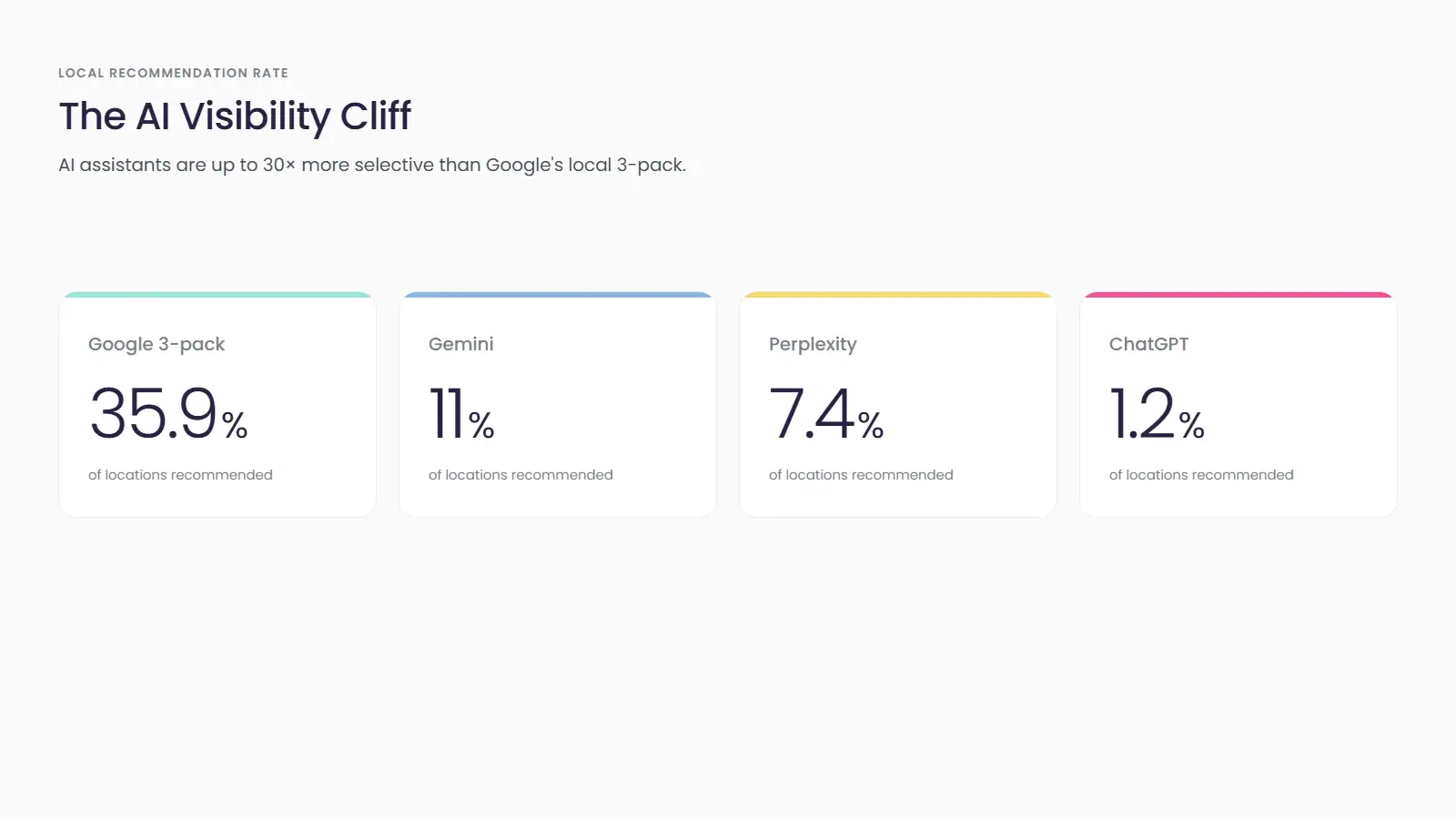
- ChatGPT recommended only 1.2% of locations analysed
- Perplexity surfaced 7.4% of locations
- Gemini recommended 11% of locations
- Meanwhile, Google’s local 3-pack returned results for 35.9% of the same brands
Even more striking: in retail, only 45% of brands leading in traditional local search also appeared in AI recommendations. That means more than half the brands winning on Google Maps today are completely invisible to the growing share of consumers using AI to decide where to eat, shop, or book a service.
This is what we are calling The AI Visibility Gap, and it is widening every month as AI search adoption accelerates. 45% of consumers now use AI for local service discovery up from under 6% just two years ago.
Why AI Is So Much More Selective Than Google
Google’s local results operate on a broad match model. Show up often enough, maintain a decent profile, and you will likely appear somewhere. AI assistants work on a confidence model. They only recommend a location they are highly certain about. Uncertainty means omission, not a lower ranking.
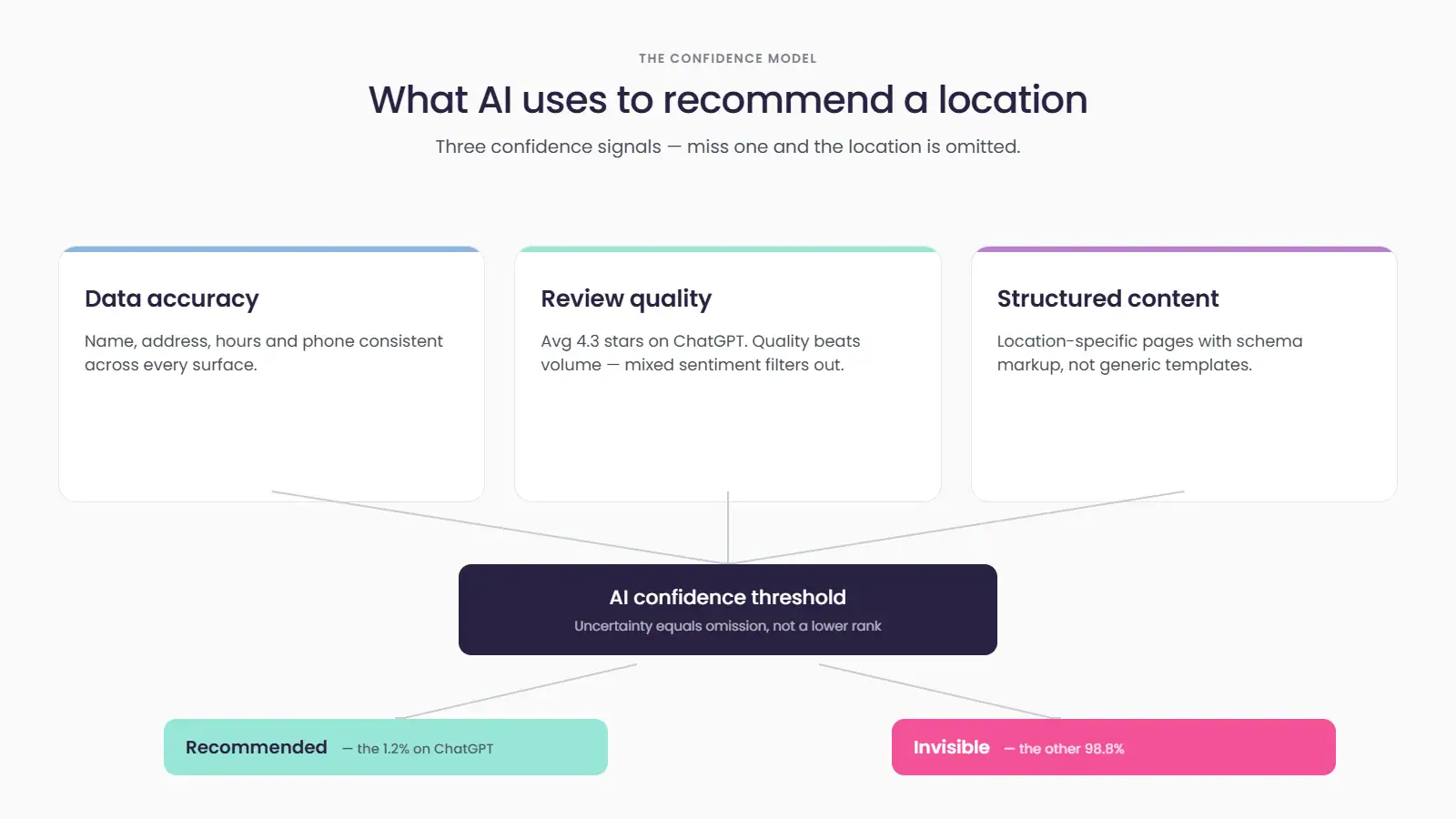
That confidence is built from three overlapping signals:
1. Data accuracy across every surface. SOCi’s research found that business profile information was only 68% accurate on ChatGPT and Perplexity, compared to 100% accuracy on Gemini, which is grounded in Google Maps in real time. A mismatched phone number, a stale address, or an incorrect trading hour does not just hurt your traditional listing. It signals to the AI model that your data cannot be trusted and it moves on.
2. Review quality, not just volume. Locations recommended by ChatGPT averaged 4.3 stars. The pattern is consistent across AI platforms: mixed sentiment filters you out. A franchise location with 150 reviews averaging 3.8 stars is statistically less likely to be surfaced than one with 40 reviews averaging 4.5 stars. AI systems are optimising for user satisfaction, not breadth.
3. Structured, location-specific content. AI models need to understand what your location does, for whom, and where. Generic templated location pages with swapped city names do not give AI systems enough signal to confidently recommend that specific location. Depth and specificity at the individual location level matters more than it ever has.
The Gemini Exception and What It Tells Us
Gemini’s 11% recommendation rate is nine times higher than ChatGPT’s 1.2%, and the reason is instructive: Gemini pulls directly from Google Maps data in real time. A brand that has invested in accurate, complete Google Business Profiles has a structural advantage in Gemini that simply does not exist on ChatGPT or Perplexity.
Liberty Tax is a useful case study. After improving profile coverage, ratings, and data accuracy across its locations, it achieved 19.2% visibility on Gemini and 26.9% on Perplexity dramatically above the baseline for most franchise brands. These numbers show what disciplined data hygiene can unlock.
For multi-location brands, this is the clearest near-term win available: if your Google Business Profiles are inaccurate, incomplete, or inconsistent across locations, you are invisible to Gemini by definition. Fix the data, and Gemini visibility follows directly.
The Schema Layer Most Brands Are Missing
One of the least discussed contributors to AI visibility is structured data. AI systems that crawl the open web use JSON-LD schema to understand the relationship between a brand, its locations, its services, and its reviews. Most multi-location brands have some implementation of LocalBusiness schema. Very few have it implemented at the individual location page level with the depth AI systems need.
Schema types that directly improve AI discoverability for multi-location brands include:
- LocalBusiness (or the relevant subtype like Restaurant, AutoDealer, Medical Business, etc.) with name, address, telephone, opening hours specification, geo, and has Map at every location URL
- FAQPage schema on location pages, answering common service and location-specific questions
- AggregateRating schema pulling live review data so AI crawlers can verify trust signals without relying solely on third-party sources
- BreadcrumbList schema clarifying the site hierarchy from brand to region to individual location
- Service schema explicitly listing what each location offers, especially where offerings vary by location
These are not theoretical improvements. They are the structured signals AI systems use to build confidence that a location is what it claims, where it claims, and open when it says it is.
Schema Recommendations for Dev Team
Add the following JSON-LD to every individual location page:

Also add FAQPage schema to location pages and BreadcrumbList schema site-wide for hierarchy clarity.
How Social Places Helps You Close the AI Visibility Gap
The three signals AI uses to recommend locations – data accuracy, review quality, and structured content depth, are exactly what Social Places manages at scale. The Listings Suite ensures your location data is accurate and consistent across every platform AI assistants index, including Google Maps, which underpins Gemini’s real-time recommendations. The Reputation Suite helps you build the review volume and quality needed to clear the AI confidence threshold. And Local Pages give each location a structured, content-rich web presence that AI crawlers can actually use.
AI visibility is not a new product category. It is the natural outcome of doing local presence management properly, at every location, without exception. Contact Us
FAQ Franchise AI Search Visibility
Why are my franchise locations not showing up in ChatGPT recommendations?
ChatGPT only recommends locations it has high confidence in, based on data accuracy, review quality, and structured content. If your business profile data is inconsistent across directories, your reviews are mixed, or your location pages are generic templates, ChatGPT is unlikely to surface your locations. SOCi’s 2026 research found that only 1.2% of franchise locations appear in ChatGPT recommendations
Is Google Gemini easier to appear in than ChatGPT for local businesses?
Yes, significantly. Gemini pulls from Google Maps data in real time, which means accurate and complete Google Business Profiles directly improve your Gemini visibility. Gemini recommended 11% of locations in SOCi’s 2026 study, compared to ChatGPT’s 1.2%. Prioritising Google Business Profile accuracy is the highest-return action for Gemini visibility specifically.
What star rating do I need to be recommended by AI search tools?
Locations recommended by ChatGPT in SOCi’s 2026 study averaged 4.3 stars. This does not mean you need a perfect rating, but locations below 4.0 face a meaningful disadvantage. Consistent review management, responding to feedback and actively generating new reviews, is essential for crossing the AI confidence threshold.
What schema markup should I add to my location pages to improve AI visibility?
The most impactful schema types for AI discoverability are LocalBusiness (with full address, phone, trading hours, and geo coordinates), AggregateRating, FAQPage, and Service schema. These structured signals help AI systems verify that a location is accurate and trustworthy without relying solely on third-party data sources.