Why 9 Directories Beat 36: The Citation Strategy Data From a 250-Location QSR Migration

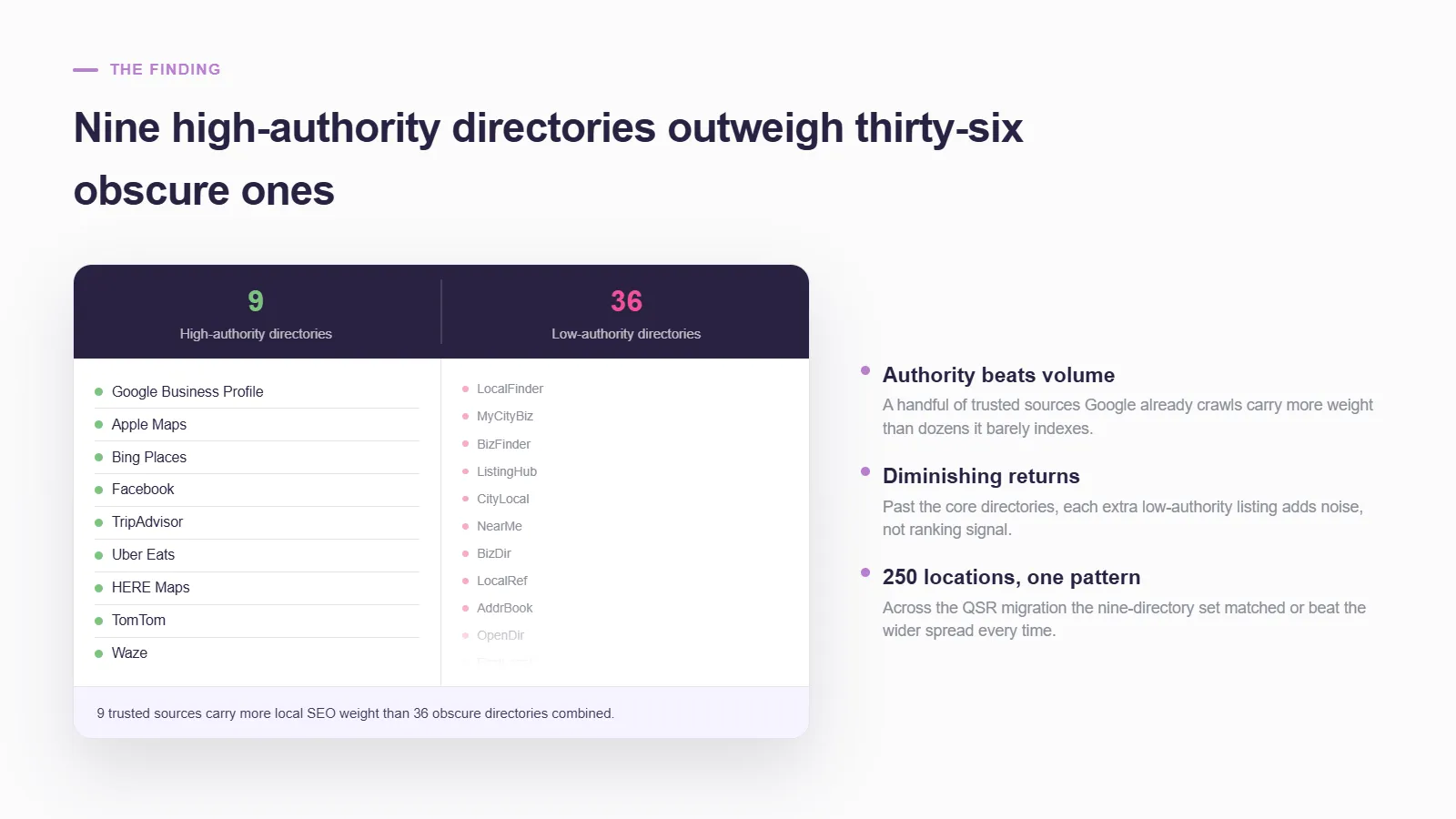
In 2026, a citation network of 36 directories does not outperform a network of 9 well-chosen ones. The long-tail directory model that defined local SEO in the 2010s has been measurably fading since at least 2020, and the latest research confirms it. What matters is real-time accuracy across the platforms consumers actually use (Google, Apple, Bing, Facebook) and the second-tier platforms that AI search engines pull from (TripAdvisor, Uber Eats, HERE Maps, TomTom, Waze). Across a recent migration of an enterprise quick service restaurant brand with over 250 locations, we ran the comparison directly. Nine of nine critical platforms were covered. The 27 long-tail directories the previous platform added produced no measurable ranking lift.
Key takeaways
- Citation volume stopped correlating with local ranking around 2020 and has continued to decline in weighted importance every year since.
- Independent 2026 local ranking-factors research lists citation volume among the factors declining in importance, and quality citations among those rising.
- Across an enterprise migration of over 250 quick service restaurant locations, the 27 long-tail directories included in the previous network produced no measurable ranking impact in independent testing.
- The platforms that matter in 2026 fall into two tiers: Tier 1 (Google, Apple, Bing, Facebook) drive ~90% of consumer discovery; Tier 2 (TripAdvisor, Uber Eats, HERE, TomTom, Waze, regional review platforms) feed AI search engines.
- Inflated citation counts come from two patterns: directories with no consumer presence in the brand’s market, and platforms miscategorised as listings sources (Instagram and LinkedIn are not listings platforms).
The “more directories is better” model has been falling for six years
The long-tail directory playbook had a clear logic in 2014. Google’s local algorithm gave weight to citation volume across a wide network of directories, and a multi-location brand listed on 30 or 40 of them outperformed a brand listed on 10. Citation aggregation services built their value proposition on this.
That model has been failing since at least 2020. Independent ranking-factors research has shown citation volume declining in weighted importance every iteration, and the 2026 research lists it explicitly under “declining factors.”
What replaced it is not the absence of citations. What matters is quality and relevance:
- Does the directory have real consumer traffic in the brand’s market?
- Does the directory have an API that supports real-time accuracy?
- Is the directory cited by AI search engines, AI Overviews, or major chatbots?
- Is the directory authoritative in the brand’s industry vertical?
What we found across 250+ enterprise QSR locations
We took over an enterprise quick service restaurant account in mid-2025. The previous provider had positioned its citation network as a key part of the offer: 36 listing partners. We audited the network platform-by-platform against three criteria: real consumer traffic in South Africa, accuracy API availability, and ranking correlation evidence from the 2026 research.
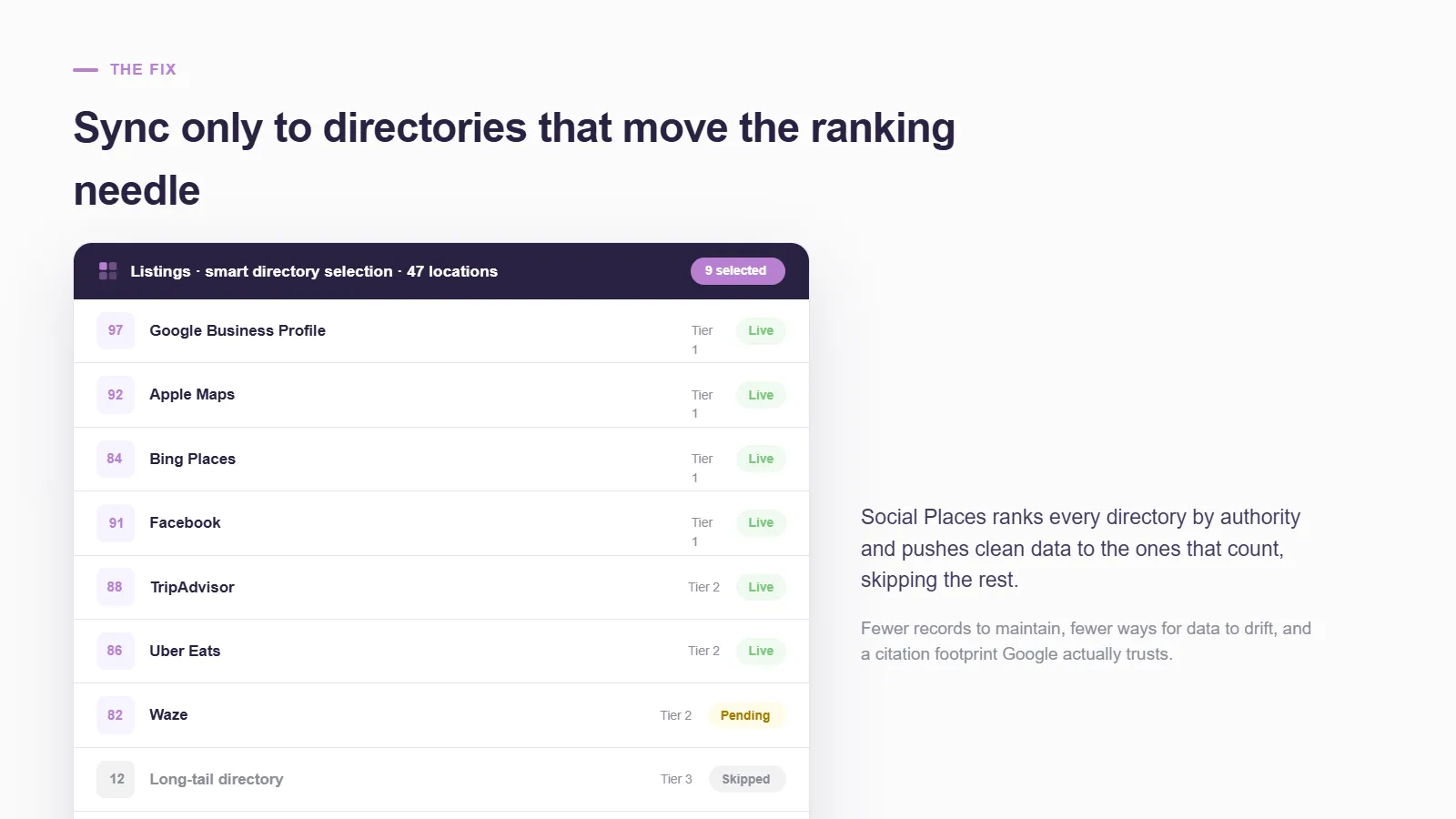
Tier 1 (4 platforms, ~90% of consumer discovery): Google Business Profile, Apple Maps, Facebook local store pages, Bing Places. Current ranking-factors research lists GBP signals as the #1 factor for both Local Pack and Maps ranking, accounting for roughly 32% of the weighting model.
Tier 2 (6 platforms, AI citation feeders): TripAdvisor, Uber Eats, HERE Maps, TomTom, Waze, and the relevant regional review platform. These are the platforms that AI search engines (Google AI Overviews, ChatGPT Search, Perplexity, Gemini) pull from to generate local recommendations.
Tier 3 (27 platforms, no measurable lift): The remaining 27 directories: hotel and travel booking platforms (no QSR relevance), directories with no consumer presence in the local market, obscure long-tail directories, and data aggregators that are not consumer-facing discovery platforms. Independent two-year tests have shown zero measurable ranking improvement from long-tail directory syndication of this kind.
The “36 vs 9” comparison was technically correct as a count. As a measure of actual visibility impact, it was misleading.
How citation counts get inflated
Pattern 1: Counting platforms not in the consumer market. A directory based in another region does not move ranking for a South African quick service restaurant.
Pattern 2: Counting platforms consumers do not use. Directories that lost consumer traffic a decade ago still pass technical citation checks.
Pattern 3: Miscategorising platforms as listings sources. Instagram and LinkedIn are social platforms, not listings platforms in the NAP-citation sense. Counting them inflates the headline number.
The cost of irrelevant citations
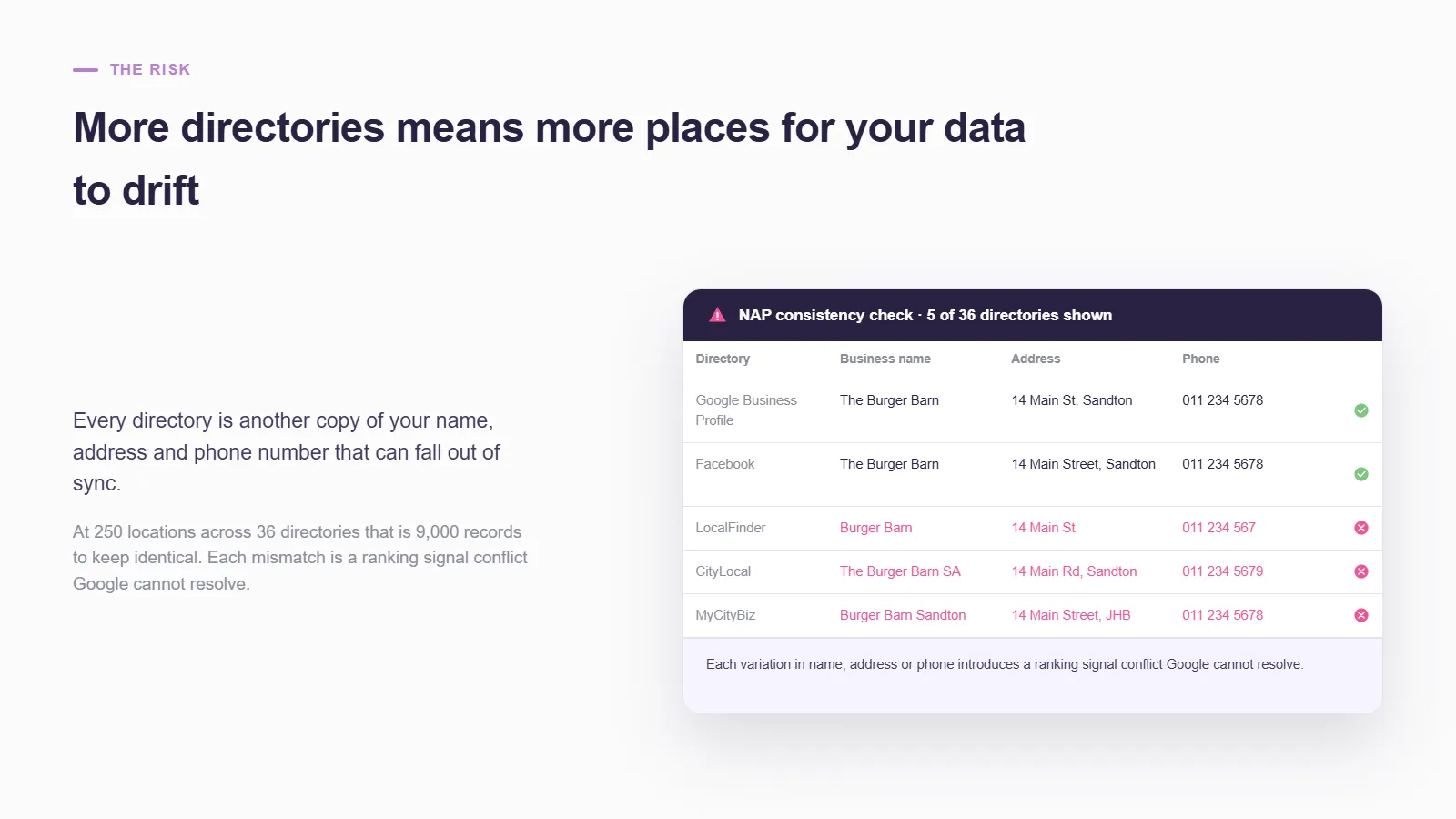
1. Data drift risk. A citation on a directory the brand does not actively check can drift out of sync with the source of truth. NAP consistency is a top-five AI search visibility factor in the 2026 ranking-factors research.
2. Opportunity cost. A flat fee paid for the long-tail network is a fee not spent on Tier 1 and Tier 2 accuracy management, review response, schema deployment, or local-page optimisation.
3. Reputation surface area. Each directory is a potential point of failure for inaccurate hours, wrong contact details, or unmanaged customer complaints.
What citation strategy looks like in 2026
- Tier 1 is non-negotiable. Google Business Profile, Apple Maps, Bing Places, Facebook. Managed via direct API, accuracy verified daily.
- Tier 2 is industry-specific. For QSR: TripAdvisor, Uber Eats, HERE Maps, TomTom, Waze, and the dominant regional review platform.
- Tier 3 is opt-out. A focused absence is better than a noisy presence.
- Audit the inherited network on day one of any switch. Without an audit, the new provider re-inherits the old problem.
How Social Places Helps
Social Places Listings manages Tier 1 and Tier 2 accuracy across the platforms that actually drive discovery and feed AI search, with daily verification rather than a vanity count of directories. If you are evaluating a provider switch, we can audit your inherited citation network before anything is re-published. Contact Us
Frequently asked questions
Do long-tail citations still matter for local SEO in 2026?
Not in the way they did pre-2020. Citation volume is among the declining ranking factors. What matters is citation quality.
Which directories should a multi-location brand prioritise?
Tier 1 covers around 90% of consumer discovery. Tier 2 varies by industry. For other verticals, the Tier 2 set is different but follows the same principle: platforms with real consumer traffic and AI citation relevance.
How many citations does Google actually need to rank a location?
Entity confidence requires accurate, consistent NAP data across the platforms Google actively crawls. That is achievable with the Tier 1 and Tier 2 set (9 to 12 platforms in most markets) and does not improve materially with more.
What is the actual cost of an irrelevant citation?
Three measurable costs: data drift risk, opportunity cost in budget allocation, and reputation surface area from stale information the brand cannot easily monitor.