Why Multi-Location Brands Are Starting to Outrank Sector Specialists With Product-Level Local Pages

One job. One product. One reason to exist in search results.
That has been the advantage specialist venues have held over multi-location brands for years. A dedicated provider of one thing, in one place, with everything on their website pointing at that one thing.
Until recently.
When the generalist starts beating the specialist
A national multi-location brand we work with has started outranking sector specialists for some of their most valuable local search terms. Not by becoming a specialist. By giving each of their locations its own dedicated page for each thing it offers.
It is a small change in how the brand structures its web presence. The results are not small at all.
The problem with standard store locators
Most franchise brands have a store locator. You type in a suburb, it returns the three closest locations with an address and a phone number.
That setup answers one question well: where is the nearest store. It does not answer the question a customer is actually asking when they search, which is usually some version of “where can I get this specific thing, near me, today, and is it any good?”
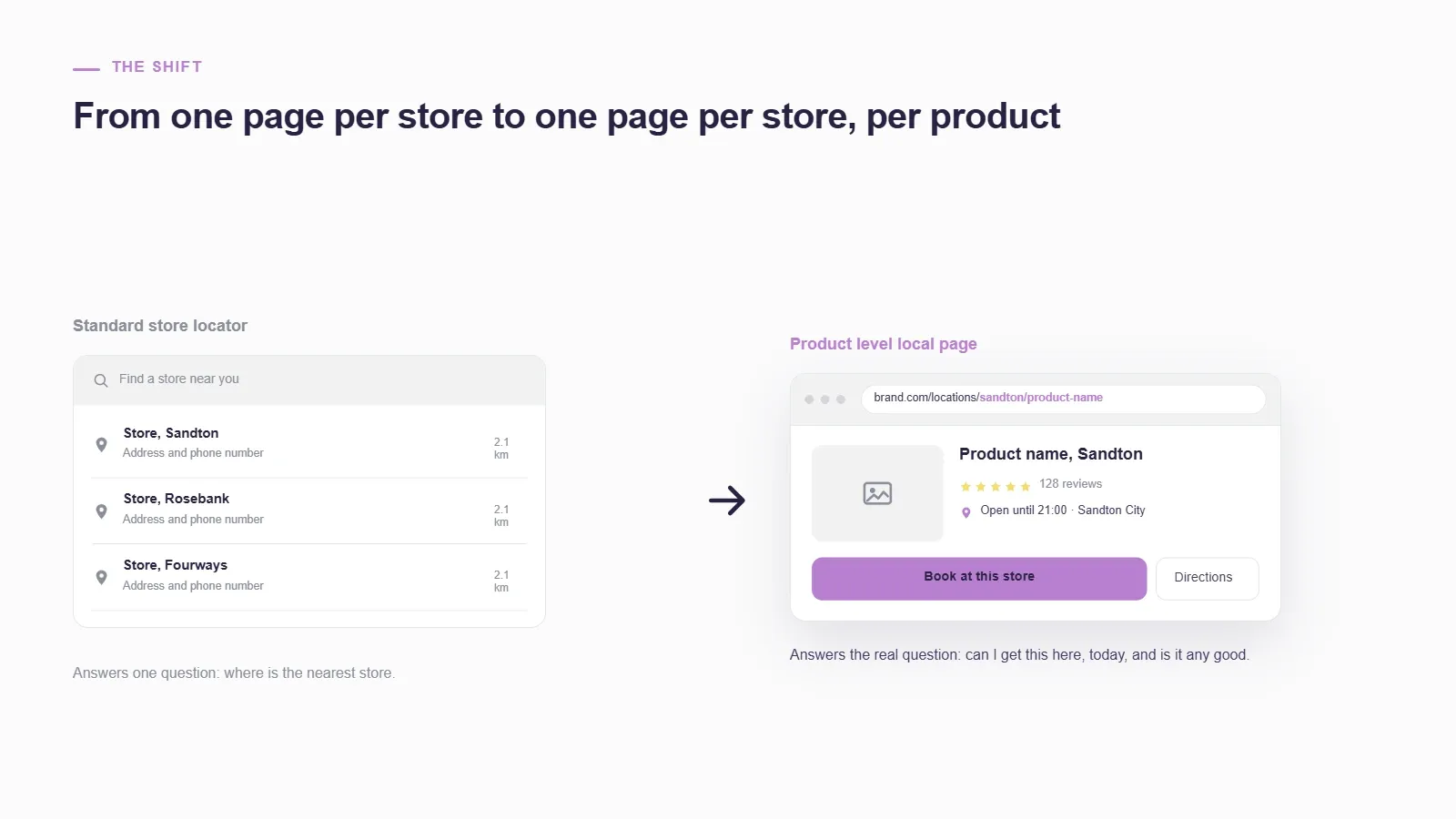
What product-level local pages actually look like
Instead of one page per store, the brand built one page per store-per-product. Each page is built around three things:
- The product itself: what is offered, what is included, what makes it worth booking
- The location: which store, which suburb, opening hours, contact details, directions
- The proof: real reviews, real photos, recent activity from that specific store
The URL pattern looks like /locations/[suburb]/[product-name]. Each page is its own asset. Each one is indexed separately, ranks separately, and answers one specific search.
![The three building blocks of a product-level local page — the product, the location and the proof — shown under the URL pattern /locations/[suburb]/[product-name].](/_astro/product-level-local-pages-page-anatomy.BmT2ryhB_2sNWMX.webp)
Why this works in 2026 specifically
Three things have shifted in local search that make product-level pages significantly more powerful now than they were two years ago.
The first is AI Overviews. Google’s AI answers now pull from the most specific page that matches the query, not just the most authoritative domain. A page that says exactly what the customer is looking for, in the suburb they are searching, beats a generic store locator every time.
The second is the widening gap between commercial intent and informational content. Pages that answer transactional questions (“can I book this at this store, today”) now perform very differently from pages that describe the brand at large.
The third is scale. A multi-location brand with a few hundred locations and a handful of distinct offerings can generate thousands of indexable pages, each one targeting a specific local search. Specialist venues cannot match that volume.
The infrastructure behind it
Strategy on its own does not scale. The architecture matters as much as the idea.
These pages are deliberately built so brands do not need to brief a separate development team every time a store updates its hours or adds a new offering. One central update propagates to every relevant page, including the local one. The same listings data keeping Google Business Profiles accurate also keeps every product-level page in sync.
Without that infrastructure, this approach falls over within months. With it, it scales indefinitely.
What the ranking result actually means
For the brand in question, the outcome is straightforward. For high-intent, location-specific searches, their pages now appear above sector specialists who have built their entire domain authority around one thing.
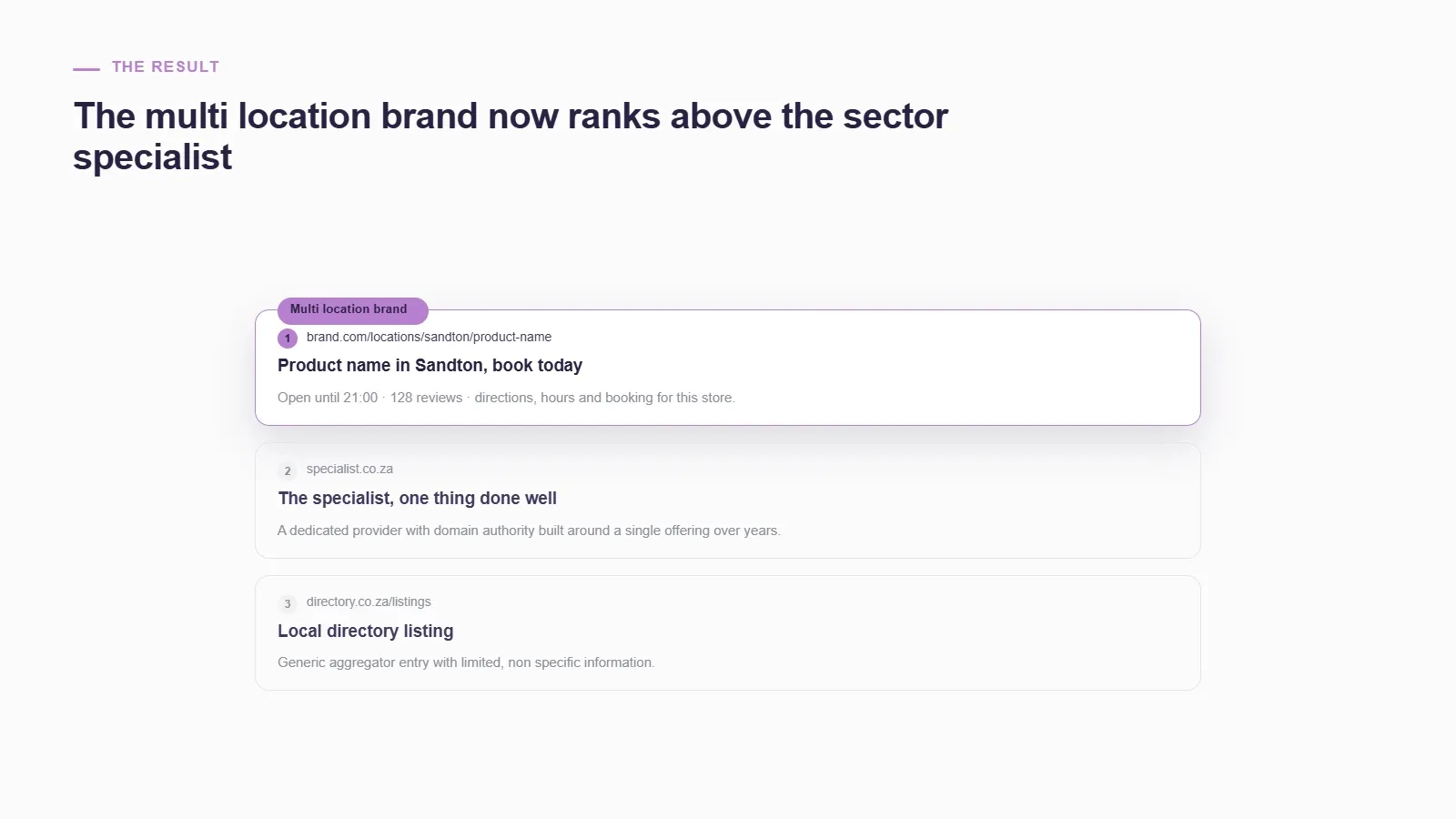
The dedicated specialist has a real advantage: specificity of purpose. Their entire domain authority, backlink profile, and content signals one thing, and they have built that signal carefully over years. That is not something to overlook.
What the multi-location brand has is something the specialist cannot easily replicate: depth multiplied by breadth. They can match the specialist’s specificity at the page level while bringing the brand recognition of a name customers already know. They can also offer the convenience the specialist cannot: more locations, longer hours, integration with their broader product range.
Both can be right for the right customer. The interesting part is that multi-location brands have now discovered they can compete in a category they previously assumed belonged to others.
The broader application
This is not a one-off. The same principle applies anywhere a multi-location brand offers a distinct product or service alongside its core:
- A pharmacy chain ranking for “[suburb] flu vaccine appointment” against specialist clinics
- A national gym ranking for “[suburb] spin class booking” against specialist studios
- A multi-brand retailer ranking for “[suburb] [specific product] in stock” against specialty shops
If your brand offers more than one thing across more than a handful of locations, this strategy is worth a serious look.
What this looks like as a product
If you run a multi-location brand and any of this sounds like your category, we would love to show you what it could look like for your network.
Social Places builds this as a dedicated product: AI Visibility Pages, launched earlier this year. Pages are auto-generated for every location and product combination, structured for both Google search and AI answer engines like ChatGPT, Perplexity, and Gemini, and connected directly to the same listings data keeping your Google Business Profile accurate. When a store updates its hours, every relevant page updates with it.
The brand in this story is seeing meaningful organic growth, real foot-traffic gains, and citations in AI search results. We would be happy to walk you through what it could mean for yours.
Frequently asked questions
What is a product-level local page?
A dedicated web page for a specific product or service at a specific store location, with detailed product information, location-specific content, booking or contact CTAs, FAQs, and filtered reviews, all optimised for the search queries a customer would use when looking for that product near that location.
How is this different from a standard store locator?
A store locator tells customers where the nearest branch is. A product-level local page tells customers what a specific branch offers in detail and answers the questions they have before they visit.
Does this work for AI search like Google AI Overviews?
Yes. Product-level local pages built with structured content and FAQ sections are well-positioned to be cited in AI Overviews. AI systems favour pages that answer specific questions clearly.
How do multi-location brands keep product pages accurate at scale?
The key is connecting local pages to the same data infrastructure managing your listings. When store data is updated centrally, pages update automatically.