Google Knows Who Your Customers Are. What the Personal Intelligence Era Means for Multi-Location Local Search.
Imagine your best customer searches “coffee near me” on a Monday morning. They have visited your brand a dozen times. Their inbox has confirmation emails from four of your locations. They have snapped photos at two of them.
Until recently, Google had no idea. Now it does.
At Google I/O on 19 May 2026, Google announced that Personal Intelligence in AI Mode is expanding to nearly 200 countries and 98 languages, with no paid subscription required. A feature previously locked behind a US-only paid tier is now rolling out globally, and it fundamentally changes which local results appear first for your returning customers.
What Personal Intelligence Actually Does
Personal Intelligence connects Google AI Mode to a user’s Gmail inbox, Google Photos library, and soon their Google Calendar. When a customer opts in, Google uses signals from those apps to personalise their local search results.
If a customer has a booking confirmation from your restaurant in their Gmail, a photo tagged at your location in their library, or an upcoming appointment at your salon in their calendar, Google AI Mode factors that in when they next search for something nearby.
At I/O 2026, Google confirmed AI Mode has surpassed one billion monthly active users. That is one billion searches now filtered through personal context before proximity and keyword signals even come into play.
The Signals That Trigger Personalised Local Results
The system draws on transactional signals inside the Google ecosystem:
- Email receipts and booking confirmations sent to a Gmail address
- Google Photos taken at or near a business location
- Google Calendar entries tied to a business
- Purchase history surfaced through Gmail or Google Pay
Every time your brand sends a customer a booking confirmation or an appointment reminder to a Gmail address, you are creating a signal that Google’s AI will use to surface your brand the next time that customer searches locally.
The Loyalty Loop: How Returning Customers Become Your AI Ranking Asset
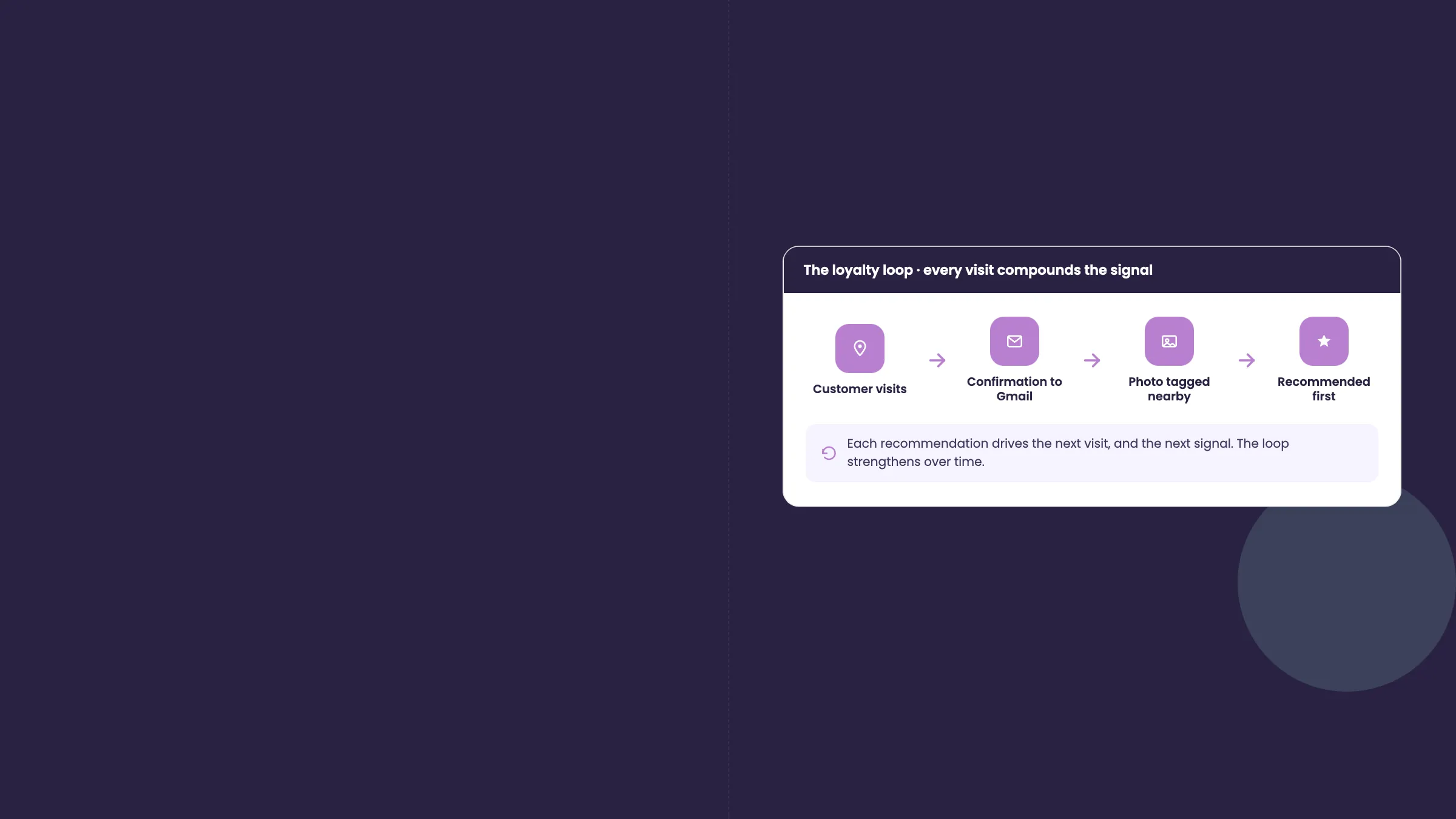
A customer visits your location. They receive a booking confirmation to Gmail. They take a photo that gets tagged nearby. A week later, they search for something related and Google AI Mode surfaces your brand ahead of a nearby competitor with stronger proximity and more reviews.
That visit leads to another confirmation email. Another photo. Another calendar entry. The signal compounds over time.
What This Means at Franchise and Multi-Location Scale
For a single-location business, acting on this is relatively straightforward. For franchise and multi-location brands, the implications are more complex and more significant.
Consider a customer who visits your Cape Town location, receives a booking confirmation to Gmail, and later searches while travelling in Johannesburg. If your Johannesburg locations are well-managed and consistently attributed, that prior interaction signal can translate into a recommendation at an entirely different location.
The May 2026 Core Update reinforces this same direction. Trustworthiness, authentic location-level signals, and consistency across pages now carry heavier weight than keyword signals on generic templated location pages.
How Social Places Helps You Build Your Personal Intelligence Footprint
Accurate, consistent listings across every location and every platform give Google a verified identity to attach personal signals to. Bookings and appointment management through your own infrastructure ensure confirmation emails carry your brand’s name rather than a third-party platform’s. Reputation management that maintains review velocity per location completes the picture.
Google has not replaced local search. It has made local search personal. The brands that understand that their existing customer relationships are now an active SEO asset are the ones AI Mode will recommend first. Contact Us
Frequently asked questions
Is Personal Intelligence available for customers in South Africa and other markets outside the US?
Yes. At Google I/O on 19 May 2026, Google announced the expansion of Personal Intelligence in AI Mode to nearly 200 countries and 98 languages, with no subscription required.
Does this make it harder for new customers to discover my brand?
Not directly. Personal Intelligence adds a personalisation layer on top of existing local search signals. New customer acquisition still depends on the fundamentals: accurate listings, strong reviews, and complete profiles.
What kinds of emails or interactions actually count as a Personal Intelligence signal?
Google consistently points to transactional signals: booking confirmations and order receipts in Gmail, photos taken at or near a business in Google Photos, and calendar entries linked to a business.
How does this connect to the May 2026 Core Update?
The May 2026 Core Update, which began rolling out on 21 May 2026, places increased weight on trustworthiness and authentic, location-level content. Combined with Personal Intelligence, the direction is consistent: brands with coherent, location-specific presences that generate real customer interactions will outperform those relying on keyword optimisation alone.