Google Now Calls Local Businesses for Your Customers. Most Multi-Location Brands Will Miss the Call.
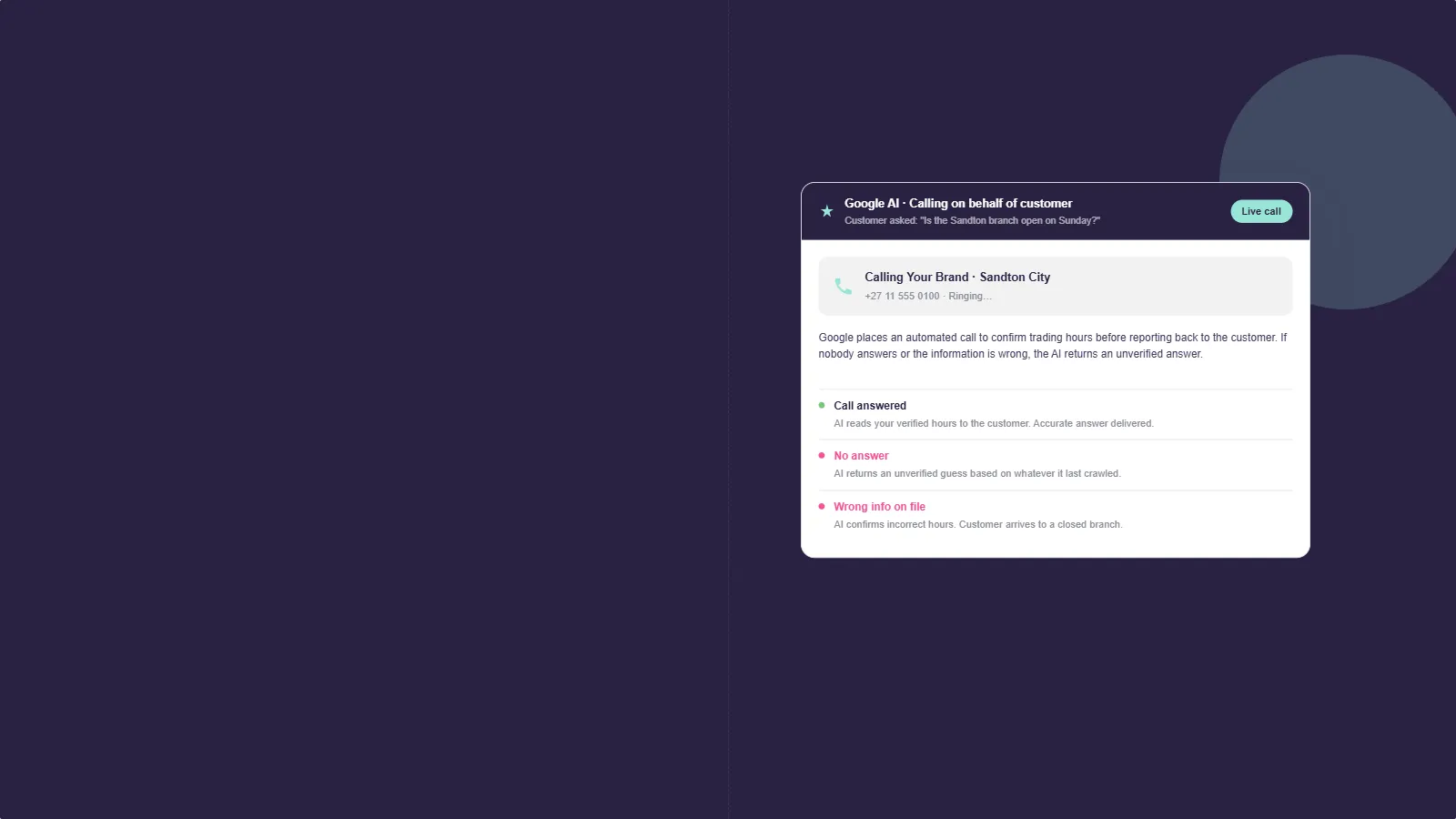
A customer won’t call five salons this summer. They’ll ask Google, Google will make the calls, and your location will either be on the shortlist or it won’t. By the time they find out you exist, someone else already has the booking.
This isn’t a future scenario. Google’s agentic calling feature launched in the US in late 2025, and at Google I/O 2026 on 19 May, Google confirmed it is expanding to home repair, beauty, pet care, and a wide range of local experiences this summer. For multi-location brands, the window to prepare is closing.
What Google Actually Announced
Agentic calling is not a chatbot. It is Google’s AI placing a real phone call to your location on behalf of a searching customer. The customer describes what they want, Google identifies the best nearby options, calls those businesses to check availability, and returns a summary. The customer never has to pick up the phone themselves.
Google first rolled this out quietly for retail product searches in November 2025. At I/O 2026, it announced the feature is expanding to local service categories: home repair, beauty, pet care, and a broader set of local experiences and bookable services. The rollout to all US users is confirmed for this summer.
AI Mode, the product underpinning this, already has one billion monthly users with queries more than doubling every quarter since launch. The scale of this is not theoretical.
The Shrinking Local Pack
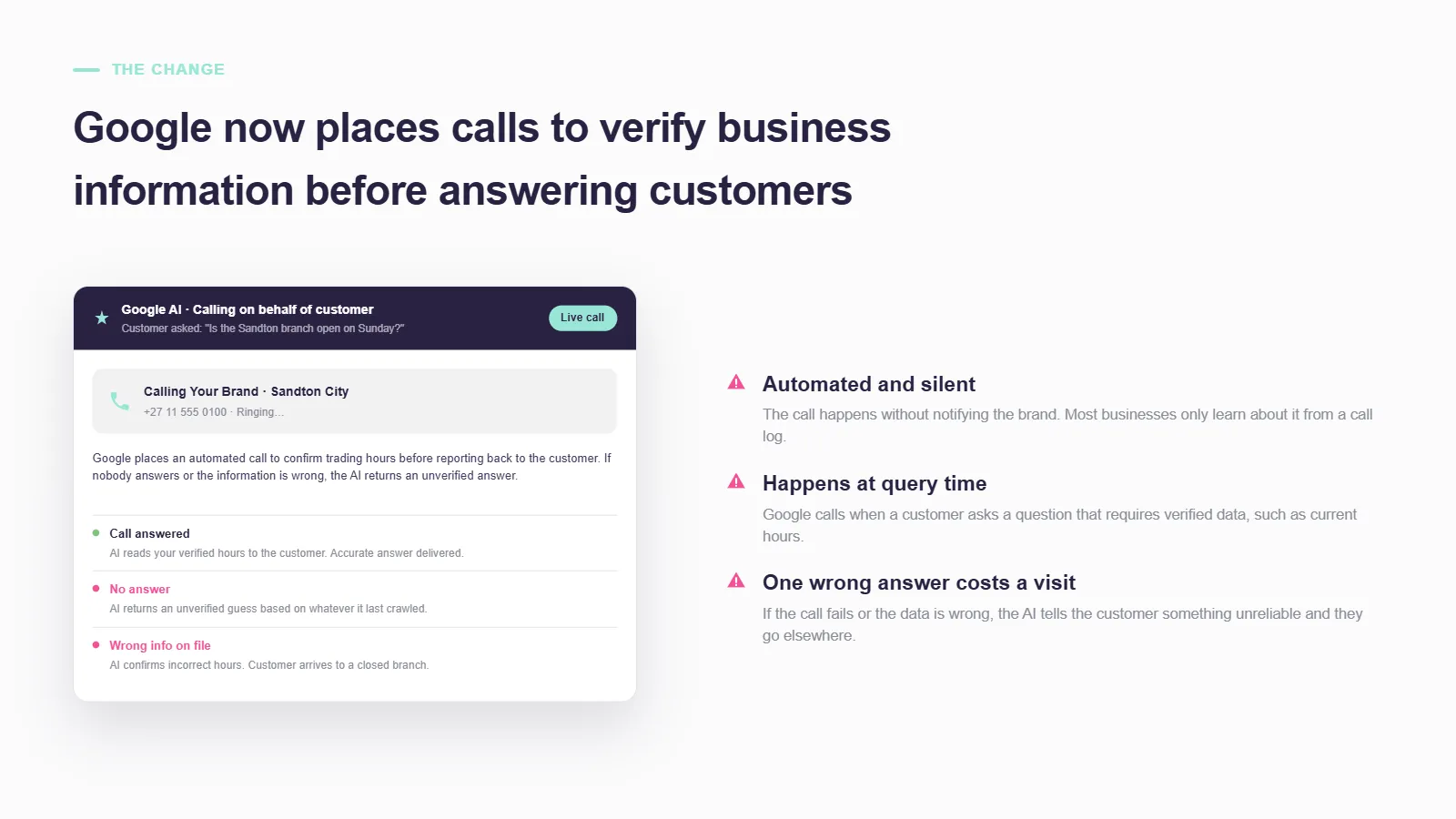
Alongside the agentic expansion, local SEO researchers have flagged a change in how many businesses the AI local pack surfaces. Where the old three-pack reliably showed three businesses for a local service query, the new AI-driven local results are surfacing materially fewer of the locations that used to appear. A meaningful share of businesses that previously had local pack visibility are now absent from the AI answer.
The implications are direct. Agentic calling doesn’t call every business on Google Maps. It calls the businesses that make the AI’s shortlist. If your locations are not surfacing in AI-driven local results due to incomplete profiles, inconsistent data, or weak review signals, Google’s agent will never dial your number.
Your locations need to be in the shortlist before the call is even possible.
Why Multi-Location Brands Have a Bigger Exposure Than Single Locations
A single-location business can audit and fix its Google Business Profile in an afternoon. A brand with 50, 100, or 500 locations cannot. And the AI does not grade on a curve. Each location is assessed individually on:
- Whether its phone number is live and answered
- Whether it has a booking link or scheduling action in GBP
- Whether its services are listed accurately and completely
- Whether its trading hours are current and match what other sources show
- Whether its review velocity and rating signal reliability
Corporate brand authority no longer automatically lifts individual location rankings. A flagship with a 4.9-star rating doesn’t help the branch three suburbs over if that branch has an outdated phone number, no services listed, and hours that haven’t been updated since a public holiday two years ago.
The agentic caller finds that out in about three seconds and moves on.
What “Callable” Looks Like at Location Level
Getting your locations ready for agentic booking is not a marketing task. It is a data operations task. The basics that determine whether Google’s AI includes or excludes a location:
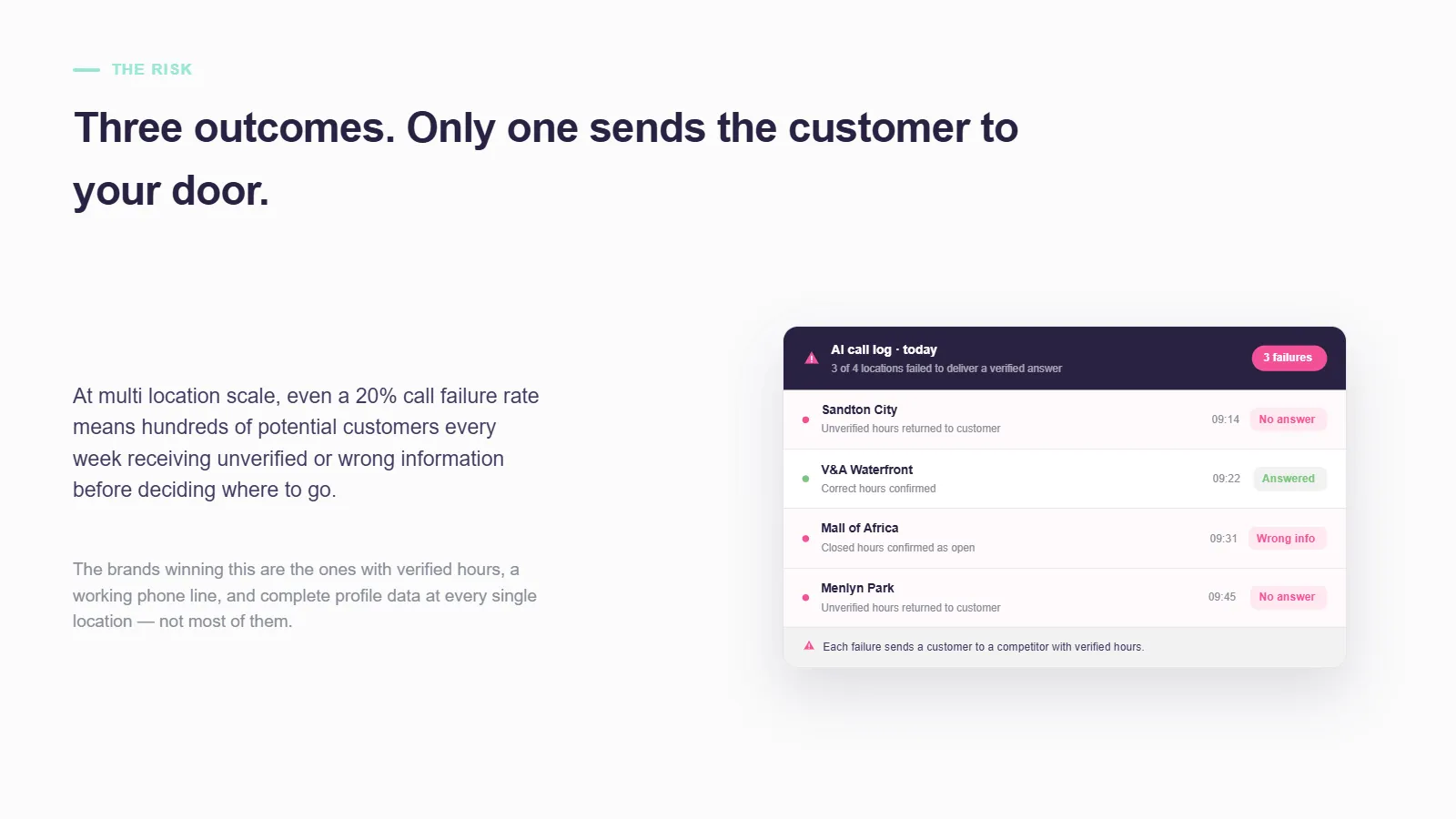
- Verified, live phone numbers. Numbers that ring and are answered during trading hours. Voicemail during business hours signals low responsiveness; the AI records this and may deprioritise the location.
- Booking actions live in GBP. If your location has an online booking link, it needs to be connected to your Google Business Profile as a booking action. Locations without this are skipped in the automated booking flow.
- Services listed at location level. Not a generic parent category. The specific services offered at that branch, with enough detail for AI to match against what the customer asked for.
- Accurate trading hours across all sources. Google cross-references your GBP hours against what it sees on your website, directory listings, and third-party data. Inconsistencies create entity ambiguity, and the AI resolves ambiguity by picking someone more reliable.
- A credible and recent review profile. The AI treats recent reviews as a live signal of reliability. Locations with stale, sparse, or unanswered reviews rank lower in the shortlist.
None of this is complicated. But across a network of any meaningful size, keeping all of it accurate and consistent is a sustained operational commitment, not a one-time fix.
How Social Places Helps You Get Call-Ready Across Every Location
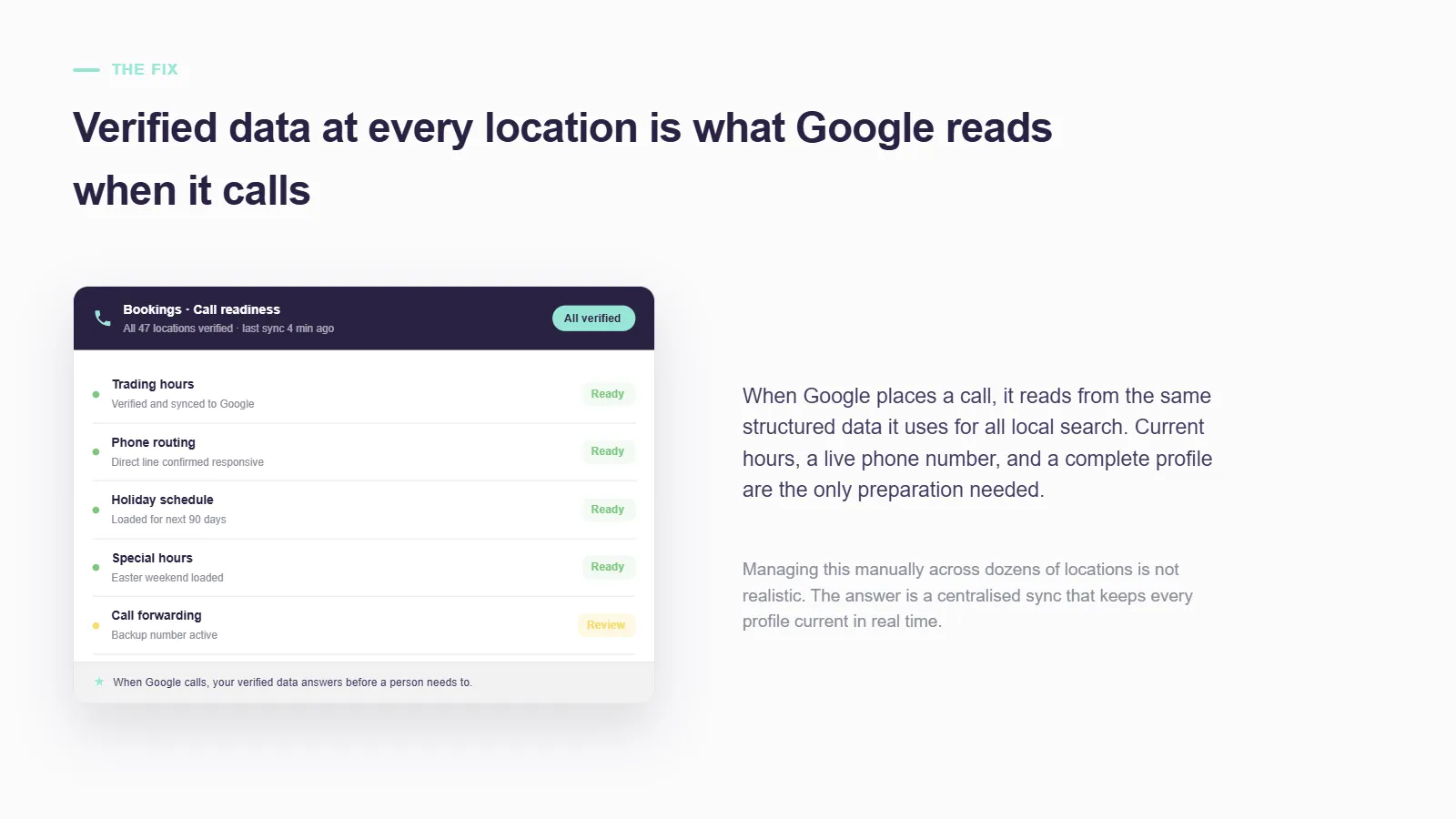
The work of becoming agentic-ready sits across three operational areas: listings accuracy, reputation management, and booking infrastructure. Social Places brings all three together in a single managed platform, designed specifically for multi-location brands.
Our Listings management keeps every location’s GBP data accurate, consistent, and synchronised across all the platforms Google cross-references when building its shortlist. Our Reputation tools help each location maintain the review velocity and response rate that signals reliability to AI systems. And our Bookings integration connects your scheduling infrastructure to the booking actions Google’s agentic system looks for before it attempts a call.
If your brand has locations that are not ready for this shift, we can help you audit where the gaps are. Contact Us
Frequently asked questions
Which categories does Google's agentic calling currently cover?
Google's agentic calling launched in late 2025 for retail product searches, where it calls local stores to check stock and availability. Following Google I/O 2026, it is expanding this summer to home repair, beauty, pet care, and a broader range of local experiences and bookable services. The feature is rolling out to all users in the United States first, with broader expansion expected to follow.
Do I need to opt in for my locations to receive agentic calls?
No opt-in is required. Google's agentic calling will attempt to reach any business that appears in its local shortlist for a relevant query. What determines whether your location is on that shortlist is the completeness and accuracy of your Google Business Profile, not a setting you toggle.
What happens if Google's AI calls my location and gets voicemail?
If the call goes to voicemail or is not answered promptly, the AI logs this as a low-responsiveness signal and typically moves to the next option on the shortlist. For multi-location brands, this makes phone answer rates during trading hours a practical local search factor.
Does having a booking link in GBP make a difference to agentic booking?
Yes, significantly. Locations that have a live booking link connected to GBP can be included in the full agentic booking journey. Locations without this are limited to the calling pathway, and in some cases may be skipped entirely in favour of locations with booking infrastructure already in place.