Franchisees Don't Buy a Marketing Job: Franchise Local Marketing and AI Search Visibility

Franchise brands are losing AI search visibility because local content is now a primary citation signal for Google AI Overviews and ChatGPT, and that local content is supposed to come from franchisees who never wanted to be marketers in the first place. Across a national restaurant franchise we work with, voluntary participation in a local advertising platform peaked at under 50% of locations and has since declined. The problem is not the tool. It is the model. Franchisees buy a brand, not a marketing job. Closing the AI search gap means restructuring local marketing as a managed service: removing the obligation from franchisees and taking ownership of the content machine at the head office level.
Franchisees buy a brand. They do not buy a marketing job.
This sounds obvious when you say it aloud. Somebody who invests in a franchise is buying a proven system, a recognised brand above the door, and the right to operate within it. They are not buying a social media brief, a campaign calendar, or a local advertising budget to manage.
And yet the franchise model, as it has evolved over the last decade, has increasingly asked franchisees to do exactly that. Local social pages to manage. Local advertising tools to learn. Content to approve. Boosted posts to fund from their own pockets. Local marketing complexity layered on top of the already considerable job of running an operation.
The predictable result: most franchisees do not do it.
Across a national restaurant franchise we have been working with, we built and deployed a local advertising platform to help franchisees amplify head office campaigns at the store level. The concept was sound. The platform worked. And at its peak, fewer than half of the franchise network was using it. That figure has since declined.
When we examined the feedback, the answer was consistent. The platform was perceived as complex. Marketing was not their wheelhouse. They had enough to manage. They did not understand why it was their job. They were right.
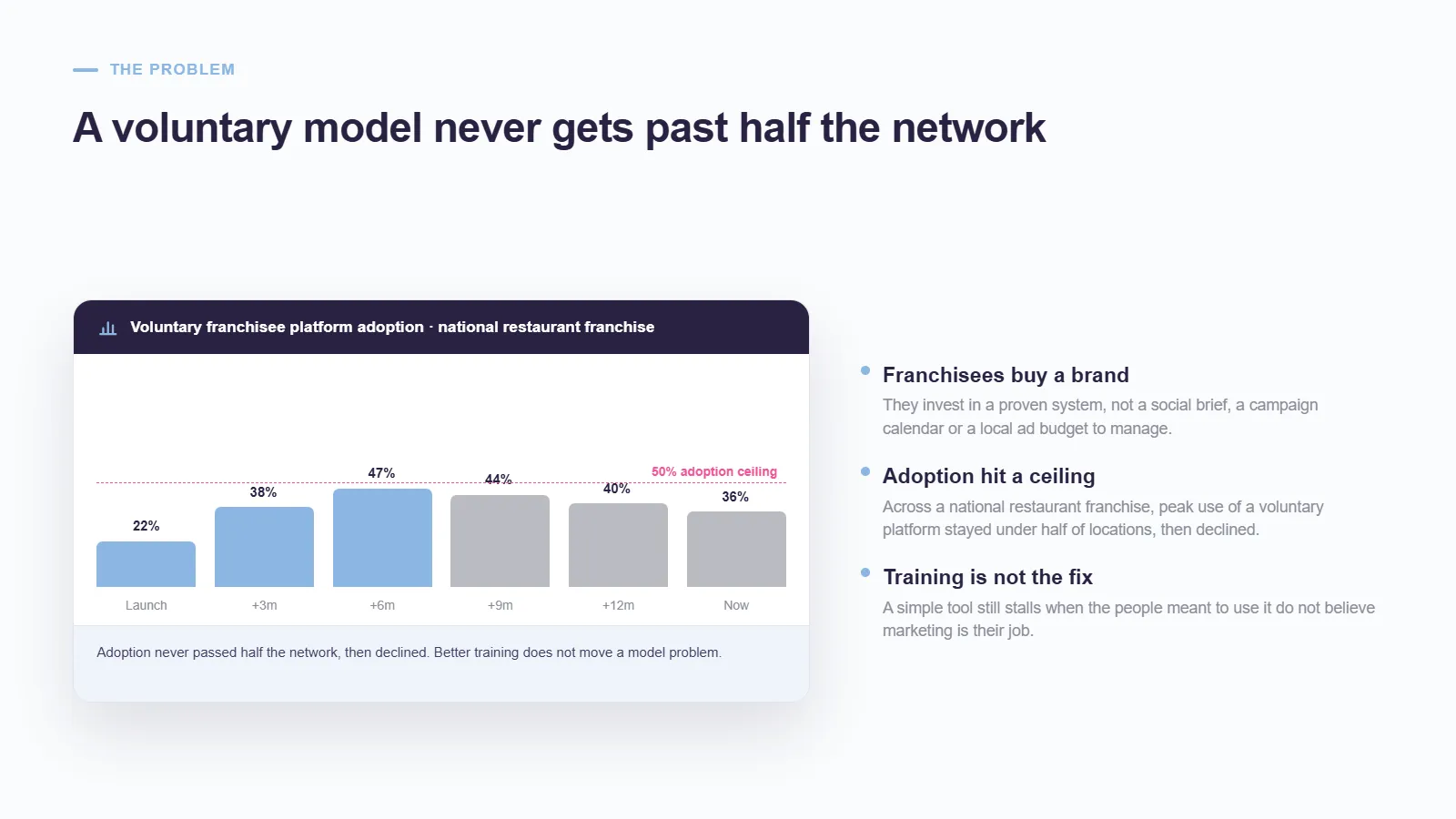
The adoption math does not improve with better training
The instinctive response to low adoption is more training. Better onboarding. Simplified UI. A shorter path to publishing. These are not wrong interventions, but they address the surface problem rather than the structural one.
The structural problem is that a voluntary local marketing model places an ongoing obligation on people for whom marketing is a distraction from their primary job. Even a well-designed, genuinely simple platform will face an adoption ceiling when the people who are supposed to use it do not believe it is their responsibility.
The additional complication is that franchisee marketing ability varies enormously across a network. Some franchisees are digitally confident and engaged. Some have never run a paid social campaign and have no intention of starting. Designing a voluntary system that works for both ends of that spectrum is functionally impossible.
Kayla Manson, who leads Ads at Social Places, has observed this pattern across multiple franchise clients. The Meta boost button feels simple, but the operational cost of personal-account billing, inconsistent targeting, and invisible reporting creates its own set of problems for head office. Franchisee-level autonomy and brand-level control are not easily reconciled in a voluntary model.
Why low adoption now costs more than it used to
For most of the last decade, local franchise social media was primarily a brand consistency problem. Locations that did not post locally were slightly less visible, slightly less engaged, but the overall effect on discovery was marginal compared to the returns from centralised brand media.
That calculus has shifted.
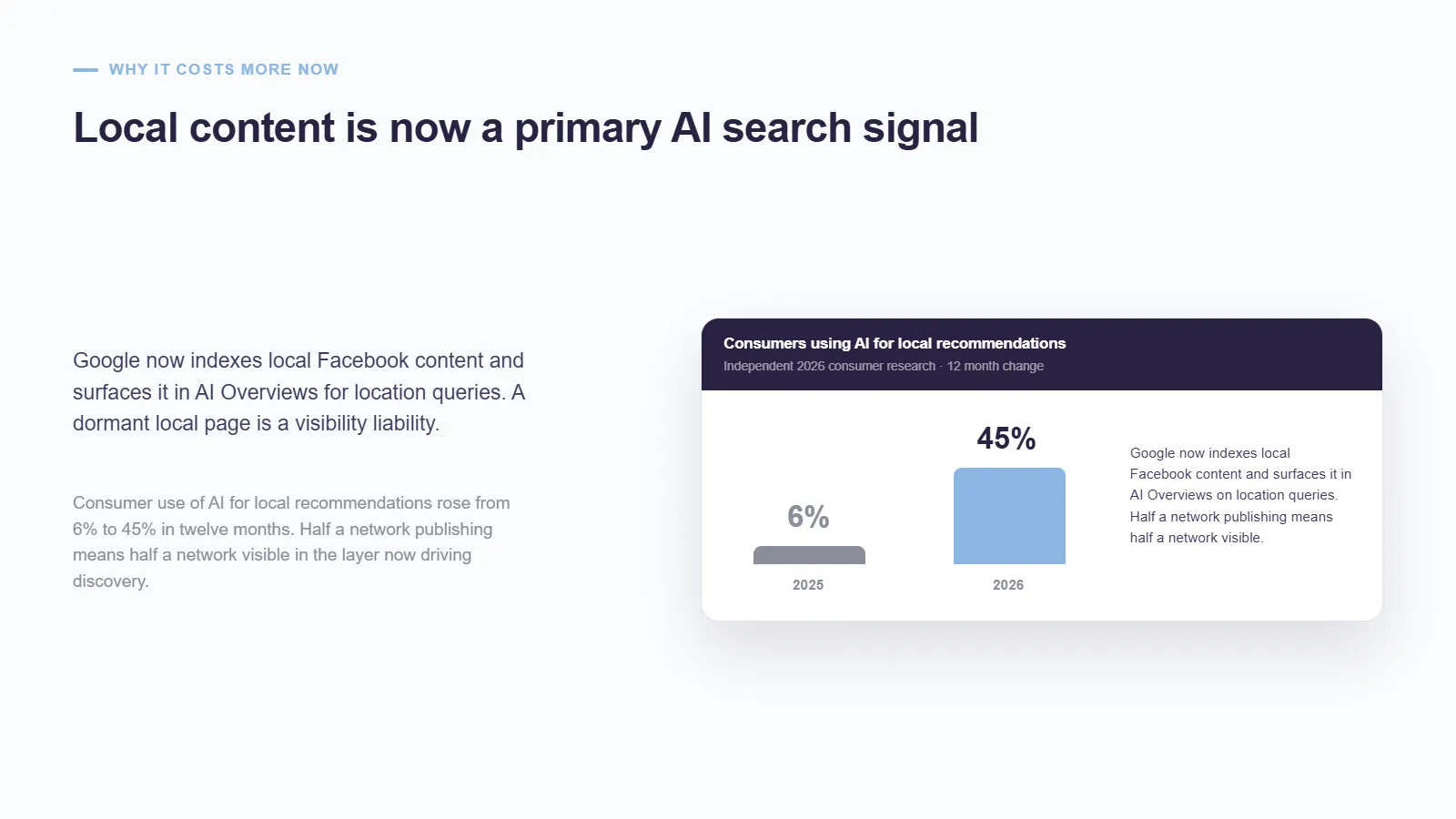
Google is now indexing local Facebook page content. Across the franchise accounts our team manages, we are seeing local social page content appearing in Google AI Overviews and AI Mode results in response to location-specific queries. A user searching for “lunch near [suburb]” or “family restaurant [shopping centre]” is surfacing results that pull from local page content as well as from Google Business Profile data.
This matters because AI search engines cite sources. A location with fresh, copy-optimised local social content, consistent Google Business Profile data, and recent activity signals is more likely to be cited in an AI Overview than a location with a dormant profile and no recent posts. Independent 2026 ranking-factors research identifies local content freshness and activity signals as rising ranking factors, directly linked to AI Mode visibility.
The franchise network that has 50% voluntary adoption is, by extension, producing consistent AI search visibility for roughly half its locations and leaving the other half underrepresented in the new search layer that is increasingly driving local discovery.
The content quality shift: fewer posts, better copy, paid amplification
There is a secondary insight embedded in this problem that is worth drawing out. The assumption underlying most franchise local marketing models is volume: post as frequently as possible across as many locations as possible.
The AI search era inverts that logic. AI engines do not reward volume. They reward entity accuracy, copy quality, and relevance signals. A local page with ten strategically written posts per month, each with location-specific copy, targeted paid amplification, and consistent brand framing will drive more AI citation and more local discovery than the same location posting twenty low-engagement pieces of content with no distribution behind them.
The franchise brand we work with is restructuring its local content model on exactly this principle: shifting from a high-frequency publishing cadence to a smaller set of high-impact posts, each amplified with local paid media and optimised for both search copy and geographic targeting.
What the managed service model looks like
The managed service model solves the adoption problem by removing the obligation entirely. Instead of asking franchisees to participate, head office takes ownership of the local marketing function and funds it through a small, non-optional royalty adjustment.
In practice, this means Social Places manages the full local content and paid distribution workflow on behalf of every franchise location:
- Strategic content calendar built at the brand level, localised per store.
- Copy written for search relevance: local landmarks, trading context, location-specific framing.
- Paid amplification set up per location with correct geo-targeting and audience parameters.
- Automated reporting delivered to franchisees and head office without any action required from the store.
- Review and feedback journeys integrated at customer touchpoints so reputation signals are captured consistently across the network.
Franchisees receive local marketing output without having to produce it. Head office receives consistent brand representation and a connected data layer across every location. The AI search visibility gap closes as every location publishes fresh, optimised local content on a managed cadence.
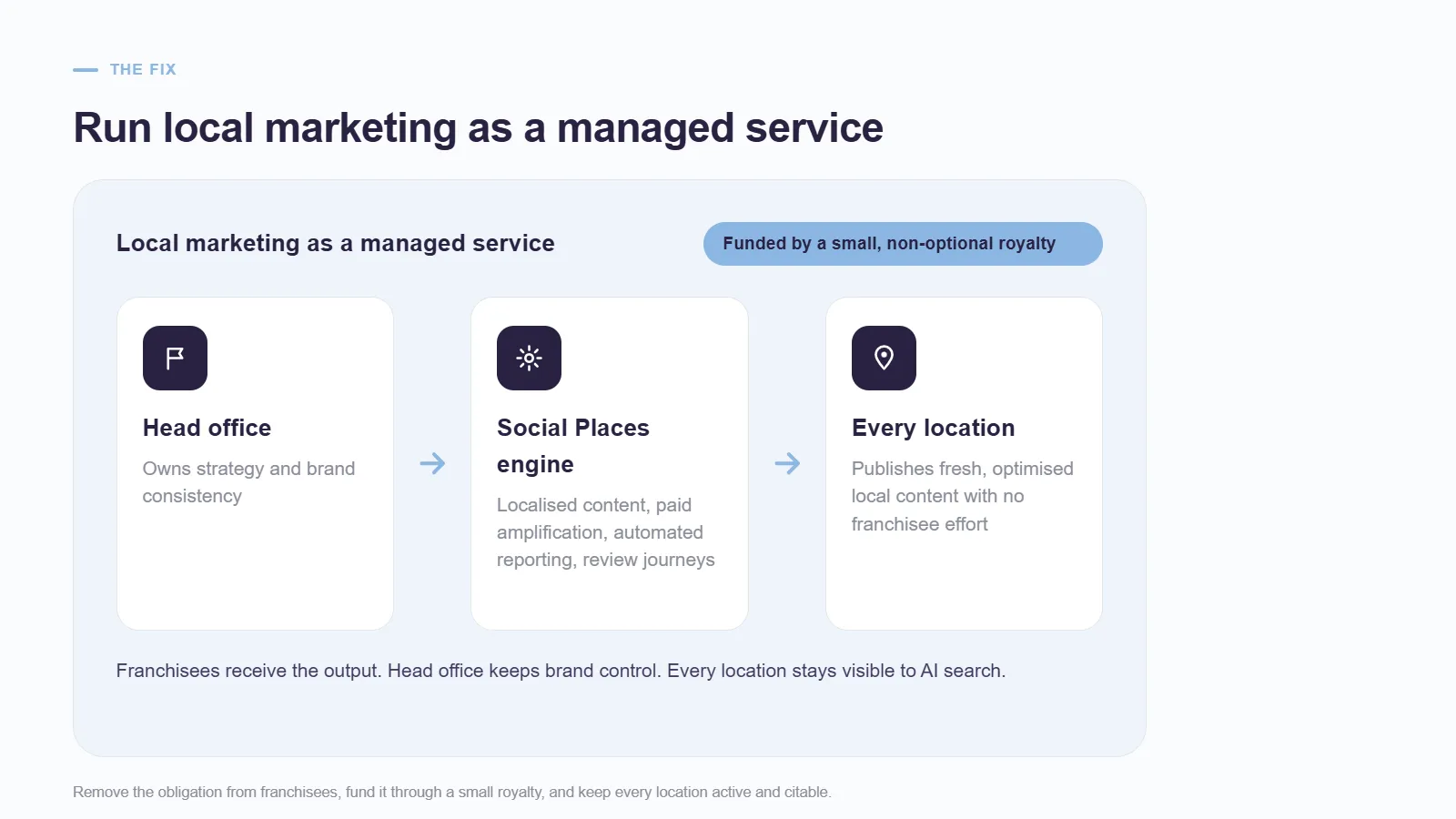
The royalty funding model resolves a structural tension that has complicated voluntary local marketing for years. When franchisees pay for local marketing out of their own discretionary budget, the ones with tighter margins opt out. When local marketing is funded as part of the royalty agreement, it becomes a guaranteed service rather than an optional add-on. Brand consistency at the local level becomes a condition of the franchise, not a request.
What this means for AI search visibility at scale
The compounding effect of this model is significant. A franchise network of 100 or 200 locations, each publishing consistent, copy-optimised local content on a managed cadence, produces a substantial entity signal footprint across Google, Facebook, and the data layers that AI search engines read.
Each location becomes a credible, active entity: fresh GBP activity, optimised local social content indexed by Google, consistent NAP data across Tier 1 platforms, and a review signal maintained through integrated feedback journeys. That combination is exactly the profile that drives AI Overview citation on non-branded location queries.
Independent 2026 consumer research found that consumer use of AI for local recommendations rose from 6% to 45% in twelve months. The franchise brand that has managed local marketing across its network will appear in those recommendations. The brand that relies on voluntary franchisee adoption will not, or at least not consistently.
How Social Places Helps
Social Places runs local marketing as a managed service across the franchise network through Social, Ads, Listings and Reputation, so every location publishes fresh, optimised local content without depending on franchisee participation. Contact Us
Frequently asked questions
Why do franchisees have such low adoption of local marketing tools?
The core reason is model mismatch. Franchisees invest in a franchise to operate a business, not to manage marketing. Even a well-designed, simple platform faces an adoption ceiling when the people using it do not believe local marketing is their responsibility, do not have the bandwidth for it alongside operational demands, and are not accountable for local search outcomes.
Is Google really indexing local Facebook page content?
Yes. Across the franchise social accounts our team manages, we are observing local Facebook page content appearing in Google AI Overviews and AI Mode results for location-specific queries. Locally-specific copy on franchise social pages is being cited alongside Google Business Profile data.
What does a managed franchise local marketing service actually include?
At minimum: strategic content creation per location with location-specific copy, paid media management with geo-targeted amplification, automated reporting to franchisees and head office, and integration with reputation and review systems.
How does local social content affect AI search visibility?
AI search engines prioritise sources that demonstrate entity accuracy, local relevance, and recent activity. A franchise location with fresh local social content, consistent GBP data, and active review signals presents a higher-confidence entity to AI engines than a location with stale or absent local signals.
How should franchise brands fund a managed local marketing model?
The most structurally stable approach is a small, non-optional royalty adjustment that funds the managed service as a core franchise benefit. This resolves the discretionary spend problem and establishes local marketing consistency as a condition of the franchise agreement rather than a request.