ChatGPT Has a Maps Tab. The Real Story Is Where the Pins Come From.
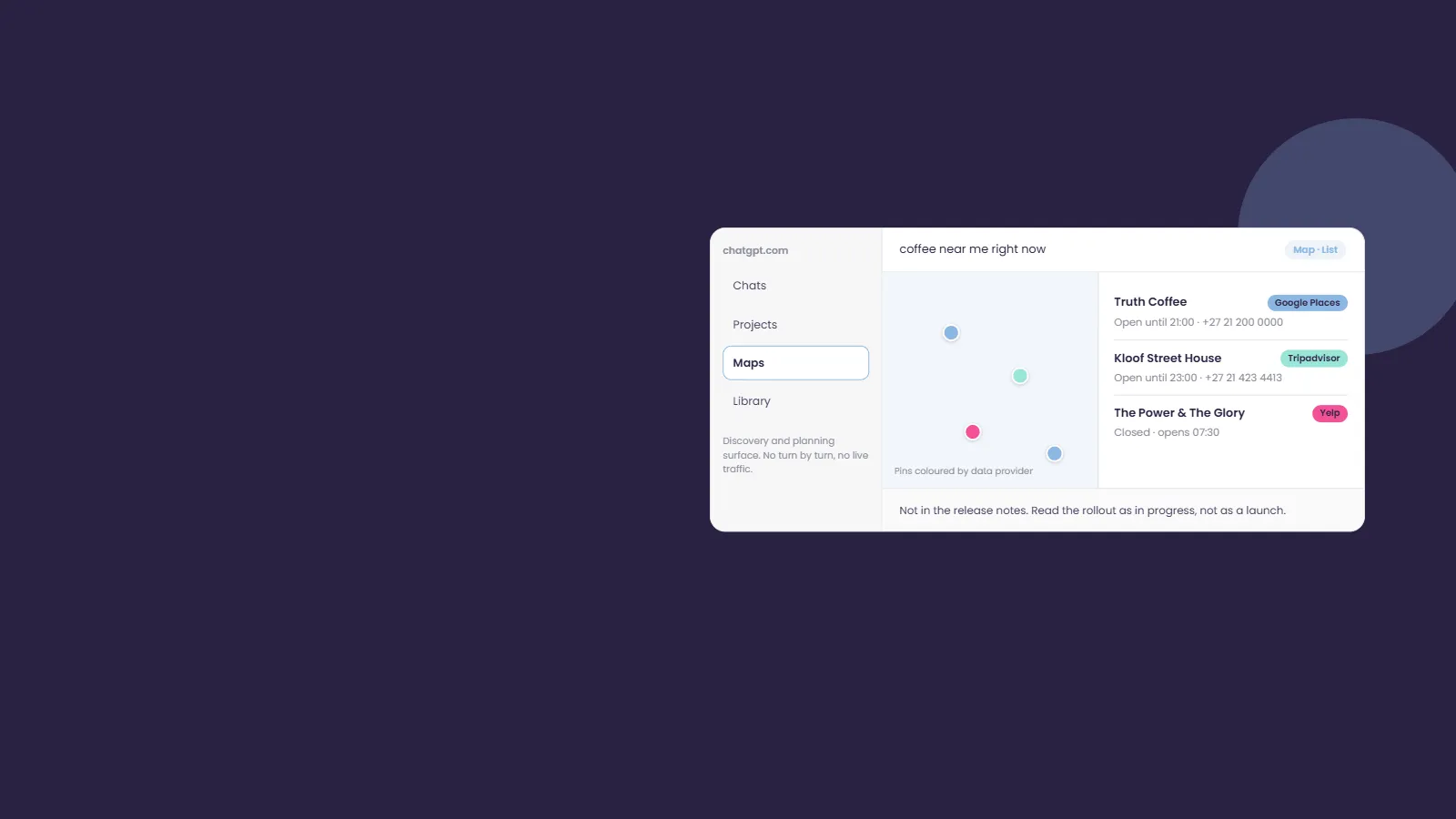
A South African ChatGPT account, opened on desktop last week, showed something new in the sidebar. Not a chat. A tab, called Maps.
That is a smaller thing than it sounds, and a bigger thing than it looks.
What actually landed
ChatGPT now has a dedicated Maps surface rolling out on desktop, reachable from the sidebar. Ask it what is around you and you get a map with pins, a card per business with hours and a phone number, and the option to flip between map view and list view. Local news and weather come along for the ride.
What it is not is a Google Maps replacement. There is no turn-by-turn navigation and no live traffic. This is a discovery and planning surface, not a navigation app. If you are driving somewhere unfamiliar, nothing has changed for you.
It is also not officially launched. OpenAI has not put it in the release notes. As recently as 9 August, the rollout was still being treated as a staged test rather than an announcement, and a “Places” section covering places, weather and travel was spotted in the client code at the end of July with no confirmation attached. Read it as in progress, not as a product launch.
The part most people are getting wrong
The interesting story is not the tab. It is where the pins come from.
For most of ChatGPT’s life, when it put a business on a map, that business came from one place. A study by Nicolas Sitter tracked 99,538 hotel map entities across roughly 25,600 ChatGPT hotel searches between December 2025 and March 2026. It focused specifically on hotel bookings across major tourist cities, not local businesses in general, but the underlying mechanism it documents is the relevant part. In December, Google Places accounted for all of the entities. By the last tracked week of March, Google had fallen to 70.3%, Yelp had climbed to 22.4% of that week’s entities, and Foursquare and Tripadvisor between them made up the rest, because three more providers had been integrated over the period.
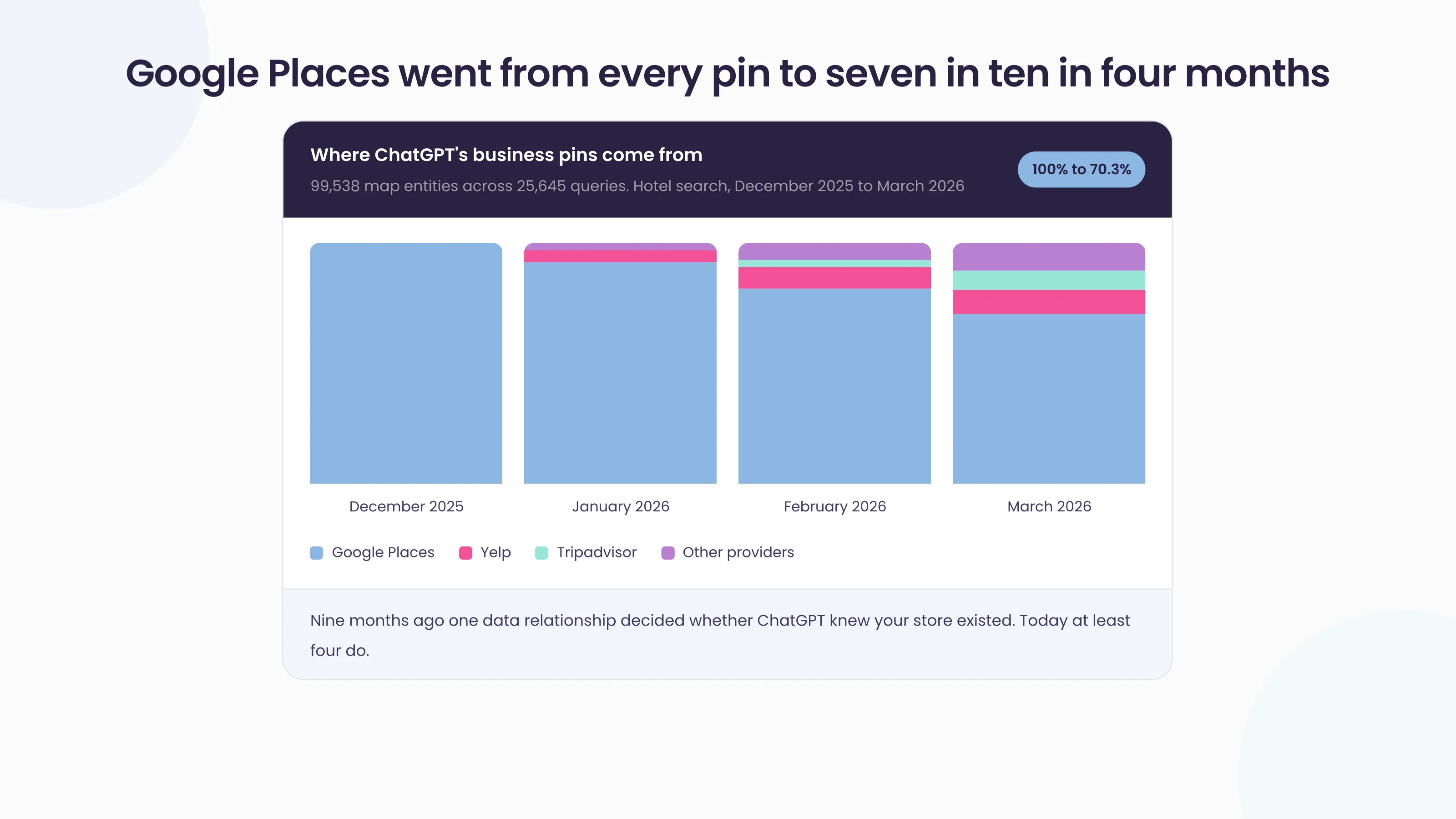
Call it the unbundling of the pin. Whether the same shift is happening at the same pace for restaurants, retailers, and services outside the hotel category is not something this data confirms one way or the other, but the direction is worth taking seriously.
Nine months ago, in the hotel category at least, one data relationship decided whether a listing appeared. Today at least four do, and the mix is still moving.
Why this matters if you run more than one location
Single-source listings hygiene used to be defensible. Keep the Google Business Profile clean and the AI answer came out mostly clean, because the AI was reading Google.
That logic has broken in both directions.
The bad news: a stale trading hour on Bing Places, a duplicate Yelp record, an unclaimed Tripadvisor listing. None of those are low-priority tickets any more, if the multi-source pattern seen in hotel search extends to your category. Each one is a potential live input into the answer a customer is handed.
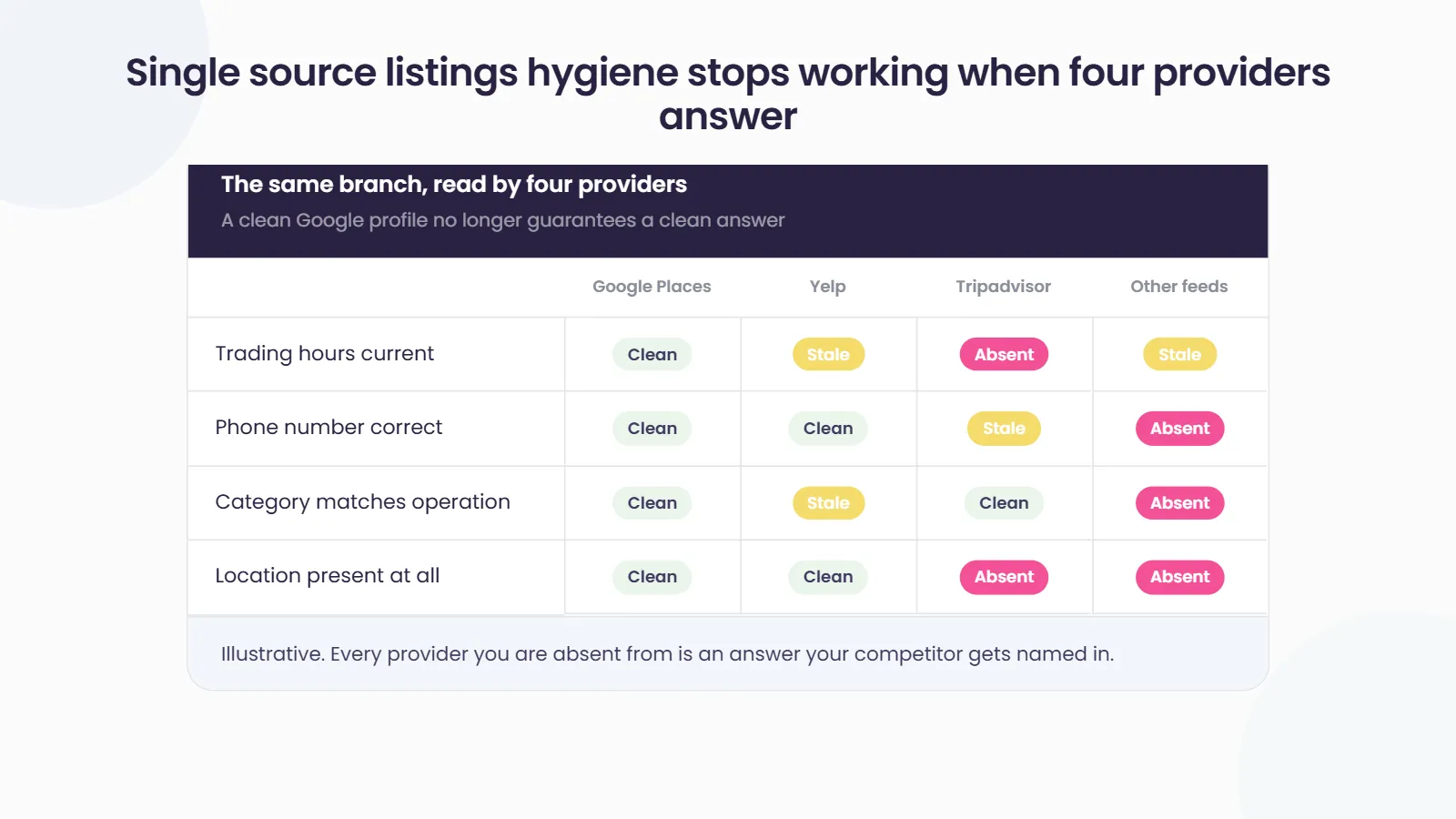
The good news is the same fact, read the other way. Accuracy everywhere is worth more than it was if that pattern holds, because there are more doors into the answer, and most of your competitors are still only guarding one of them.
The bar is already unforgiving regardless of source mix. A 2026 local visibility study analysing over 350,000 business locations, reported by Search Engine Land, found brands appearing in Google’s local 3-pack 35.9% of the time, and recommended by ChatGPT 1.2% of the time. Most brands are not losing the AI recommendation. They are not in the running for it.
What we do not know yet
Worth being straight about this, because plenty of coverage is not.
OpenAI has published no provider list for local business search generally, so the numbers above come from measurement of one category, not from disclosure. They will drift, and they may not transfer cleanly from hotels to other business types. There is no confirmation of which markets have the Maps tab, and no reliable read on South African availability beyond individual accounts seeing it.
None of that changes what you should do, which is the useful part. Every scenario above rewards the same work: accurate structured data in more places than Google, and enough review quality to clear a recommendation threshold you cannot see.
Nobody should rebuild a local strategy on a screenshot. Nobody should ignore one either.
What I would do this quarter
- Audit past Google. Pull your record on Bing Places, Apple Maps, Yelp and Tripadvisor for every location, not a sample. Name, address, phone and hours, checked field by field.
- Kill the duplicates. Unclaimed and rogue records are the most common source of a wrong answer, and they are invisible until an assistant repeats them back to a customer.
- Fix trading hours first. It is the field that changes most, the field customers act on, and the field that most often propagates wrong.
- Get review averages above 4.0 and keep responding. Review quality is a filter, not a tiebreaker.
- Measure it. If you cannot see whether assistants are naming you or naming a competitor, you are managing the inputs and guessing at the output.
How Social Places helps
We have spent eleven years keeping multi-location brands accurate across Google, Apple Maps, Bing, Tripadvisor, in-car navigation and the rest of the directory estate, which is the same structured data these assistants now draw on. Listings keeps every location correct on every platform and reverses unauthorised edits. Reputation builds and defends the review signals that decide whether a location clears the bar. And AI Visibility Tracker shows how often ChatGPT and Gemini actually recommend each of your locations against its local rivals, so the output stops being a guess.
If you want to know where your brand stands before the next surface arrives, Contact Us
Related reading
The AI visibility gap sets out the per-assistant recommendation rates this post’s provider analysis sits on top of.
What 250 locations taught us about getting cited by AI covers what actually makes a location page citable.
Frequently asked questions
Is ChatGPT Maps available in South Africa?
There is no official confirmation either way. OpenAI has not announced the feature or listed supported markets, and it appears to be rolling out in stages. The fastest check is to open ChatGPT on desktop and look for Maps in the sidebar. If it is not there yet, that is not evidence it is not coming.
Does ChatGPT Maps replace Google Maps?
No. It has no turn-by-turn navigation and no real-time traffic. It is built for finding and planning, not for getting there. The competition it creates is for the discovery moment, which is the moment that decides where someone goes.
Where does ChatGPT get information about my business?
In hotel search, where this has actually been measured, from several sources now rather than one: Google Places remains the largest, with Yelp a significant second and Tripadvisor and Foursquare emerging. Whether the same mix applies to restaurants, retail, and services has not been separately confirmed, so treating multiple platforms as relevant is the safer assumption either way. That means corrections have to be made at source, on each platform, rather than in one place.
Can I pay to appear in ChatGPT's local recommendations?
Not for the organic local recommendations. OpenAI has been running ChatGPT Ads since February 2026. As of late August 2026 the pilot covers the US, Canada, UK, Australia, New Zealand, Japan, South Korea, Brazil and Mexico, plus a newly announced expansion into 31 European markets. South Africa is not among the announced markets. Visibility here comes from data accuracy, review quality and structured content.