What Agencies Actually Need From Review Management Software (And Why It Is Harder Than It Looks)

The demo always looks clean. One inbox. All the reviews. Respond with a click. The agency signs the contract, onboarding begins, and then the real shape of the problem starts to show.
Platform access needs chasing. Some channels feed in, others do not. The client’s brand voice is different from last month’s brief. The approval chain is three people and a shared inbox. And the reporting dashboard does not map to anything the client actually asked for.
This is not a software failure. It is the nature of what multi-platform review management actually involves at agency scale.
1. Platform Fragmentation Is Real and Rarely Admitted
The pitch is centralisation. The reality is that Google, Facebook, TripAdvisor, Yelp, industry-specific directories, and retail and hospitality marketplaces each operate entirely differently. Different APIs. Different moderation rules. Different rate limits. Different response workflows.
A platform claiming to “aggregate everything” often means: monitor everything, but only fully respond, sync, and report on the channels where API access is stable and complete. For most agency use cases, that is Google and Facebook first and everything else second, or manual. Any tool that does not say this clearly upfront is setting agencies up to overpromise to clients.
2. Multi-Client Complexity Breaks Single-Brand Tools
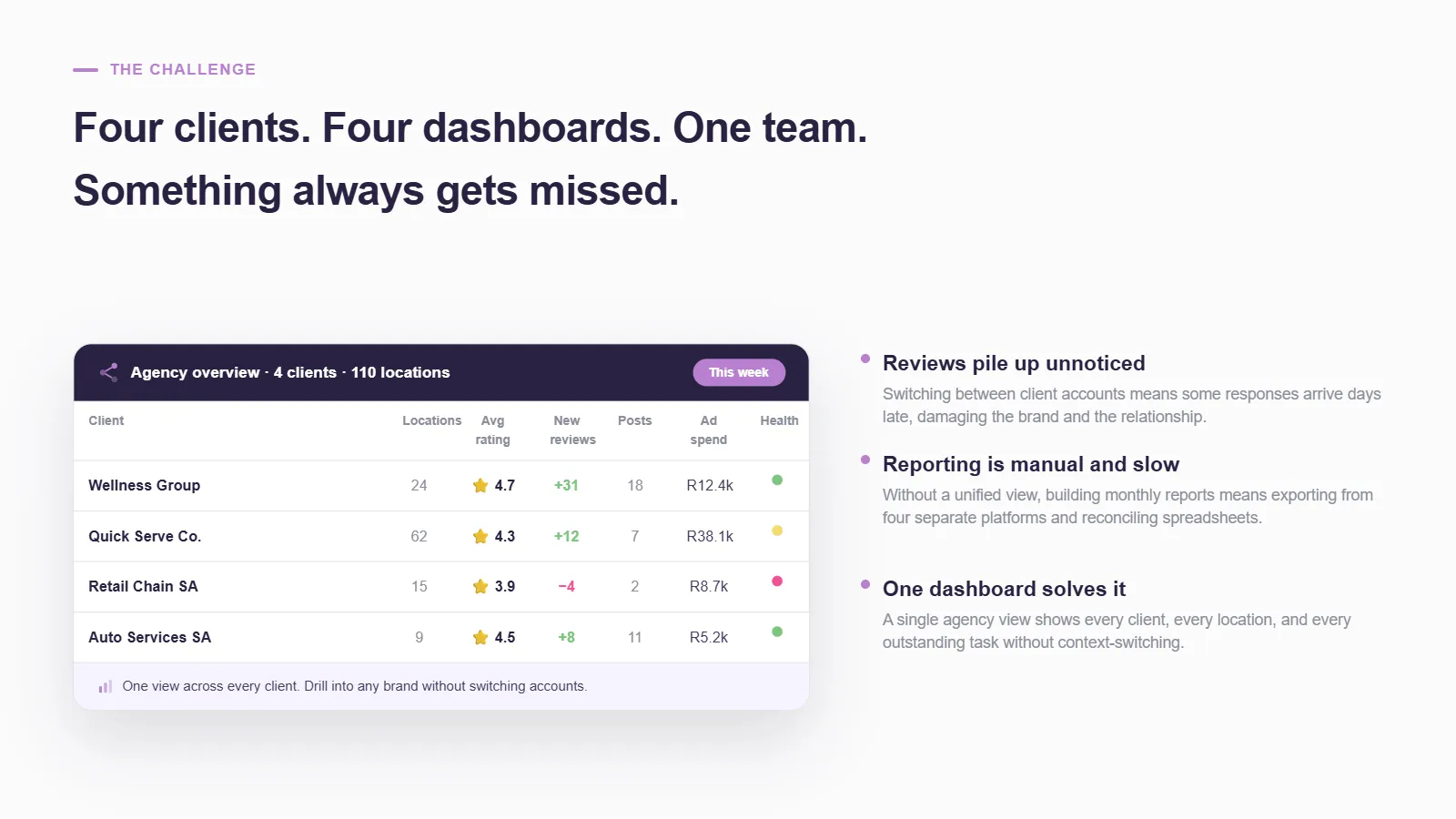
A tool built for one brand managing its own locations has a fundamentally different architecture than one built for an agency managing 15 brands, each with different locations, different review profiles, different brand voice guidelines, different approval processes, and different reporting expectations.
The first operational problem is permissions. Agency teams depend entirely on clients granting access to Google Business Profiles and Facebook Business pages. That access is almost always incomplete on day one. It gets revoked when client contacts change.
The second problem is data separation. Role-based permissions scoped by client and location are not a premium feature for agencies. They are a baseline requirement that many single-brand tools simply do not have.
3. Workflow Is the Problem Most Software Ignores
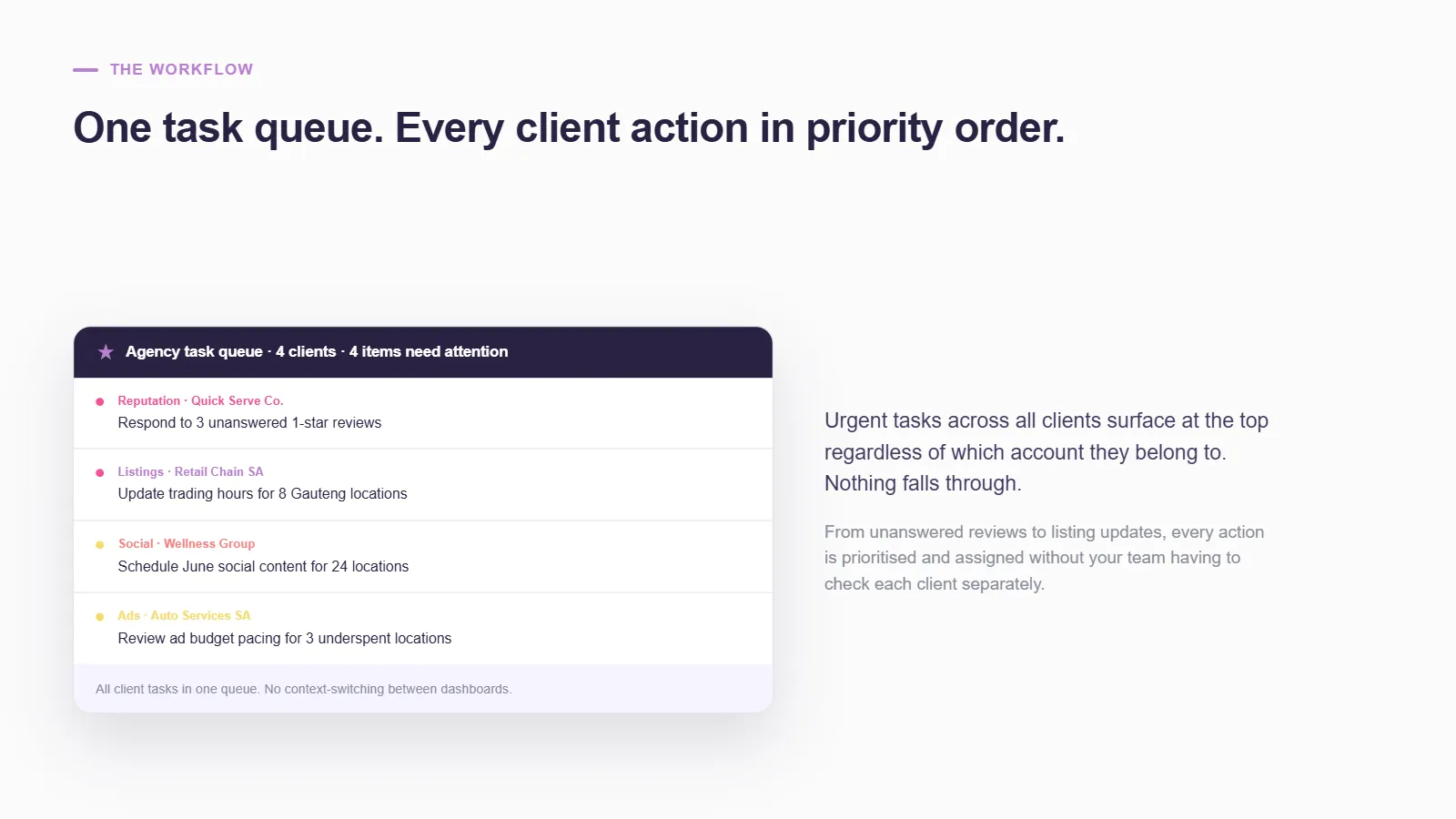
Most review management tools were designed for in-house marketing teams, not agency operations. Review responses need to be routed to the right account manager, written against the right brand guidelines, and in many cases approved by the client before going live.
When a sensitive complaint comes in, whether it is a food safety issue, a discrimination allegation, or a review that reads like a legal threat, the escalation path for an agency is entirely different from an internal marketing team. Software that skips that step and auto-drafts a response is creating risk, not reducing it.
AI-drafted responses are genuinely useful at scale for standard feedback. But agencies are right to be cautious about AI handling nuanced or high-risk reviews where off-brand tone or a poorly judged phrase can amplify the original problem.
4. Reporting Has to Prove Value, Not Just Display Data
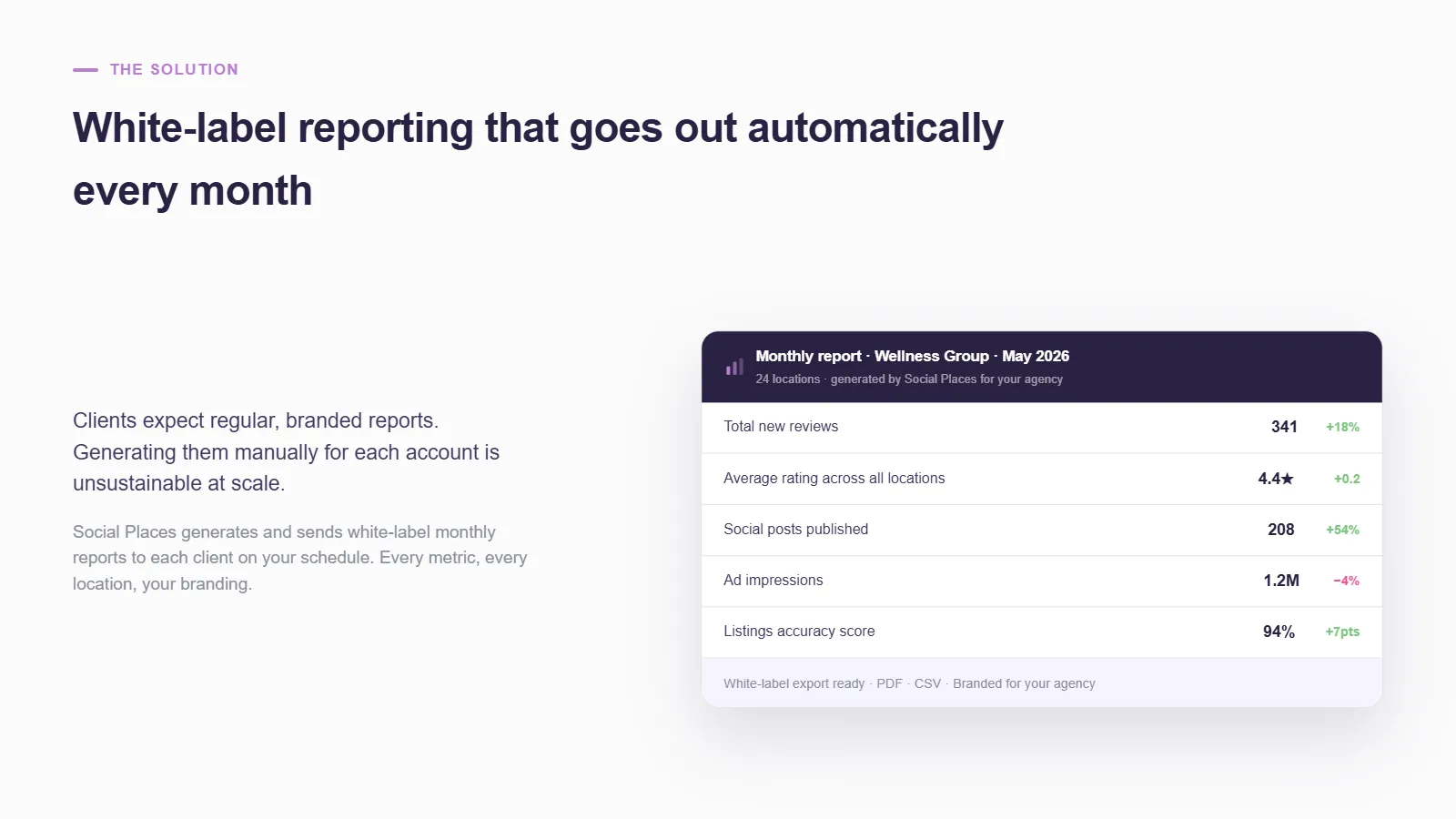
Clients do not want a dashboard. They want to know whether the agency’s work is making a measurable difference. Review volume trends, average rating movement, response rate, response time, sentiment breakdown by location, and performance comparisons across the location network are the numbers that tell that story.
Agency reporting cannot be raw data export. It needs to be presentation-ready, clear to a client who is not briefed on how each platform defines its own metrics.
5. Software Solves Part of This. The Rest Is Still Service.
Review management software is genuinely useful. It reduces monitoring overhead, surfaces issues faster, structures the response process, and makes reporting consistent. What it does not do is remove the human judgment required to craft responses to complaints that carry real brand risk, coach clients through a reputational crisis, or turn review data into a business strategy recommendation.
The agencies that get the most from Social Places are the ones who use the platform to remove the administrative overhead and redirect that time into genuine client service. The software should be the engine, not the product.
— Ryan Haworth, CEO at Social Places
6. What Agency-Grade Review Management Actually Looks Like
The requirements are specific. A platform built for agencies needs:
- A multi-client account structure with role-based permissions scoped by client and location
- Honest, stable integrations with clear documentation of what is fully integrated versus monitored only
- Workflow tools designed for agency-client relationships, including approval steps, escalation flagging, and brand voice controls per client
- Reporting that demonstrates value without requiring manual data work to produce
- Pricing and architecture that does not immediately compress margins as the client base grows
How Social Places Helps Agencies at Scale
Social Places Reputation handles review monitoring, response workflows, and client-ready reporting across every location. Our Social publishing tools and structured approval workflows extend the same logic to content. And our Ads management ensures that when campaigns are running, traffic lands at the right location with accurate data every time. Contact Us
Frequently asked questions
What should agencies look for in review management software?
The critical requirements are a multi-client account hierarchy with role-based permissions scoped by client and location, transparent documentation of which platforms are fully integrated versus monitoring-only, workflow tools built for agency-client approval chains, reporting that produces client-ready proof of value without manual data processing, and pricing structured so that adding clients does not immediately erode margins.
Can Social Places manage reviews for multiple clients from one login?
Yes. Social Places is built around a multi-client account structure. Permissions are scoped per team member and per client, so account managers only see the clients and locations relevant to their role.
How does Social Places handle the review response workflow between an agency and its clients?
Social Places includes structured approval workflows between the draft response step and the publish step. Agency teams draft responses, the client reviews and approves within the platform, and responses only go live after approval is recorded. Sensitive reviews can be flagged for escalation before any response is drafted.
How does Social Places handle AI-generated review responses for agencies?
Social Places uses AI to assist with drafting review responses, and keeps humans in the loop through its approval workflow. Agency teams can review, edit, and approve AI-drafted responses before anything goes live, and sensitive reviews can be flagged for manual handling.
How does Social Places help with the reporting problem agencies face across multiple platforms?
Social Places normalises review and reputation data across all connected platforms into unified reporting that agency teams can share directly with clients, covering review volume, average rating trends, response rate, and response time across the entire client location network.