Your Rankings Haven't Changed. So Why Is Your Traffic Disappearing?
You open Google Search Console on a Monday morning. Your rankings look fine: stable top-five positions on your most important terms. But sessions are down 30%. Then 40%. And nobody can explain it.
This isn’t a bug in your analytics. It isn’t a penalty. It’s the new normal, and it’s happening to brands of every size, in every category, across the world.
“The search result that used to send a customer to your website is now answering their question before they ever arrive. Visibility and traffic are no longer the same thing.”
Ryan Haworth, CEO at Social Places
What is actually happening to organic traffic?
Google’s AI Overviews, the AI-generated answer blocks that appear above organic results, are now present on a significant portion of searches. And the data on what they do to click behaviour is stark.
When an AI Overview appears on a search result page, organic click-through rate drops by 61%. A position-one result that used to pull a 1.62% CTR now pulls 0.61% when an AI Overview is present. Your ranking didn’t change. Your traffic did.
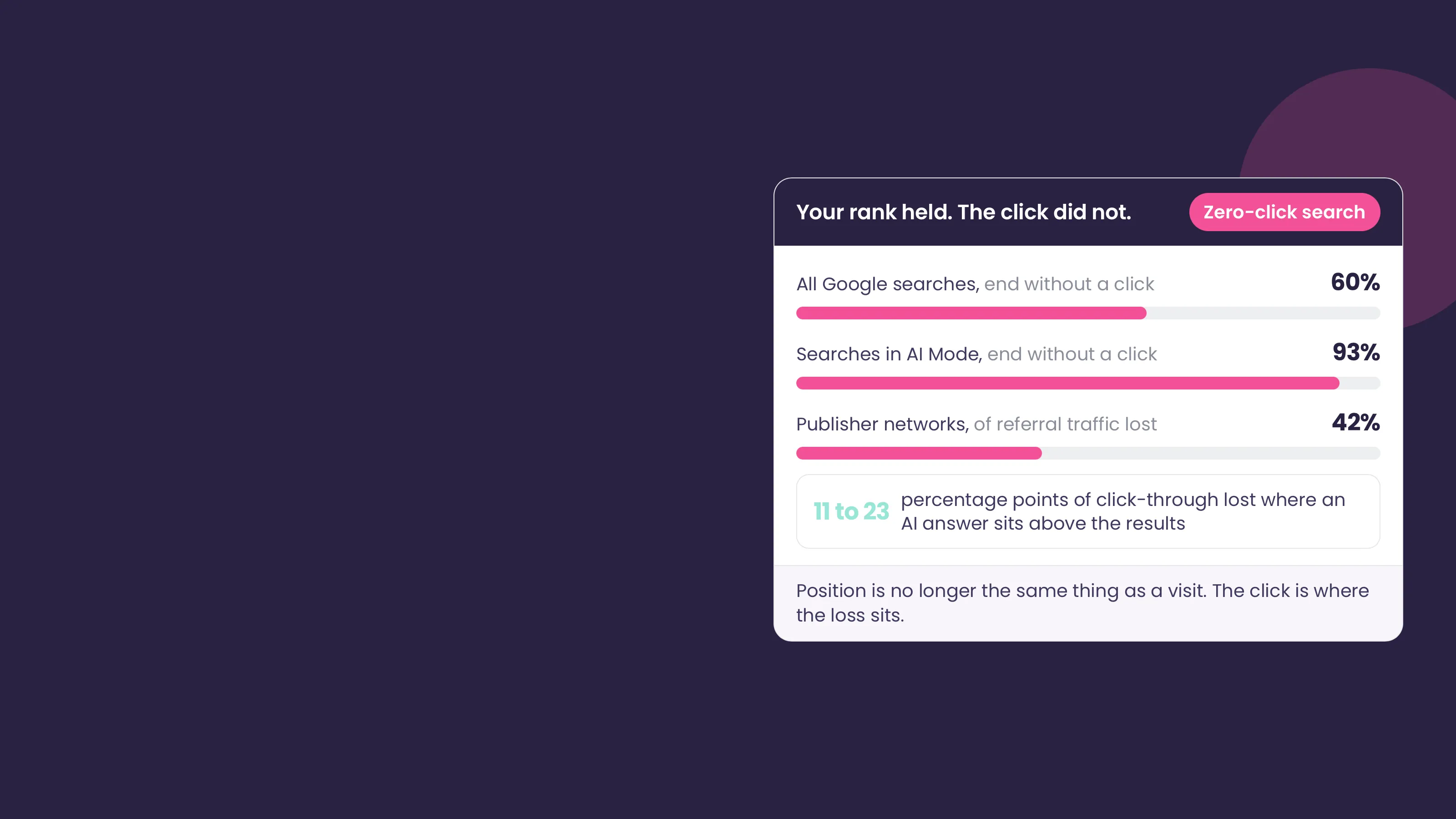
Zoom out further and the picture is even more confronting. 60% of all Google searches now end without a single click to any website, a figure that has climbed steadily from 50% in 2019 and is now approaching 65%. In Google’s newer AI Mode, that figure rises to 93% of searches generating zero outbound clicks.
This is not a traffic dip. It is a structural shift in how the web works.
The scale of the problem for real businesses
The brands feeling this most acutely are those whose traffic was built on informational content: how-to guides, comparison pages, explainer articles, FAQs. These are exactly the query types that AI Overviews were designed to answer in-place, without the user needing to go anywhere.
The numbers from real brands are significant. HubSpot lost an estimated 70 to 80% of its organic traffic between late 2024 and mid-2025. Major publisher networks collectively lost 42% of their organic search clicks by Q4 2025. Across multiple verticals, organic click share is down 11 to 23 percentage points year on year. Some sectors have seen 40 to 70% losses in a single year.
And it is not only Google causing this. ChatGPT now processes 2 billion queries daily and has 883 million monthly users, making it the fifth most visited website in the world. Perplexity, Claude, and Gemini are all absorbing research queries that used to begin and end on Google. When someone asks an AI platform “what is the best local SEO tool for franchise brands,” they are getting an answer. They are not clicking through to ten websites to find one.
Should brands actually be worried?
Yes, but with important nuance. The crisis is real, but it is not evenly distributed. Here is what the data actually shows about who is protected and who is not.
Most exposed: Informational and educational content. How-to articles, definitions, comparison pages, “best of” lists. These query types are being absorbed directly into AI answers at the highest rate. If your traffic strategy was built on ranking for these terms, you have likely already seen the impact.
More protected: Transactional and local intent. “Book a table near me,” “find a store in Sandton,” “get a quote from a plumber in Cape Town.” These searches still require a human action that AI cannot complete. Local and transactional intent is holding better than informational intent, though it is not immune.
The counterintuitive finding: Brands that are cited inside AI Overviews actually see a traffic uplift. Being referenced as a source in an AI-generated answer produces a +35% increase in organic CTR and a +91% increase in paid CTR for that brand. AI citation is becoming a competitive advantage, not just a consolation prize.
The Gartner forecast is worth sitting with: organic search traffic to websites is predicted to fall by 50% or more by 2028 as generative AI search continues to scale. The trend is not reversing.
The metrics that actually matter now
If sessions and organic clicks are becoming unreliable indicators of brand health, what should you be tracking instead? The answer requires a new measurement framework alongside, not instead of, your existing SEO metrics.
AI Citation Frequency. How often is your brand referenced as a source in AI-generated answers across Google AI Overviews, ChatGPT, Perplexity, and Gemini? This is now a core visibility metric. Brands cited in AI responses are being surfaced to high-intent users at the exact moment of decision.
Share of Model Voice. When someone asks an AI platform a question relevant to your category, does your brand appear? This mirrors the Share of Voice concept from traditional media, except the platform is now an AI model and the content it draws from is yours.
Branded search volume. Direct and branded search is one of the cleaner indicators of genuine brand awareness growth. If AI is doing the informational heavy lifting and sending customers direct to brands they have heard of, branded search becomes a leading indicator of acquisition health.
AI referral traffic quality. While AI platforms currently send less than 1% of total referral traffic, the quality is measurably higher. Users arriving from ChatGPT spend an average of 15 minutes on site versus 8 from Google, generate 12 pageviews per visit versus 9, and convert at a 7% rate versus 5%. Low volume, high intent. Track it separately.
Engagement and conversion rates by channel. If overall sessions are falling but your conversion rate is holding or improving, your qualified traffic may be stable while low-intent informational traffic disappears. Do not conflate volume with value.
Local visibility metrics. For multi-location brands, GBP profile views, direction requests, call clicks, and website clicks from Google Business Profile are direct indicators of local discovery health. These are largely insulated from the AI Overview effect and remain high-signal.
What brands should do right now
The strategic response is not to abandon SEO. It is to restructure what you are optimising for.
Become a source, not a destination. The brands winning in AI search are the ones being cited inside AI answers, not the ones waiting for clicks that no longer come. That means producing content with clear structure, named entities, schema markup, and verifiable claims that AI systems can pull from and attribute confidently. Pages with clean organisation and schema earn 2.8 times more AI citations than poorly formatted equivalents.
Double down on transactional and local content. Review pages, location pages, booking flows, product pages with clear pricing and availability. These serve query intent that AI cannot fulfil on behalf of a user. Invest here.
Build direct channels. Email lists, SMS opt-ins, app downloads, loyalty programmes. The brands with direct access to their customers are least exposed to algorithm shifts on any platform. Every customer who opts into a direct channel is one less customer you need to re-acquire from search.
Optimise for being mentioned, not just ranked. Answer the specific questions your customers ask in plain language. Use your brand name in context. Get covered by credible third-party sources. These are the signals AI systems use to decide who gets cited.
How Social Places helps multi-location brands stay visible
For multi-location brands, the shift from traffic to visibility plays out location by location. A customer who asks an AI assistant “is there a [brand] near me that’s open now” needs your locations to have accurate, structured, and complete data across every surface. Social Places Listings ensures your location data is clean and consistent across Google, Apple Maps, Bing, and the broader directory ecosystem that AI systems draw from. Pair that with Social Places Reputation to build the review content and sentiment signals that get individual locations cited and recommended in AI-generated answers.
The brands that adapt their measurement frameworks now, and invest in structured local presence, are the ones that will be cited inside the answers. The ones that wait are the ones whose traffic continues to disappear. Contact us for a visibility audit across all your locations.
Frequently asked questions
Is organic traffic declining for everyone or just certain industries?
The decline is widespread but uneven. Informational and educational content has been hit hardest: how-to articles, comparison pages, and FAQ-style content are being answered directly by AI Overviews without generating clicks. Transactional and local intent searches are holding better, but are not immune. Brands in heavily informational categories like media publishing, SaaS, and education have seen the most severe drops, with some reporting 40 to 70% losses in a single year.
Does it matter if we appear in AI Overviews?
Yes, significantly. Brands cited as sources inside AI Overviews see a 35% increase in organic CTR and a 91% increase in paid CTR compared to brands that are not cited. Being referenced in an AI-generated answer puts your brand in front of a high-intent user at the moment they are forming a decision. It is becoming one of the most valuable forms of organic visibility available.
Should we stop investing in SEO?
No, but you should restructure what you are optimising for. Traditional SEO signals (structured content, schema, E-E-A-T, authoritative backlinks) are still the foundation of AI citation. The brands appearing in AI answers are the ones that have built the strongest organic foundations. The shift is from optimising for clicks to optimising to be cited and recommended.
What is the fastest thing we can do to protect our organic visibility?
Three things: add structured data (schema markup) to your key pages, ensure your Google Business Profile and directory listings are complete and accurate across all locations, and create content that directly answers the specific questions your customers ask in plain, citable language. These signals are what AI systems prioritise when deciding which brands to surface and reference.