The Impression Recession: Why Visibility Metrics Stopped Telling the Truth
If your location impressions collapsed this year and your foot traffic did not, your reporting is broken, not your business.
Recent industry research puts Google Business Profile impressions per location down 53.8% year on year, while actual customer actions fell only about 5%. That gap is the most important thing happening in local search right now, and most brands are still reporting the wrong half of it.
1. Search Console Now Has Its Own Generative AI Section
On 3 June 2026, Google added a new Generative AI report to Search Console. It sits under Performance, next to the search results report you already use, and it reports on AI Overviews and AI Mode in Google Search. Search Labs experiments are excluded, and the data covers the Web search type only.
This is the first time anyone outside Google has been able to separate AI presence from ordinary organic presence. Those impressions were always in your numbers. They were just folded into the totals, indistinguishable from a blue link.
Now read what it gives you, and what it withholds.
-
Impressions, split by page, country, device and date. That is the entire metric set.
-
No clicks and no click-through rate, so there is no way to work out what an AI impression is actually worth.
-
No query or keyword data. You can see that a page was cited. You cannot see what was asked.
-
No meaningful position, because every link inside an AI Overview shares a single ranking slot.
Google also added a property-level opt-out. It blocks your content from appearing in and grounding generative AI features, with an assurance that using it will not affect your normal Search rankings. Read that twice before anyone in your business reaches for the switch, because the two things are not as separable as the wording implies, and opting out also removes you from the report you just gained.
Two things to check before you go looking for it. Google is rolling the report out incrementally rather than flipping one global switch, so access still varies by property, and a colleague seeing it does not guarantee you will. Second, eligibility is conditional: you need enough impressions in generative AI features to register at all, and any property that has opted out of those features is excluded from the report by definition. An empty report is not the same finding as an absent brand.
So Google has confirmed two things at once. AI answers are absorbing a measurable share of search, and we now get to watch our presence inside them without ever seeing what that presence earns. More visibility data than we have ever had, less certainty about what any of it is worth.
That is the same problem, one layer up, as the one sitting in your Business Profile numbers.
2. Impressions Fell. Actions Held.
At location level the pattern is sharper. Impressions per location down 53.8%. Customer actions down roughly 5%.
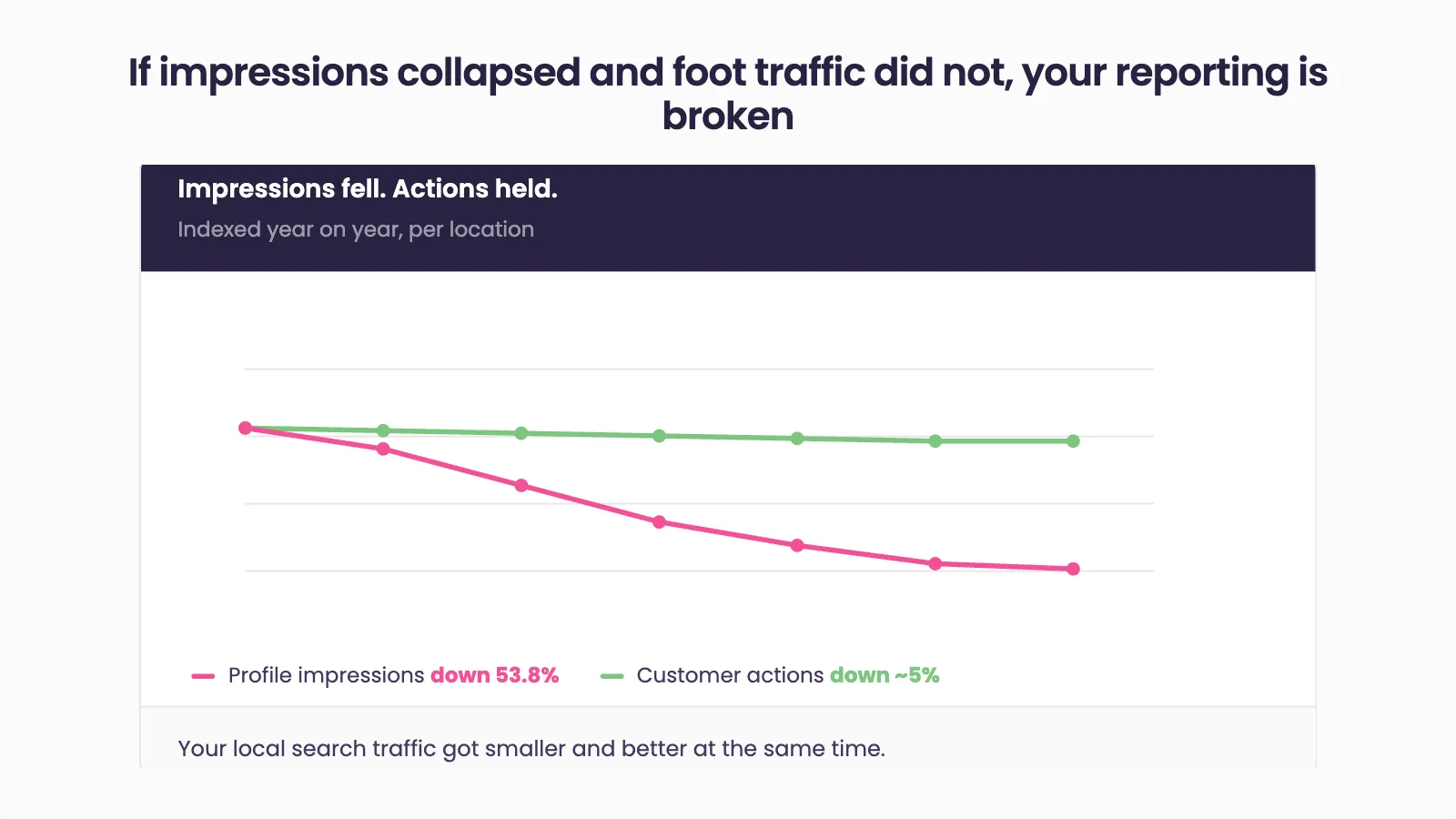
The explanation is straightforward once you stop treating it as a ranking problem. AI compressed the funnel. Fewer people scroll a full page of results, because more of them get an answer instead. The people who still tap through are further along the intent curve, not fewer in number.
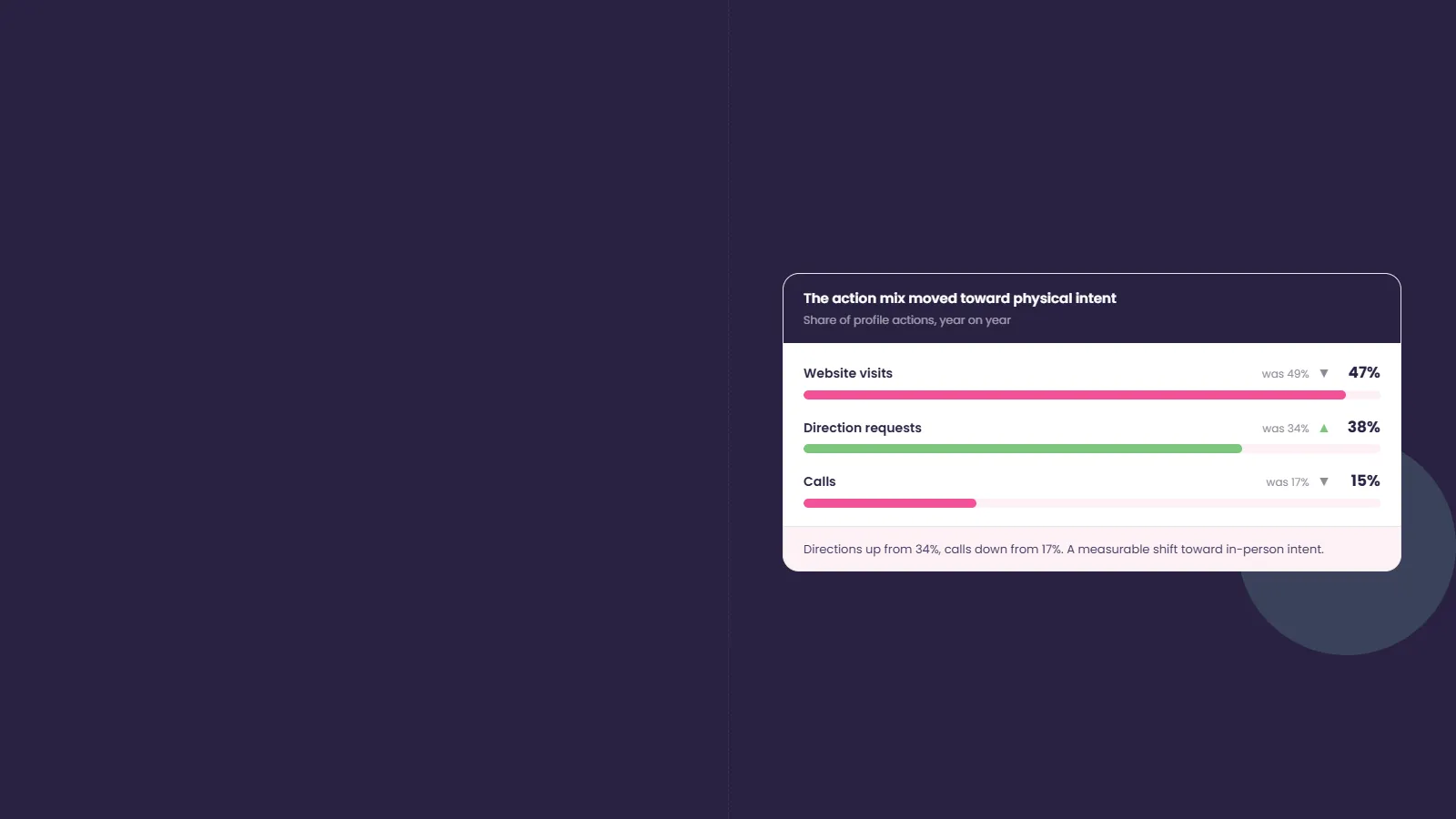
The mix of what they do has moved too. Website visits now account for about 47% of profile actions, direction requests 38%, and calls 15%. Directions are up from 34%, calls down from 17%. That is a measurable shift toward physical, in-person intent.
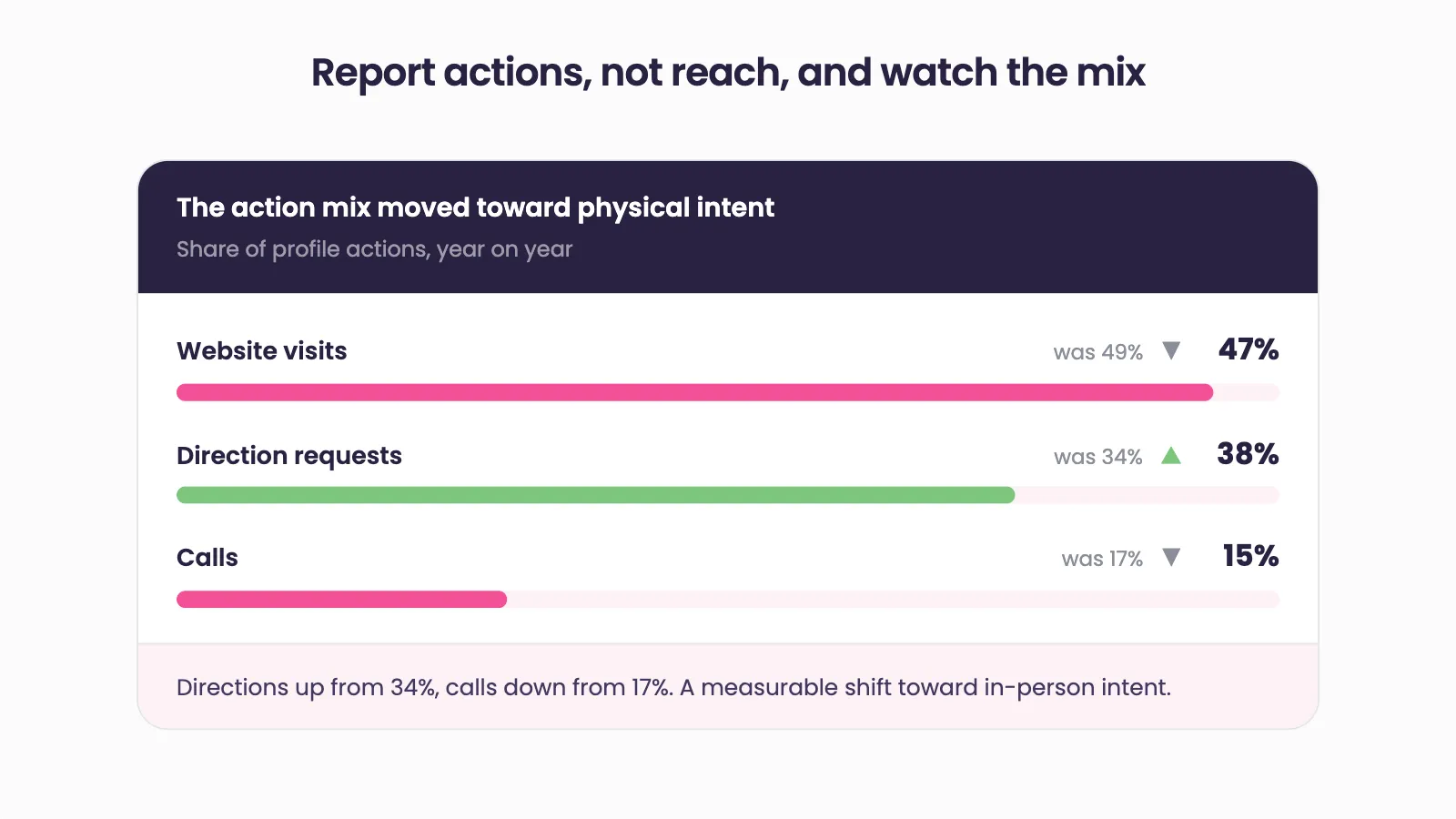
Your local search traffic got smaller and better at the same time. A report that leads with reach will show a disaster. A report that leads with actions will show what actually happened.
3. Discovery Moved Faster Than Anyone Planned For
In a single year, the share of consumers using AI tools to find local businesses went from 6% to 45%, making AI the third largest local discovery channel behind Google and Facebook. Over the same period Google’s share of local business discovery fell from 83% to 71%.
Consumers now consult roughly six different sources before choosing where to go. Apple Maps as a recommendation source nearly doubled, from 14% to 27%.
One nuance worth holding for South African brands: the platform mix here is not the global mix. StatCounter puts iOS at roughly 24% of South African mobile devices against Android’s 76%, and Google still holds over 90% of local search. So Apple matters less here than the global headlines suggest, and Google data accuracy matters more. Copying a US playbook into a South African footprint will misallocate effort.
4. The Trust Bar Moved Up While You Were Watching Traffic
The same research shows consumer standards tightening on every axis at once:
-
31% will only use a business rated 4.5 stars or higher, up from 17% a year earlier
-
68% will only consider 4 stars or higher, up from 55%
-
47% will not use a business with fewer than 20 reviews
-
74% only care about reviews written in the last three months
-
80% are more likely to use a business that replies to every review, and 50% are put off by generic, templated replies
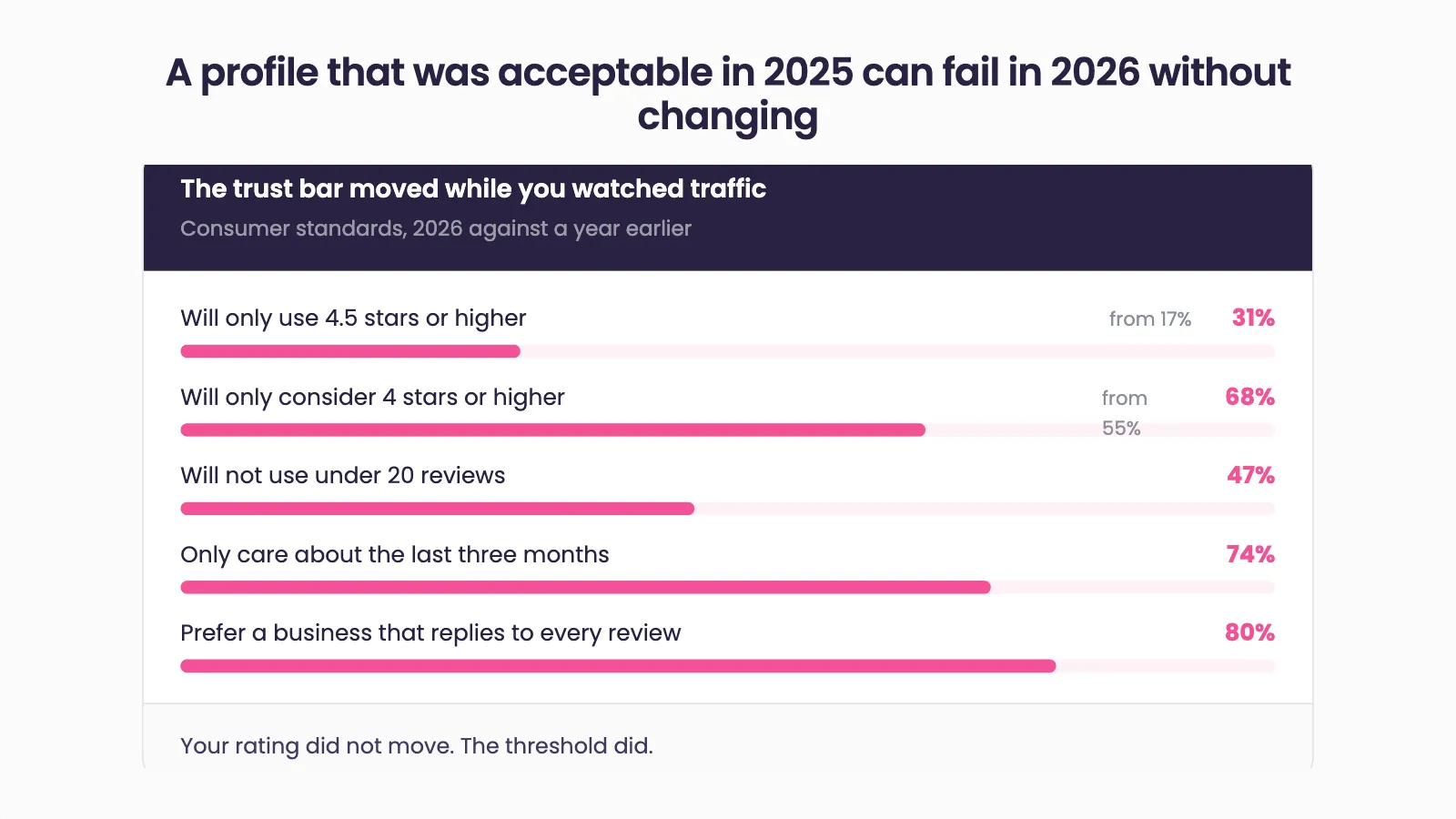
Read those together and the implication is uncomfortable. A profile that was perfectly acceptable in 2025 can fail in 2026 without anything about it changing. Your rating did not move. The threshold did.
5. What to Measure Instead
Five metrics that still mean something, in the order we would report them:
-
Actions per location, split by type. Directions, calls and website clicks. This is now your stable base number and the one closest to revenue.
-
Action mix over time. A shift toward directions tells you intent is getting more physical, which changes what you should be optimising.
-
Review velocity, not review total. With 74% of consumers only trusting the last three months, a dormant profile with 300 reviews is worth less than an active one with 40.
-
Response completeness and quality. Response rate alone is no longer the measure, because half of consumers actively dislike templated replies.
-
Structured data completeness per location. Hours, categories, attributes and services are the inputs AI systems read when they decide whether to mention you at all.
Keep impressions in the pack. Use them as a diagnostic, not a headline. When impressions fall and actions hold, that is the market changing. When impressions hold and actions fall, that is a problem with your listing, and you want to be able to tell the difference.
How Social Places Helps Multi-Location Brands Measure What Still Counts
Every metric above depends on data being accurate and consistent across every location and every platform, which is exactly what gets harder at scale. Listings keeps store data correct across Google, Apple Maps, Bing, Facebook and more, and reverses unauthorised edits before they cost you a customer. Reputation tracks review velocity, sentiment and response quality across the whole footprint rather than one profile at a time. And our AI Visibility Tracker measures how often ChatGPT and Gemini name each individual location, and where that location sits against the competitors you choose to track, which is precisely the number the new Search Console report cannot give you. If you want to see what your action numbers look like once they are reported properly, Contact Us.
Frequently asked questions
Why did my Google Business Profile impressions drop so sharply in 2026?
Most likely because of AI-driven search compression rather than anything you did. Recent industry research shows impressions per location down 53.8% across a large multi-brand base while customer actions fell only about 5%. If your calls, directions and website clicks are broadly stable, the drop reflects how results are now displayed, not a decline in demand.
Should I stop reporting impressions altogether?
No, but demote them. Impressions are still a useful diagnostic when read alongside actions. Falling impressions with steady actions indicates a market shift. Steady impressions with falling actions points to a problem in the listing itself, such as inaccurate data, weak photos or a rating that has slipped below a consumer threshold.
How does AI search actually use my listing data?
AI answers draw on structured fields such as hours, categories, attributes and services, on recently updated content, and on reviews including the responses to them. Where that data is inconsistent between your listings and your website, AI systems are more likely to leave you out of the answer entirely rather than risk being wrong.
How recent do our reviews need to be?
Aim for continuous rather than periodic. 74% of consumers only care about reviews from the last three months and 32% want reviews from the last two weeks, so a review generation campaign that runs in bursts will leave visible gaps. Steady weekly velocity per location beats an occasional push.
Where do I find AI search data in Search Console, and why can I see it when a colleague cannot?
It sits under Performance as the Generative AI report, covering AI Overviews and AI Mode. Google has been rolling it out incrementally since 3 June 2026 rather than switching it on for everyone at once, so access still varies from property to property. Eligibility also depends on having enough impressions in generative AI features to register, and any property that has opted out of those features is excluded from the report entirely.
Does the new report tell me whether AI search is sending us traffic?
No, and that is its main weakness. It reports impressions broken down by page, country, device and date. There are no clicks, no click-through rate, no average position and no query data, so there is no way to calculate what an AI impression is worth. Treat it as a presence check and keep your commercial read on actions.